Utilizing Agricultural Waste for Sustainable Water Remediation: A Study on Acid-Activated Rice Straw Biochar
Published in Earth & Environment, Sustainability, and Civil Engineering






Why is this study important?
The discharge of industrial effluents containing synthetic dyes represents one of the most pressing environmental challenges of the modern era. Industries such as textiles, pharmaceuticals, leather, and cement are responsible for releasing millions of tons of waste into water bodies annually. Among these pollutants, cationic dyes-specifically Methylene Blue (MB) are particularly problematic due to their chemical stability, toxicity, and profound negative impact on aquatic ecosystems. Methylene Blue is known to cause severe health issues in humans, including tachycardia, jaundice, and tissue necrosis, while simultaneously hindering the photosynthesis essential for aquatic life. As a result, the scientific community is under pressure to develop cost-effective, efficient, and rapid methods to remediate water contaminated with these dyes.
Why do we have to choose adsorption, biochar and rice straw?
The Potential of Biochar as a Low-Cost Adsorbent
Adsorption remains one of the most favored techniques for wastewater treatment due to its operational simplicity, high efficacy, and flexibility. While materials like graphene and carbon nanotubes have shown promise in laboratory settings, their high cost often limits their large-scale industrial application. Biochar, derived from abundant agricultural biomass, has emerged as a superior alternative. It is not only inexpensive but also possesses a high surface area, robust porous structure, and a variety of surface functional groups that make it an excellent adsorbent.
In regions like India, where rice straw burning is a major contributor to air pollution, the conversion of this agricultural byproduct into value-added biochar serves a dual purpose: it offers an environmentally sustainable solution for water remediation while simultaneously mitigating the hazards associated with stubble burning.
What are the key objectives of this study?
Research Objectives and Methodology
The study conducted by Senapati et al. (published in Biomass Conversion and Biorefinery) focuses on optimizing the production of biochar from rice straw [1]. While previous research has confirmed that nitric acid activation can enhance the adsorption capacity of biochar [2], this study delves deeper into the relationship between acid concentration, surface chemistry, and the kinetics of Methylene Blue adsorption.
The researchers prepared non-activated biochar by pyrolyzing rice straw at 600°C. Subsequently, they modified this material using 5 M (DBCH5) and 10 M (DBCH10) nitric acid solutions. The resulting adsorbents denoted as DBCH5 and DBCH10 were characterized using a suite of advanced analytical techniques, including FESEM (Field Emission Scanning Electron Microscopy), XRD (X-ray Diffraction), FTIR (Fourier Transform Infrared Spectroscopy), and XPS (X-ray Photoelectron Spectroscopy). These methods allowed for a detailed assessment of how acid treatment alters the biochar’s surface morphology, porosity, and chemical composition.
What are the key findings?
Key Findings: Enhanced Adsorption Capacity
The experimental results underscore the success of nitric acid activation. The study reports a 4- to 5-fold increase in the adsorption capacity of the biochar after treatment. Notably, the acid-activated biochar achieved a maximum adsorption capacity of 78.24 mg.g⁻¹ at alkaline pH. Perhaps most impressively, both the non-activated and acid-activated materials reached their maximum adsorption capacity in less than 5 minutes, characterizing them as "ultra-fast" bioadsorbents.
The characterization data provides insight into why this occurs:
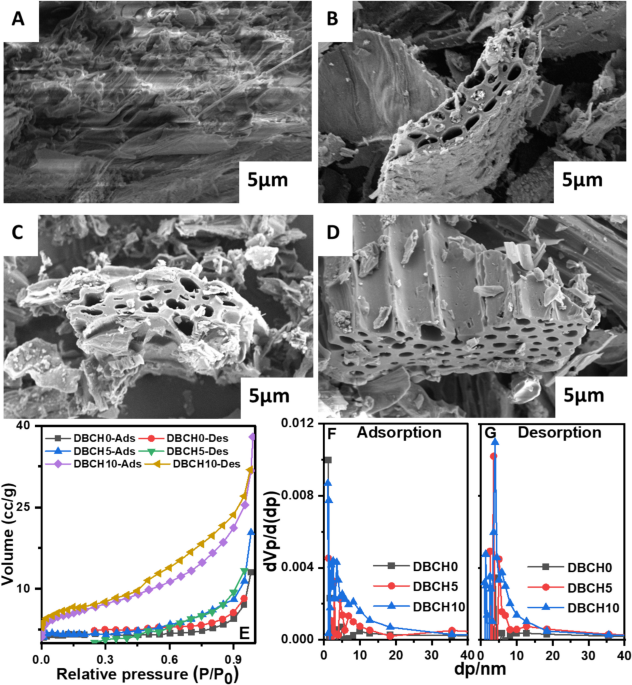
- Morphological Changes: SEM analysis revealed that nitric acid treatment effectively cleans the biochar surface by removing small impurity particles and ash-forming minerals (such as silicon), thereby making the pores more accessible.
- Enhanced Functionality: The treatment enriched the surface with oxygen-containing functional groups, specifically carboxyl (-COOH), carbonyl (-C=O), and hydroxyl (-OH) groups, which are known to facilitate stronger interactions with cationic dyes.
- Structural Optimization: The activation process increased the degree of graphitization and surface area, shifting the material toward a more mesoporous structure.
What is the mechanism behind the adsorption phenomena?
Mechanistic Insights
A significant portion of the research was dedicated to understanding the "adsorption mechanism" the physical and chemical interactions that allow the biochar to trap dye molecules so effectively. The study concluded that the adsorption of Methylene Blue is primarily a physiosorption process. The ultra-fast removal is driven by a combination of electrostatic interactions, hydrogen bonding, n–π, and π–π interactions (Figure 1). These mechanisms are significantly bolstered by the presence of oxygen-containing functional groups and the electron-rich domains created by the pyrolysis and acid-activation processes.
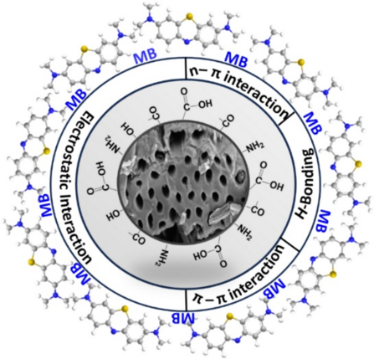
Figure 1: Probable adsorption mechanism diagram of MB dye removal by rice straw biochar [1]
Implications for Wastewater Treatment
The findings of this study offer a compelling argument for the adoption of low-cost, chemically modified biochar in real-world environmental applications. By utilizing readily available agricultural waste, this approach bypasses the need for expensive, synthetic materials.
Furthermore, the study highlights the importance of alkaline pH in maximizing adsorption efficiency, providing critical data for the potential integration of this biochar into existing wastewater treatment workflows. The ability to remove dye pollutants within minutes suggests that this method could significantly reduce the residence time required for industrial water purification, potentially leading to lower operational costs and increased throughput in treatment plants.
Conclusion
The work of Senapati and colleagues stands as a significant contribution to the field of green chemistry and environmental engineering. By successfully synthesizing an ultra-fast, nitric acid-activated rice straw biochar, the researchers have demonstrated that sustainable waste management can be effectively bridged with advanced environmental remediation technology. As the world continues to grapple with the complexities of industrial water pollution, such studies provide a foundational roadmap for developing circular economy models where agricultural waste is not just a nuisance to be disposed of, but a valuable resource in protecting our global water supply.
References:
- Senapati, Soumyaranjan, et al. "Ultra-fast adsorption of the industrial cationic dye pollutant using nitric acid-activated rice straw biochar: insights into adsorption mechanisms." Biomass Conversion and Biorefinery 15.12 (2025): 18905-18923.
- Senapati, Soumyaranjan, et al. "Synthesis and characterization of biochar from dehradun rice straw and its application for adsorption of methylene blue dye." AIP Conference Proceedings. Vol. 2740. No. 1. AIP Publishing LLC, 2023.
Follow the Topic
-
Biomass Conversion and Biorefinery
Biomass Conversion and Biorefinery is a research-focused journal dedicated to the exploration of biomass conversion and biorefinery processes based on a holistic approach.

What are SDG Topics?
An introduction to Sustainable Development Goals (SDGs) Topics and their role in highlighting sustainable development research.
Continue reading announcement



Please sign in or register for FREE
If you are a registered user on Research Communities by Springer Nature, please sign in