Tiny ponds, big impact: Why biodiversity matters for Europe’s freshwater future.
Published in Ecology & Evolution

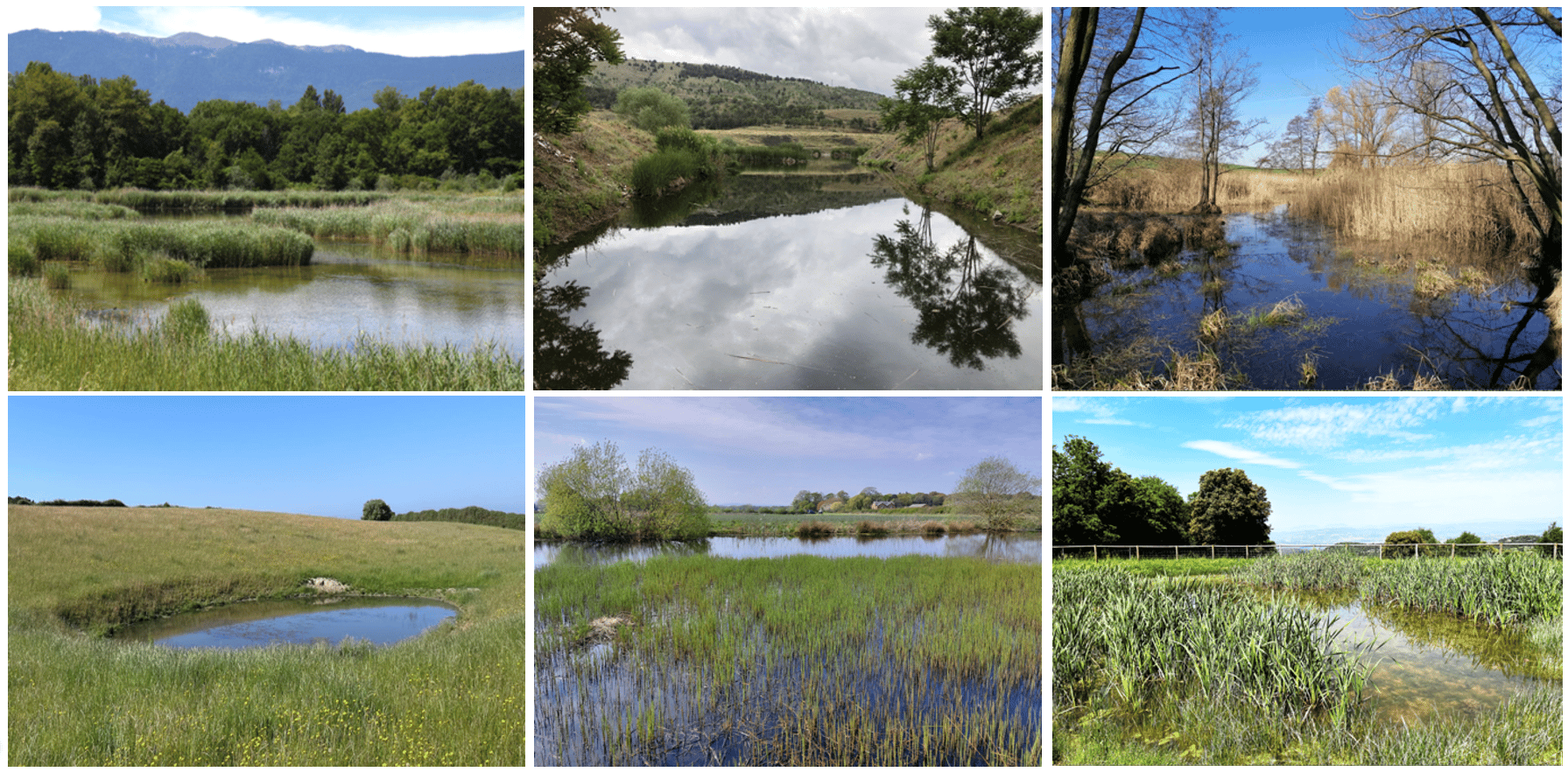

Ponds are small freshwater habitats, typically covering less than 1 to 5 hectares and a maximum depth of five metres (Fig. 1). Scattered across a wide range of landscapes, ponds have been overlooked by researchers, who traditionally focused on larger aquatic ecosystems such as lakes and rivers (Oertli et al., 2005). Yet these modest water bodies support astonishingly high biodiversity, often harbouring rare and endemic species (Céréghino et al., 2014), and serve as ecological stepping stones that connect habitats across fragmented landscapes. They are extraordinarily abundant and collectively contribute disproportionately to regional biodiversity and ecosystem functioning (Downing et al., 2005). Growing recognition of their ecological value has led to increased research attention in recent decades. However, many fundamental questions about how pond ecosystems function and how they respond to ongoing environmental change remain unresolved.
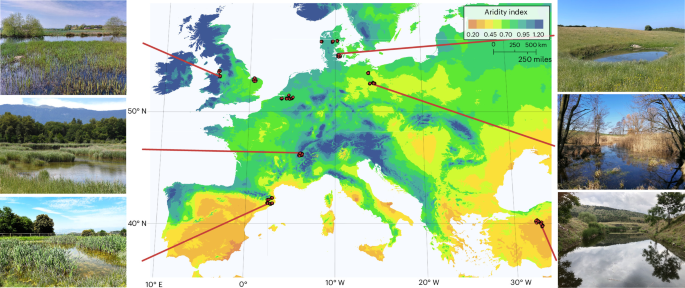
In our study, supported by the PONDERFUL project (H2020, no. 869296), we explore how biodiversity contributes to ecosystem functioning in ponds. To do this, we survey 206 ponds distributed across Europe (Belgium, Denmark, Germany, Spain, Switzerland and the United Kingdom) and Turkey. We integrate multiple ecosystem processes, including methane emissions, chlorophyll-a concentration as a proxy for primary production, zooplankton and macroinvertebrate biomass as proxies for secondary production, and plant cover, into a single measure, the multifunctionality index, which provides a more complete picture of ecosystem function. We also consider four major groups of organisms: macrophytes, zooplankton, macroinvertebrates, and amphibians. We examine how this biodiversity–ecosystem multifunctionality (B-EMF) relationship is shaped by environmental factors such as land use, aridity, nutrient enrichment, presence of fish, and pond morphology.
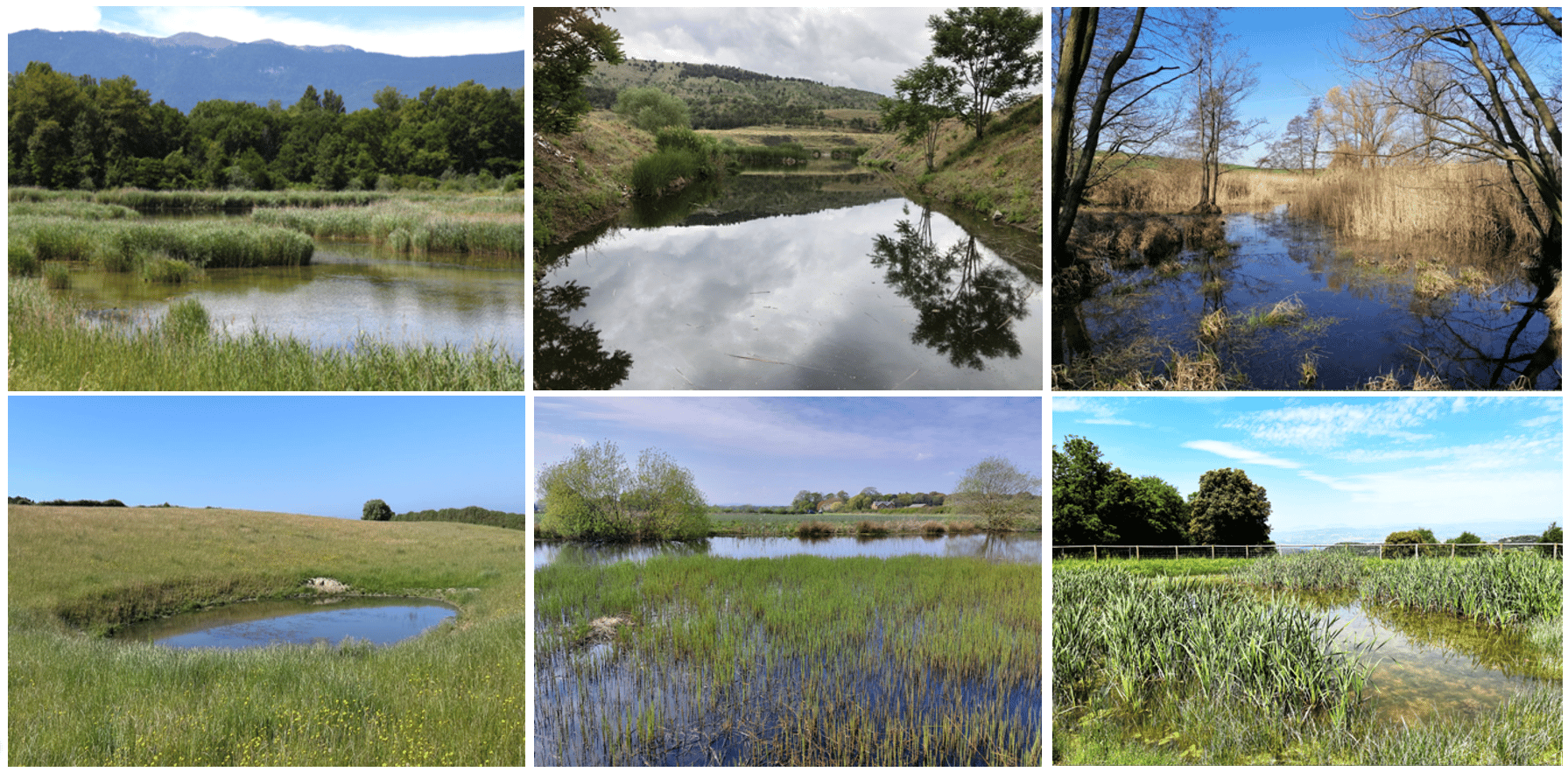
Fig. 1. Pond representation for the different countries included in this work. Image credits from top left to right: Switzerland, Julie Fahy; Turkey, Meryem Beklioglu; Germany, Thomas Mehner. From bottom left to right: Denmark, Thomas Davidson; UK, Carl Sayer; Spain, Maria Cuenca-Cambronero.
Hypothesis:
Biodiversity will enhance ecosystem multifunctionality, but local and regional environmental conditions will shape the relationship between biodiversity and ecosystem multifunctionality (B-EMF).
Under harsher environmental conditions, such as increasing aridity, species are more likely to play complementary roles, allowing communities to use limited resources more efficiently. In contrast, ponds with abundant resources often exhibit more homogeneous patterns of resource use, reducing the importance of niche differentiation and complementary interactions among species.
Methodology
We studied 206 ponds across six European countries and Turkey, covering a wide range of climates, landscapes, and pond types. We sampled each pond once, at the peak of biodiversity, using a standardised protocol to ensure consistent surveys across all ponds. For each pond, we recorded key environmental conditions, including water nutrients, land use within 100 meters, pond size and depth, climate (mean annual temperature and aridity index), and whether fish were present, capturing the diversity of local and regional settings that shape pond ecosystems.
To understand pond biodiversity, we measured four major groups of freshwater life: aquatic plants, zooplankton, macroinvertebrates, and amphibians. We sampled these groups using established field methods and expert identification, including environmental DNA for amphibians. We then combined these measures into a single multidiversity index that reflects each pond's overall biodiversity. Finally, we evaluate how biodiversity contributes to ecosystem multifunctionality and how environmental factors affect these interactions.
Results and discussion:
Our results reveal a clear pattern: ponds with higher biodiversity generally showed higher ecosystem multifunctionality. Interestingly, not all groups contributed equally, and zooplankton diversity emerged as one of the more significant predictors of multifunctionality. Zooplankton richness was negatively associated with increases in methane emissions and chl-a concentration, linked to eutrophication. This finding suggests that zooplankton diversity may help maintain ecological balance by controlling algae and supporting energy transfer through the food web. Although our study cannot prove direct cause and effect, the results point to an important role for these organisms in freshwater ecosystems.
In addition, our results suggest that biodiversity matters especially in arid regions, where we found a stronger B-EMF relationship than in humid regions. One possible explanation is complementarity among species. Species with different ecological roles use resources differently and collectively contribute more effectively to ecosystem functioning (Fig. 2).
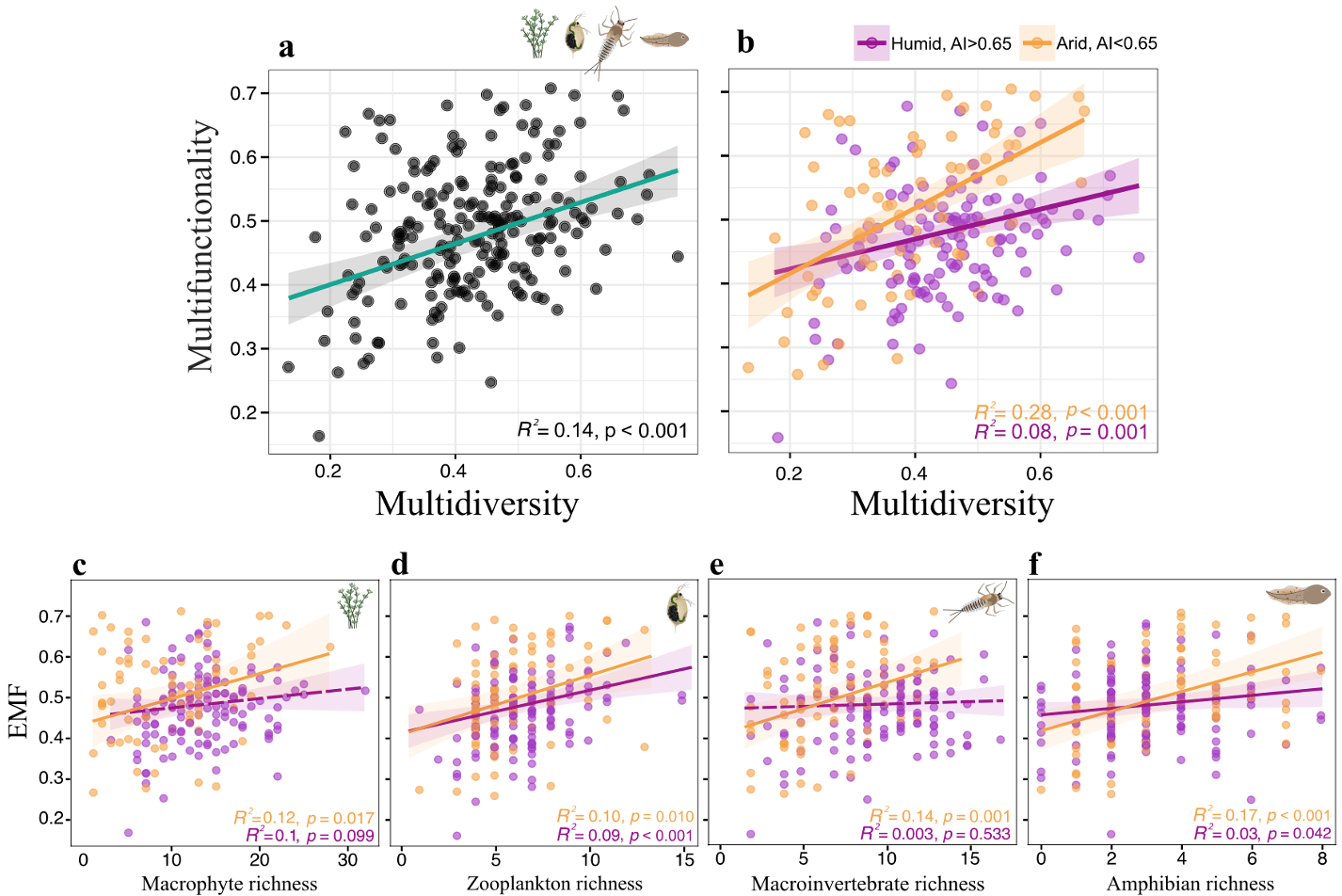
Fig. 2. EMF relationship with multidiversity and individual richness, considering the aridity index (AI) as a categorical variable. B-EMF relationship, as the relationship between multidiversity (a) and taking into account the aridity index (b), and individual taxonomic groups and multifunctionality (c-f), according to two categories of aridity. Statistical analysis was performed using linear mixed-effects models (LMMs) with predicted (fitted) values. Humid sites (AI>0.65) are represented in purple, and arid areas (AI<0.65) are represented in orange. Dashed lines represent no significant relationships; shaded areas are the 95% confidence interval; R2 represents the variance of the fixed effect; n = 206 ponds. Illustrations credit: Maria Cuenca-Cambronero.
We also examined nutrient enrichment driven by land use, a major threat to ponds. Many ponds are located within agricultural landscapes where fertiliser use in cropland production often increases nitrogen and phosphorus inputs to nearby pond ecosystems (Scholz et al., 2025). This excess nutrient enrichment was associated with lower ecosystem multifunctionality, reinforcing current concerns that eutrophication remains one of the greatest threats to freshwater ecosystems across Europe (Le Moal et al., 2019). We also found that fish presence was negatively associated with ecosystem multifunctionality in ponds. This may relate to fish effects on zooplankton consumption and increased water turbidity from sedimentation disturbance.
Remarks.
Our study represents one of the largest assessments of biodiversity and ecosystem multifunctionality in freshwater ecosystems to date, covering an unprecedented geographical extent and multiple trophic levels. Despite growing evidence of ponds' ecological importance, many European regions have already lost between 50% and 90% of their ponds due to land-use change, agricultural intensification, and environmental degradation (Oertli et al., 2005). Our findings deliver a clear message: conserving pond biodiversity is not only about protecting species, but also about safeguarding the ecosystem functions and services. As societies face increasing pressures from climate change, altered precipitation patterns, expanding agricultural activities, and other global environmental changes, protecting pond ecosystems may play a crucial role in strengthening the resilience of Europe's freshwater landscapes.
Future direction
Although our study provides evidence for a positive relationship between biodiversity and ecosystem multifunctionality, future research should consider a broader range of ecosystem functions, including nutrient cycling, ecosystem metabolism, and carbon storage. Additionally, experimental studies will be especially important for identifying the ecological mechanisms linking biodiversity and ecosystem functioning and for determining the causal nature of these relationships. Incorporating below-ground communities, such as sediment microbial communities and soil biota, could provide a more complete understanding of how biodiversity supports multifunctionality in pond ecosystems.
Bibliography:
Céréghino, R., Boix, D., Cauchie, H.-M., Martens, K. & Oertli, B. The ecological role of ponds in a changing world. Hydrobiologia 723, 1–6 (2014). Downing, A. L.
Downing, A.L. et al. Relative effects of species composition and richness on ecosystem properties in ponds. Ecology 86, 701–715 (2005).
Le Moal, M. et al. Eutrophication: a new wine in an old bottle? Sci. Total Environ. 651, 1–11 (2019).
Oertli, B. et al. Conservation and monitoring of pond biodiversity: introduction. Aquat. Conserv. 15, 535–540 (2005).
Scholz, M. J., Obenour, D. R., Morrison, E. S. & Elser, J. J. A critical eutrophication–climate change link. Nat. Sustain. 8, 222–223 (2025).