Too much fibre can promote parasitic infections
Published in Microbiology






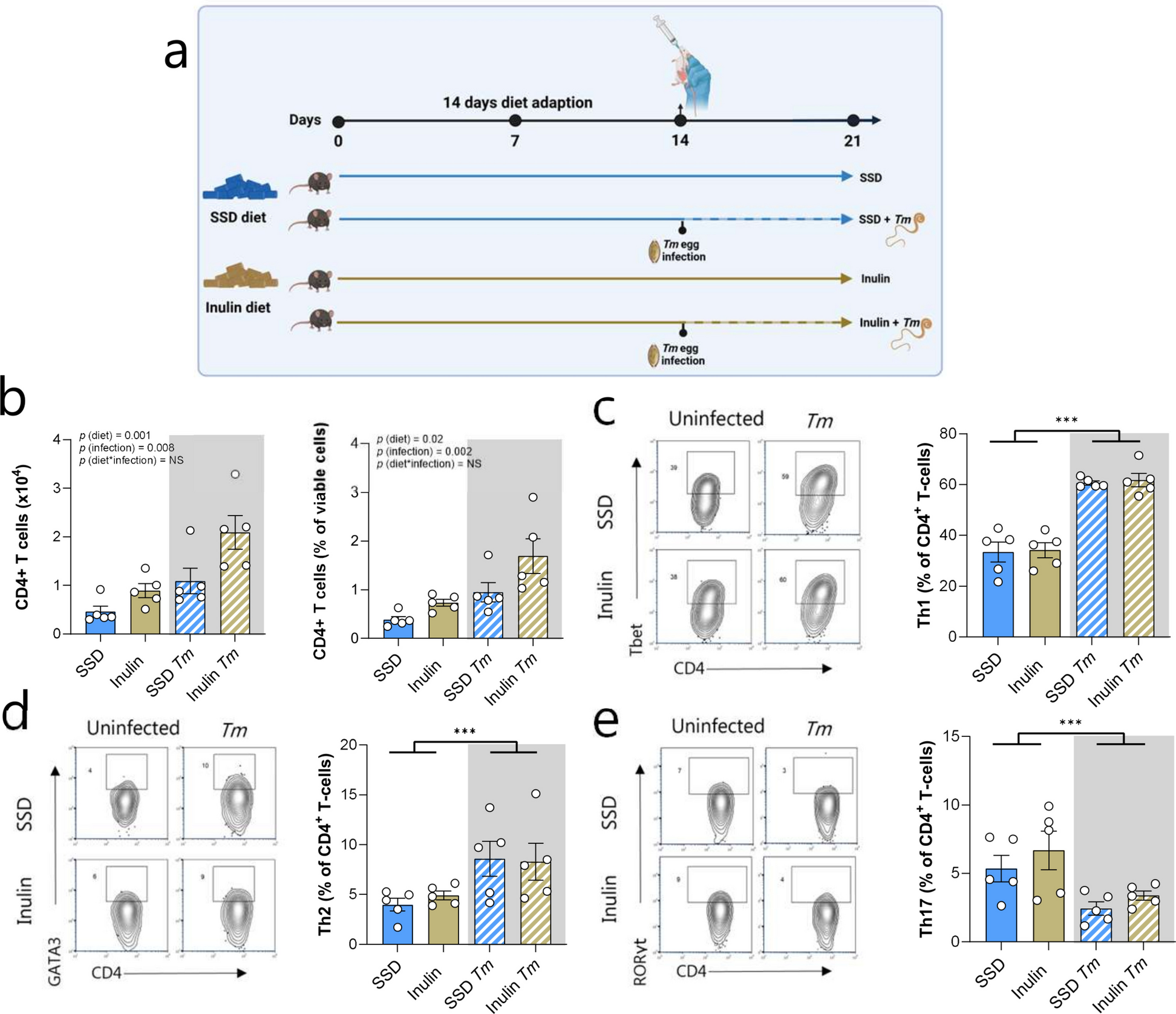

We are used to health professionals telling us to include more fibre in our diets, but the old adage ‘too much of a good thing may be harmful’ may ring true here. New research published in the journal Microbiome indicates that high fibre uptake may leave us susceptible to parasitic infections.
The gut microbiome is a complex system that helps us stay healthy, but imbalances within it can lead to dysbiosis and ill health. One of the factors affecting the gut microbiome is diet and, generally, it is believed that incorporating a good amount of fibre in our diet is essential for good ‘gut health’. However, in their recent paper, Laura Myhill and colleagues found that a too high intake of fibre could lead to serious health implications.
They had, in their previous work, shown that inulin fibre diets increased the parasitic burden in parasite-infected mice. This time around, healthy mice were fed a diet that included a high concentration of inulin. This resulted in mice with chronic whipworm (Trichuris muris) infections.
Inulin was thus shown to affect the early part of the immune response to such parasitic infections. Examination of the mice showed that high levels of inulin lead to dysbiosis in the gut microbiome, inflammation of the gut, and increased tryptophan breakdown – all of which detrimentally impacted the immune system's ability to clear the parasite.
When the research team blocked the breakdown of tryptophan, normal immune response was restored. The same thing happened when certain cytokines (IL-18 and IL-27) were neutralised, highlighting how these pathways were important for the host immune response. When inulin was decreased or removed, the mice’s ability to fight infection came back.
The team also found that even if the microbiome composition was unchanged by the inulin diet, the immune response was still impaired. This showed that inulin affects the mucosal lining and the immune response directly and not only via the microbiome.
The exact interaction between the microbiome, the host and the environment are always going to be complex to figure out – after all they evolved together over millennia. But it is clear that high fibre intake can impair response to certain parasites, and this would be an important consideration when advising on the diet of people and animals living in regions where parasitic infections are endemic.

I completed a BSc in Microbiology (UCL) and a PhD in environmental microbiology/ atmospheric chemistry (Royal Holloway University of London) before joining BioMed Central. I blog about microbiology, infectious diseases and the environment amongst other things.
I am the Executive Publisher for Parasites & Vectors, Malaria Journal, Microbiome and other microbiology/ infectious diseases journals at BioMed Central.
Follow the Topic
-
Microbiome
This journal hopes to integrate researchers with common scientific objectives across a broad cross-section of sub-disciplines within microbial ecology. It covers studies of microbiomes colonizing humans, animals, plants or the environment, both built and natural or manipulated, as in agriculture.
-
BugBitten
A blog for the parasitology and vector biology community.

Related Collections
With Collections, you can get published faster and increase your visibility.
Oncobiome
This collection of papers delves into the burgeoning field of oncobiome research, exploring the intricate relationship between cancer and the microbiome. The oncobiome encompasses the diverse microbial communities residing in and on the human body, which influence cancer development, progression, and treatment responses. By examining these interactions, our aim is to unravel the complex mechanisms through which the microbiome impacts oncogenesis and therapeutic outcomes.
This compilation highlights cutting-edge research, offering insights into potential diagnostic markers and novel therapeutic strategies, thereby advancing our understanding of cancer biology and paving the way for innovative, microbiome-targeted cancer treatments.
This is a cross-journal collection between:
Experimental Hematology and Oncology
Articles will undergo the standard peer-review process of the journal to which they are submitted and are subject to either the BMC editorial policies or those of BJC Reports. Articles will be added to the Collection as they are published. The Editors have no competing interests with the submissions which they handle through the peer review process. The peer review of any submissions for which the Editors have competing interests is handled by another Editorial Board Member who has no competing interests.
Publishing Model: Open Access
Deadline: Ongoing
The Apple Microbiome
Microbiome and Environmental Microbiome are calling for submissions to our Collection on the Apple Microbiome.
With world apple production estimated at 84 million tons, the microbiome of the apple has significant implications for agriculture, food security, and human health. Understanding the complex interactions between apple plants and their associated microbial communities can lead to improved crop management strategies, enhanced fruit quality and longevity, and sustainable agricultural practices. Recent advances have highlighted the role of specific bacteria and fungi in promoting plant health and resilience against specific pathogens. Moreover, detailed profiling of these microbial communities, revealing their diversity and functional potential facilitate exciting future developments, such as the identification of beneficial microbial consortia for biocontrol and the formulation of tailored probiotic treatments for both plants and humans. By advancing our collective understanding in this area, we can work towards a more sustainable and resilient agricultural system.
Topics of interest include but are not limited to:
-Microbial diversity and function associated with apples
-Effects of soil health and rhizosphere interactions on apple production
-Impact of climate change on the apple microbiome
-Role of the apple microbiome in fruit quality
-Microbiome-driven strategies for disease resistance
This collection is open for submissions from all authors on the condition that the manuscript falls within both the scope of the collection and the journal it is submitted to.
All submissions in this collection undergo the relevant journal’s standard peer review process. Similarly, all manuscripts authored by a Guest Editor(s) will be handled by the Editor-in-Chief of the relevant journal. As an open access publication, participating journals levy an article processing fee (Microbiome, Environmental Microbiome). We recognize that many key stakeholders may not have access to such resources and are committed to supporting participation in this issue wherever resources are a barrier. For more information about what support may be available, please visit OA funding and support, or email OAfundingpolicy@springernature.com or the Editor-in-Chief of the journal where the article is being submitted.
Publishing Model: Open Access
Deadline: Sep 30, 2026