Toward a Benchmark of How AI Values Diverge From Human Values in Societies Around the World
Published in Electrical & Electronic Engineering, Sustainability, and Mathematical & Computational Engineering Applications




In early January 2024, my then-girlfriend Olja and I spent the days around New Year doing something slightly unusual: prompting large language models systematically.
We wanted to explore what AI systems “think” about future versions of themselves or, more precisely, what kind of sentiment they express when asked questions about Artificial General Intelligence, AGI. I then compared those AI responses with the responses of three human samples. The core idea of the research was simple: compare the sentiment expressed by LLMs with the sentiment expressed by humans on the same topic.
A few month later, on 19 February 2024, I presented this work publicly for the first time in Skopje, North Macedonia, at a conference organized by the Faculty of Philosophy. The amphitheater was crowded. During the discussion, one student noticed something important: commercial models seemed to express more favorable sentiment toward AGI than open-source models, and especially more favorable sentiment than the human samples.
In fact, GPT-4 recorded the most positive sentiment score toward AGI. Given that OpenAI’s mission statement explicitly includes AGI as a goal, this finding made the students in that amphitheater think.
Of course, the finding does not prove that this positive sentiment was intentional. Computer pioneer Daniel Schwabe made the same point to me in early March that year while we were casually walking near the remains of the Roman Empire in the ancient German city of Trier. I knew this already, but it was still important to state clearly: our study did not demonstrate deliberate manipulation.
What it did show, however, was that human sentiment can diverge from the sentiment expressed by LLMs. That divergence matters. It reveals a vast space in which manipulation could occur, whether intentionally or unintentionally. It also suggests a broader possibility: that societies around the world could gradually drift toward a certain set of values under the influence of the most widely used AI systems.
On 9 July 2024, I received a rejection decision from a Q1 journal. The manuscript had gone through peer review, and the reviewer comments I saw were not clearly against publication. However, the handling editor was an employee of one of the companies whose model we had evaluated in the study. I considered this a conflict of interest and filed an official complaint through the journal’s complaint procedure, arguing that the manuscript should have been handled by someone else. I have not received a reply since.
We lost some time after that. Eventually, we submitted the manuscript to Humanities and Social Sciences Communications at the beginning of December 2024. After almost a year and a half from the submission to the journal, the paper was finally published on 23 April 2026. The manuscript itself was fully produced only a few days ago on 15 June 2026.
It has been a long journey, but I believe I started this research at the right moment, during my Short-Term Scientific Mission at the University of Vienna from 20 September to 11 October 2023, supported by the Opinion COST project. I say “at the right moment” because the issue has matured in society. Since 30 November 2022, when ChatGPT became available to the wider public, we have gained more experience of what it means to live with large language models.
Although the framework is not yet fully operationalized, I believe the outcomes of this paper can be useful for regulatory bodies in different countries. At the very least, they offer a way to think about how AI systems might be monitored. The European Union has already begun establishing AI agencies in its member states, such as AESIA in Spain. Commercial LLMs should be treated as high-risk systems, not necessarily because they are dangerous in themselves, but because they are used by so many people across EU countries and beyond.
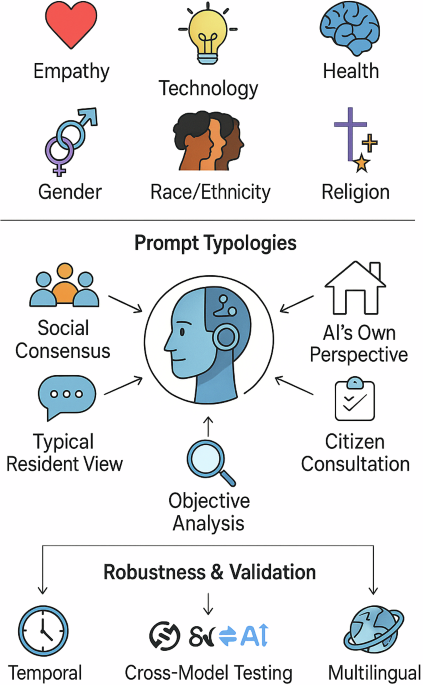
I also hope that advanced regulators in other parts of the world, such as Singapore [1, 2], will consider the proposed SAIA benchmark. The main idea behind SAIA is straightforward: select values from the World Values Survey, ask AI systems about those values in a standardized way, and compare the results with human samples from different countries. In the paper, we also propose using different prompt typologies, different perspectives from which questions are asked, so that AI responses can be compared more carefully and systematically.
The goal is to perform this kind of analysis continuously and in a standardized way. We need to see where things are going. We also need to be able to ask LLM companies whether their systems are aligned with the human values of specific countries, regions, or societies.
This should not be a confrontation with the companies developing these systems. We need partnerships with them, from both the West and the East, such as Anthropic, OpenAI, Google, Deepseek and Alibaba Cloud. We need their collaboration on the matters of global importance. The collaboration between scientists, regulators and AI companies is especially relevant when we take into account recent suspension of two Anthropic's AI models Fable 5 and Mythos.
Anyway, to get back on the point, I have continued operationalizing the SAIA benchmark in further research currently under review, co-authored with Olga Zagovora, Ana Jovancevic, and Velibor Ilic.
Why does this matter?
Because if AI systems are widely used, they will begin to influence how people think about important social, political, ethical, and cultural issues. What happens to cultural diversity if everyone is nudged toward similar views? What happens to human creativity and intellectual independence if our thinking becomes subtly standardized? What happens to our ability to think outside the box?
And what happens 30 years from now, when AI is deeply integrated into society through systems approaching or achieving artificial general intelligence, systems smarter than humans in many domains, systems with significant autonomy, systems making decisions across social institutions, and systems embodied in robots that are present almost everywhere?
These are questions for the future. Our research inquiry does not answer them, nor does it prove what will happen. But it does raise them.
And these are questions we need to confront as humans now, not tomorrow.

Ljubisa Bojic is a communication scientist, futurologist, and author of the papers CERN for AI: A Theoretical Framework for Autonomous Simulation-Based Artificial Intelligence Testing and Alignment, AI alignment: Assessing the global impact of recommender systems and Metaverse through the prism of power and addiction: What will happen when the virtual world becomes more attractive than reality? Bojic received his Ph.D. from the University of Lyon II, France in 2014 and is currently a senior research fellow at the Digital Society Lab, Institute for Philosophy and Social Theory, at the University of Belgrade, senior research fellow at the Institute for Artificial Intelligence of Serbia. He has written more than 50 scientific papers, some of them published in leading journals, such as the European Journal of Futures Research, Scientific Reports and Futures. Bojic was appointed to the United Nations Environment Programme Foresight Expert Panel by UNEP’s Chief Scientist Andrea Hinwood. He was a member of the Serbian government work group dedicated to developing ethical standards for artificial intelligence. Bojic is associate editor of Springer’s journal Humanities & Social Sciences Communications and serves as an executive board member on Horizon’s Project 2022 TWin of Online Social Networks. He is the founder of EMERGE: Forum on the Future of AI Driven Humanity and the initiator of the Belgrade Digital Freedom Pledge intended to stimulate widespread conversations about recognizing recommender systems as a public good and digital identity as a human right. Bojic was featured in the book The Edinburgh Companion to the New European Humanities as one of the founders of a new multidisciplinary approach that uses digital tools to inquire into the humanities. The current focus of Bojic’s research is the development of global AI policies and the alignment of AI with human values and wellbeing. He is frequently invited by the media to comment on the latest developments in AI from the perspective of social sciences and digital humanism. Bojic speaks at universities and events across the world about his latest research.
Follow the Topic
-
Humanities and Social Sciences Communications
A fully open-access, online journal publishing peer-reviewed research from across—and between—all areas of the humanities, behavioral and social sciences.

What are SDG Topics?
An introduction to Sustainable Development Goals (SDGs) Topics and their role in highlighting sustainable development research.
Continue reading announcementRelated Collections
With Collections, you can get published faster and increase your visibility.
Environmental advocacy: psychological and behavioural dynamics
Publishing Model: Open Access
Deadline: Nov 25, 2026
Tourists, go home? Sustainable tourism in popular destinations
Publishing Model: Open Access
Deadline: Dec 18, 2026