Transposon Day 2026: Commemorating the birthdate of Barbara McClintock
Published in Genetics & Genomics
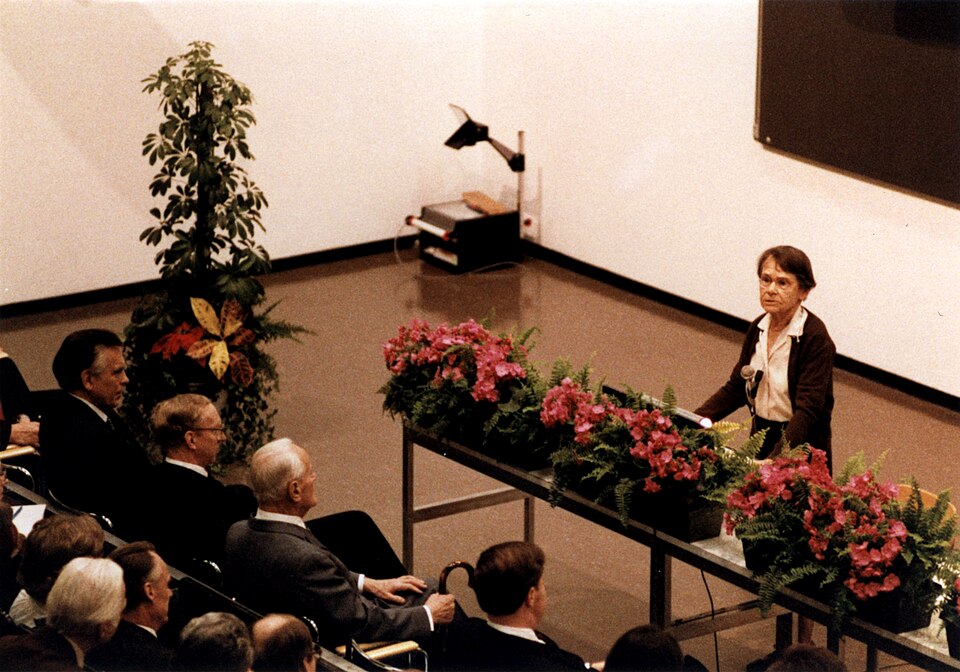
This blog shares quotes from Editors of Mobile DNA, both past and present, on the life, career and legacy of Barbara McClintock, who discovered and described transposable elements in the 1950's.
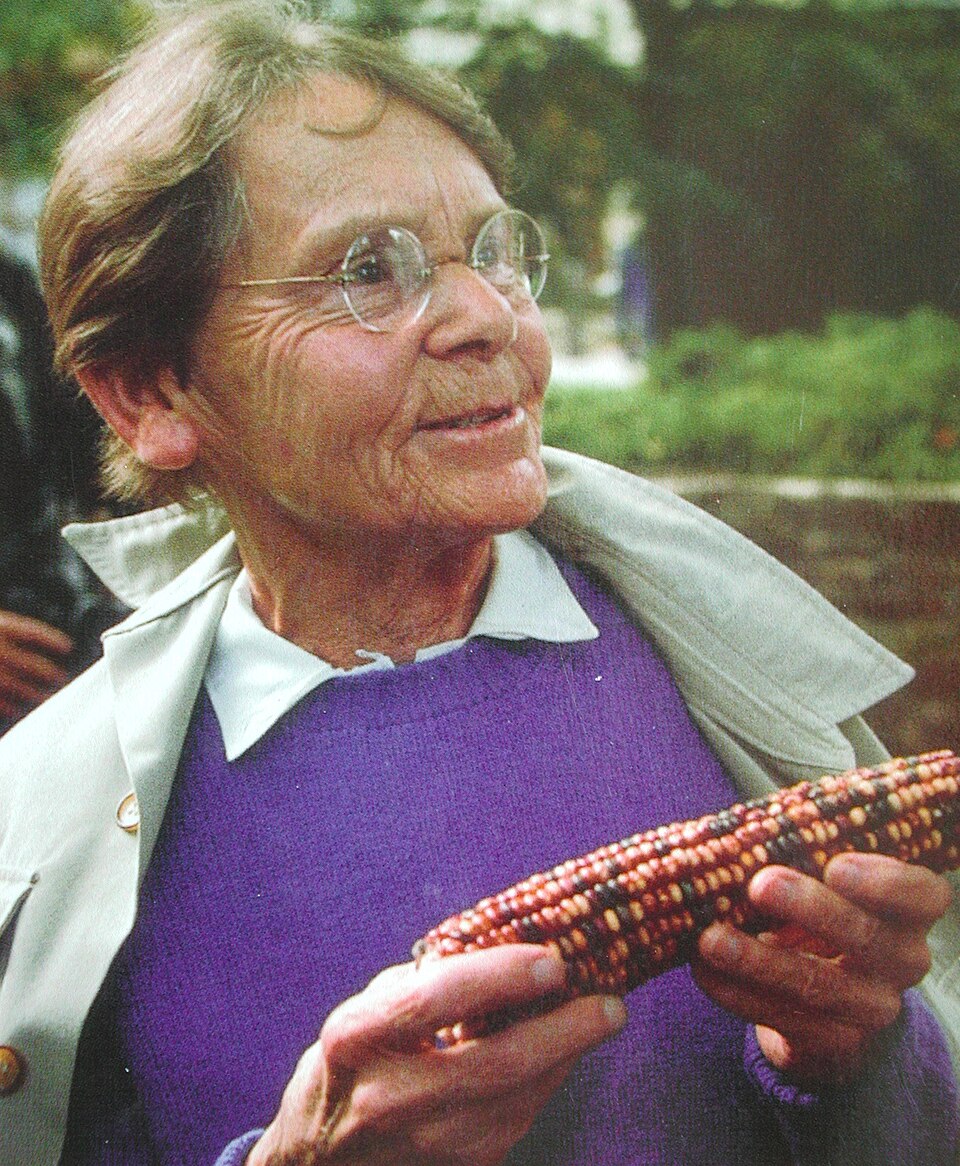
From Wikimedia: Cristian472735
CC BY-SA 4.0
Henry Levin, NIH, USA
"I am inspired by Barbara McClintock for her profound understanding of biology and for her extraordinary perseverance. Barbara McClintock received her PhD just 61 years after Gregor Mendel published his work demonstrating “factors" now called genes, determined the heredity of traits. Although the importance of Mendel’s work wasn’t initially recognized, McClintock’s deep insight allowed her to apply Mendelian principles to make profound advances in genetics. Her early studies of cross-over recombination were widely recognized and led to her election into the National Academy of Sciences. Despite the impact of her discoveries, it was extremely difficult for her to obtain a position as an independent investigator. Women were not hired as lab directors. To understand the challenges she faced I recommend “A feeling for the organism” by Evelyn Fox Keller."
Leandro Quadrana, Université Paris-Saclay, France
"The Transposon Day is a great opportunity to reflect on Barbara McClintock’s inspiring legacy and on the depth with which she approached a fundamental biological question. Long before the molecular basis of heredity was understood, she realized that genomes were dynamic entities and had the rigor and conviction to pursue this idea despite widespread skepticism. Her work reminds us that major discoveries often come from a deep understanding of a system, sustained curiosity, and the patience to follow observations wherever they lead. More than any particular discovery, this combination of imagination, rigor, and intellectual independence is perhaps her most enduring legacy."
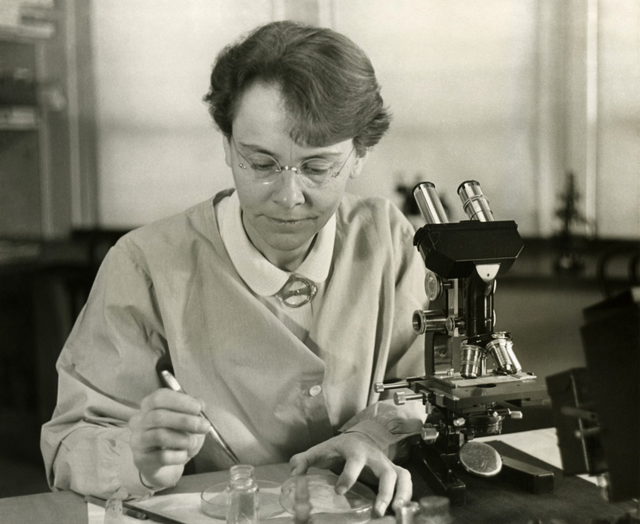
laboratory. Smithsonian institution,
public domain.
Gael Cristofari, INSERM, France
From TE Day 2025
"Barbara McClintock has been a huge inspiration throughout my career. As a PhD student, I first discovered her work while studying yeast Ty elements. Later, during my postdoc on telomeres and telomerase, I realized she was also the one who introduced the concept of telomeres protecting chromosomes from fusions. These days, the work of my team is heavily influenced by her idea of transposable elements acting as « controlling elements ». But what blows me away every time I read her groundbreaking papers is that she proposed all of this before we even knew DNA was the chemical basis of genetic information. Pretty incredible when you think about it."
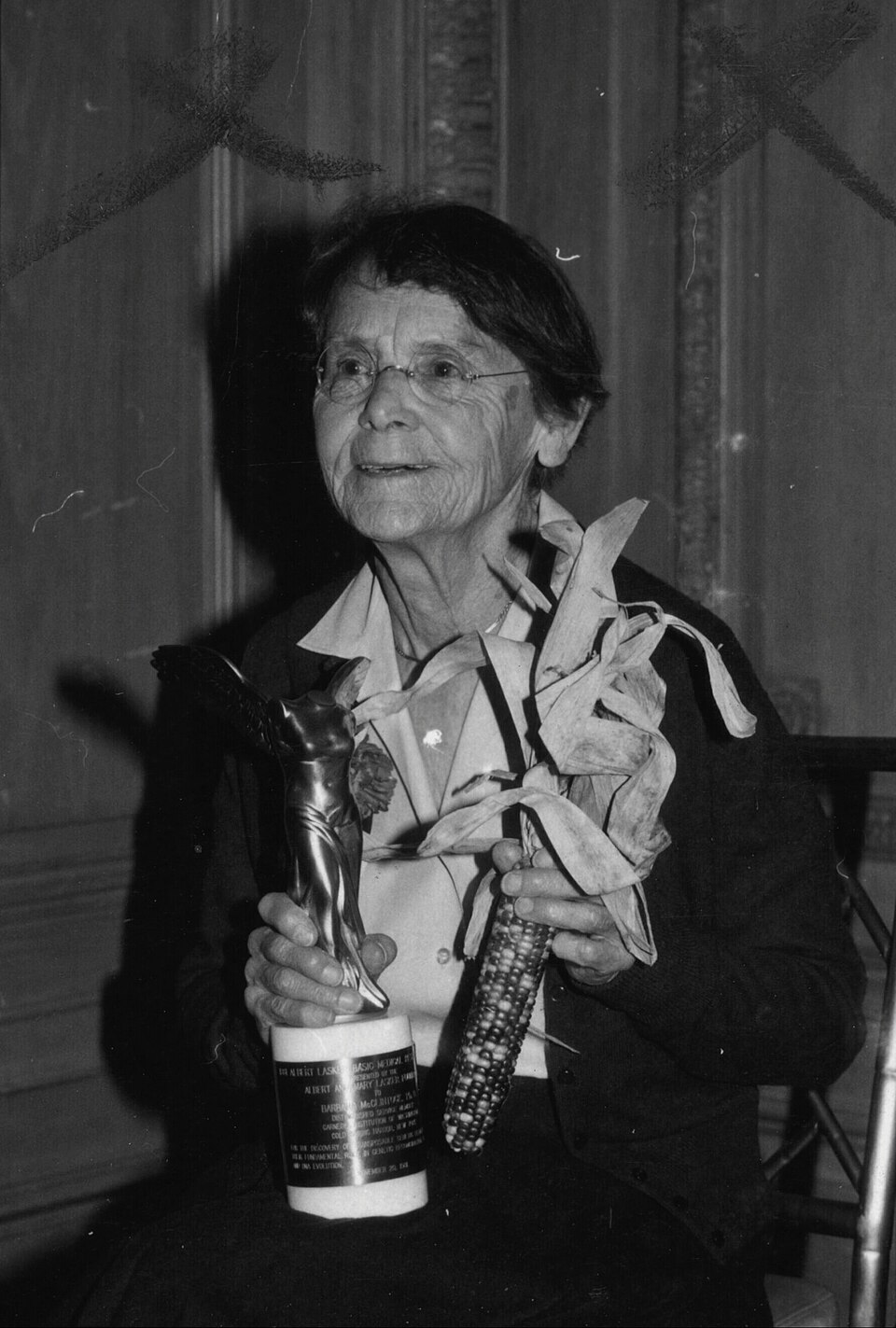
Lasker Award and an ear of corn.
Library of congress, public
domain
Joe Peters, Cornell University, United States
From TE Day 2025
“Every year we are finding more examples of how Barbara McClintock’s vision of mobile DNA so many years ago is being realized in molecular biology. Horizontal transfer is the driving force of evolution in bacteria, both as selfish elements and as the feedstock for evolving new molecular systems. We feel especially honored at Cornell to be at the root of her training in science."
Pascale Lesage, INSERM, France
From TE Day 2021
Beyond her major discovery of transposable elements nearly 70 years ago, Barbara McClintock is a source of inspiration for her creativity, her keen sense of observation and her intuition to understand the underlying biological phenomena. She had the courage to challenge prevailing theories. In today's fast-paced world, it is important to remember that research requires time and freedom of thought."
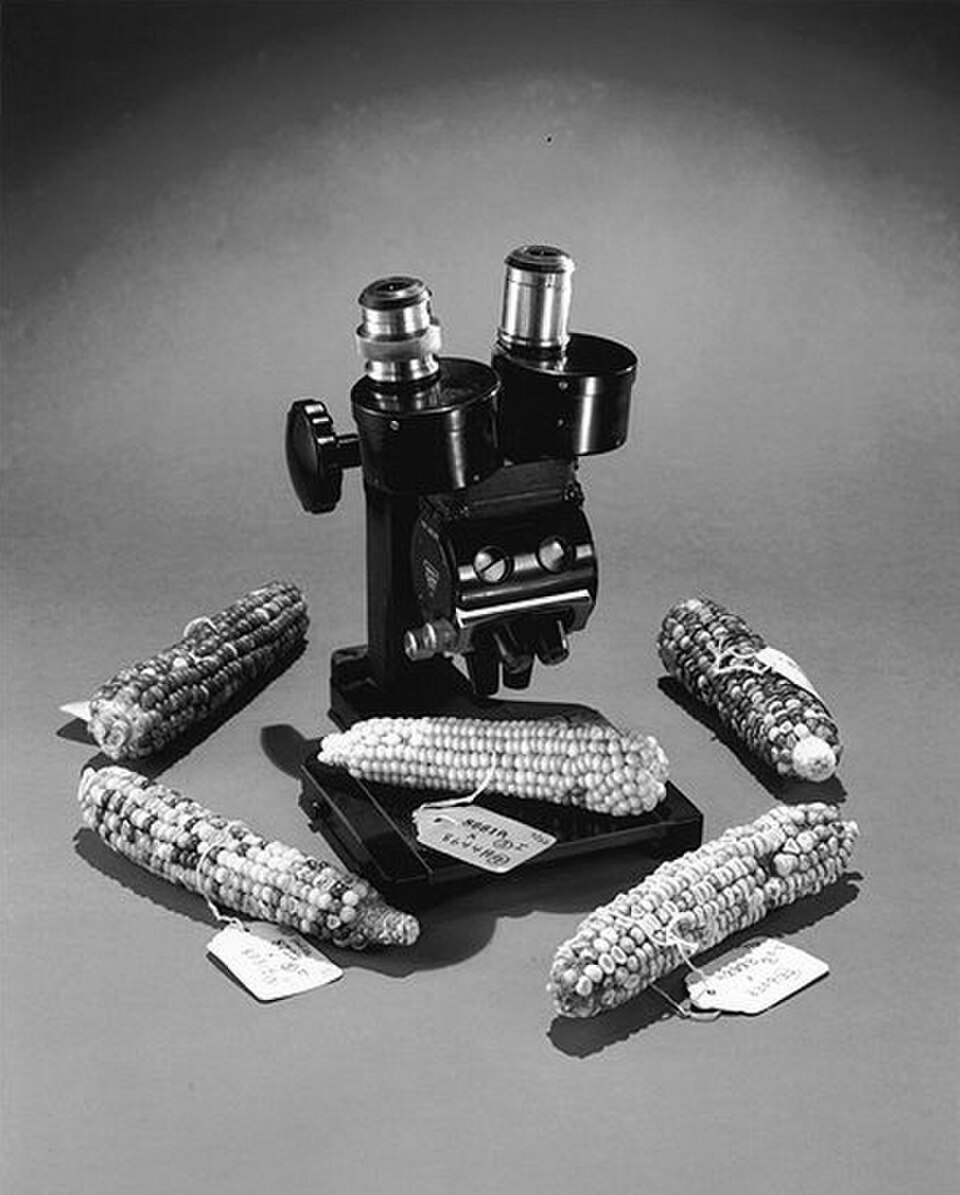
ears of corn (five) and a Bausch& Lomb
KW Wide Field Binocular Microscope.
Smithsonian Institution
Damon Lisch, Purdue University, USA
From TE Day 2025
"Although she is celebrated for the discovery of transposable elements, what really captured Dr. McClintock’s interest was the propensity of mobile genetic elements to regulate gene expression. That is why she called them “controlling elements” rather than “transposable elements,” and that is why she spent the last several decades of her career investigating the relationship between those controlling elements and gene expression.
McClintock was not looking for evidence of transposition or regulation of gene expression. Rather, her careful genetic analysis of the healing of broken chromosomes resulted in a series of unexpected phenomenon, including the propensity for a particular locus, disassociation, to break chromosomes, and the propensity of that locus to move to new locations. It soon became apparent to her that these mobile elements could also act independently to regulate gene expression. Although we now know that transposable elements are not an intrinsic feature of that control, because they can trigger rapid and obvious changes in gene expression, they provided a set of clues that lead directly to McClintock’s key discoveries. But these discoveries were only possible because McClintock was prepared to accept the implications of her observations. Many lessons can be, and have been, drawn from McClintock’s pioneering work, in no small measure because of her willingness to follow the data, wherever it might lead. For me, the most enduring lesson is that we should never let our ideas about how the world ought to be get in the way of what is in front of our faces. Our models are not reality, and that the natural world is often the best source of inspiration and new ideas, but only if we are prepared to let go of our preconceptions. If our experiments are well controlled and we are simply paying careful attention, we will almost certainly be surprised."
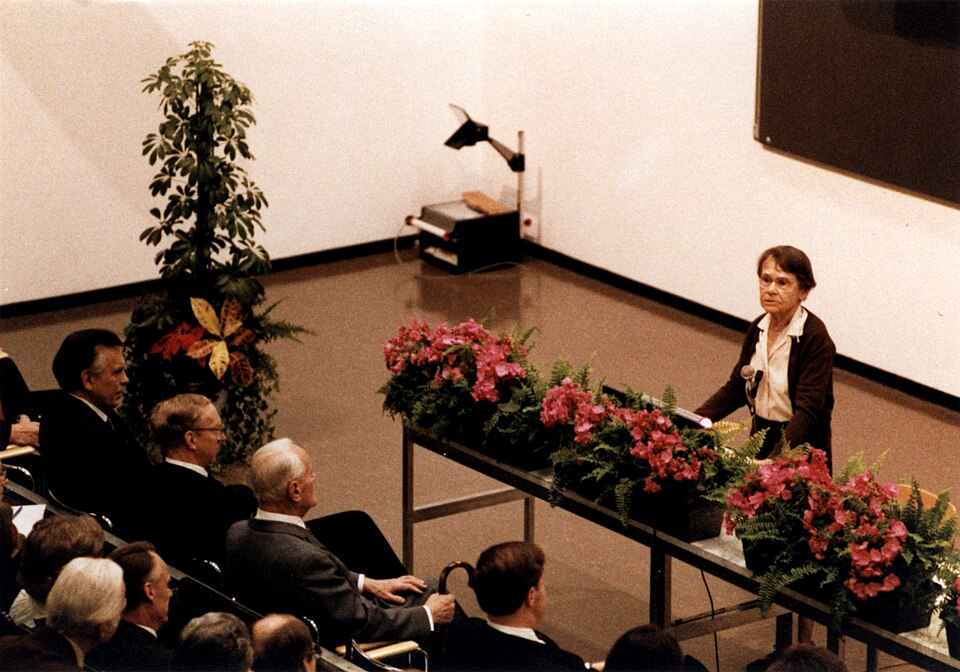
at Karolinska Institute in Stockholm.
From NIH- public domain image
Kathleen Burns, Dana-Farber Cancer Institute, USA
From TE Day 2021
I had the great pleasure of serving as the Opponent for Dr. Tatiana Cajuso defending her Ph.D. in Lauri Aaltonen’s research group at the University of Helsinki last year. Tatiana included a quote attributed to Dr. Barbara McClintock in the forward of her thesis : “If you know you are on the right track, if you have this inner knowledge, then nobody can turn you off … no matter what they say.” As our field moves forward to more fully appreciate the wonders of mobile elements in genomes, it is great that we stop each year to celebrate McClintock’s scientific legacy and reflect on her sense of purpose. And that we recognize the connection between her track and ours.
Freyja has a BSc in Zoology, and an MSc in the History of Science, Technology and Medicine from The University of Manchester. She currently works as an Associate Publisher for BMC's open access portfolio.
Follow the Topic
-
Mobile DNA
Mobile DNA is an online, peer-reviewed, open access journal that publishes articles providing novel insights into the function, biological impact, and evolution of transposable elements in any organism.

Related Collections
With Collections, you can get published faster and increase your visibility.
Mobile DNA Tools
Repository for all published articles on softwares, databases, and methodologies. Submit your updates and new submissions on not yet covered databases and other tools for analyzing and categorizing transposable elements.
This collection has been peer reviewed by the journal's Editorial Board.
Publishing Model: Open Access
Deadline: Ongoing
All Reviews Collection
Repository for all published Review articles. Contributions from some of the leading researchers working with mobile DNA.
This collection has been peer reviewed by the journal's Editorial Board.
Publishing Model: Open Access
Deadline: Ongoing