Tuneable Terahertz Surface Plasmons Excitation in a Metal‑Air‑Metal Symmetrical Structure by Relativistic Electron Beam
Published in Physics
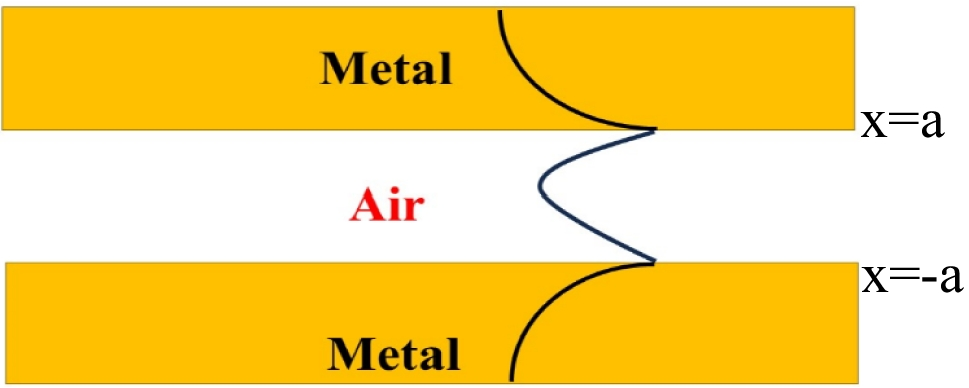

In this paper , we study the properties of plasmons in THz frequency range that arise when a beam passes through the gap between two metallic plates. The structure supports
the field of guided electromagnetic modes or SPs and have
minimum value at the middle of the gap, so the electron beam
passing through this air gap, experiences a converging force
and this electron beam can propagate without any divergence
through this gap. These SPs have lower phase velocity than
the free space velocity of photon, so SPs can be excited by a
moving relativistic electron beam via Cherenkov interaction.
A relativistic electron beam moving through this air gap, it
resonantly excites the SPs in THz frequency and these THz-
SPs are transformed into Coherent THz radiation, when they
passing over a periodic structure.The proposed structure will open the possibility to design
a compact source for coherent and tuneable THz radiation generation in broad spectrum regime, which will be useful for
medical diagnostics, photonics devices, etc.

I am a theoretical physicist. My expertise in area of fundamental plasma physics, Laser plasma interaction, Fusion research, Plasmonics, Compact radiation sources, Fundamental physics.
Follow the Topic
-
Plasmonics
This is a peer-reviewed journal that advances and reports on the interactions of free-metal electrons, Plasmons, and their applications.

Related Collections
With Collections, you can get published faster and increase your visibility.
Plasmon-enhanced sensing and catalysis
Plasmon-enhanced sensing and catalysis harnesses the unique light-matter interactions of metallic nanostructures to enable high-sensitivity detection and efficient chemical transformations. This special collection invites contributions that advance the fundamental understanding and practical application of plasmonic effects, including but not limited to:
1. Novel plasmonic materials and nanostructures for enhanced spectroscopic sensing (SERS, TERS, SEIRA, enhanced fluorescence, etc.)
2. Plasmon-enhanced fluorescence for bioimaging, immunoassays, and molecular detection
3. Plasmonic biosensing (e.g., LSPR-based biosensors, fiber-optic plasmonic sensors, point-of-care devices)
4. Plasmon-driven and plasmon-mediated catalytic reactions
5. Hot carrier dynamics and energy transfer mechanisms
6. Hybrid plasmonic–photonic, plasmonic–2D material or wearable systems
7. Single-particle and single-molecule sensing
8. Plasmon-enhanced electrochemistry and photocatalysis
9. Theoretical and computational modelling of plasmonic enhancement
10. Emerging applications in biological analysis, environmental monitoring, and energy conversion
Both original research articles and comprehensive reviews are welcome. Studies that bridge experimental and theoretical approaches, or that demonstrate significant advances in sensitivity, selectivity, or catalytic efficiency, are particularly encouraged.
Publishing Model: Hybrid
Deadline: Mar 31, 2027