Ecosystems may access deeper water stores than our measurements suggest
Published in Earth & Environment and Computational Sciences


Studies in ecohydrology often focus on how near-surface soil moisture and atmospheric aridity influence photosynthesis. The role of groundwater in shaping spatial patterns of photosynthesis is less well quantified; groundwater is in fact mostly treated only as a boundary condition. In our new study, we combined satellite observations of solar-induced chlorophyll fluorescence (a proxy of ecosystem photosynthesis) with estimates of water-table depth to quantify the relative contribution of groundwater in explaining the spatial variation of mean annual photosynthesis compared to the effect of climatic aridity.
We used causality-guided explainable machine learning focusing on the spatial dimension. In simpler terms, we combined machine learning with an understanding of the physical relationships between groundwater, climate and elevation. We could thus disentangle the contribution of each driver to the patterns of photosynthesis observed across the landscape. We found that groundwater regulates the spatial pattern of photosynthesis across the contiguous United States, with an effect comparable in magnitude to climatic aridity in forests, and smaller effect in other vegetation groups.
The result left us with a question: if groundwater can be as important as climatic aridity at least for some vegetation groups, how deep can the rooting zone actually extend to access that groundwater? Direct measurements of maximum rooting depth are difficult to obtain and remain sparse, even when deep roots can play a critical role in sustaining plant activities especially during dry periods. Field studies have documented roots far below the surface and widespread use of water stored in weathered and fractured bedrock, but these processes are still poorly represented at large scales.
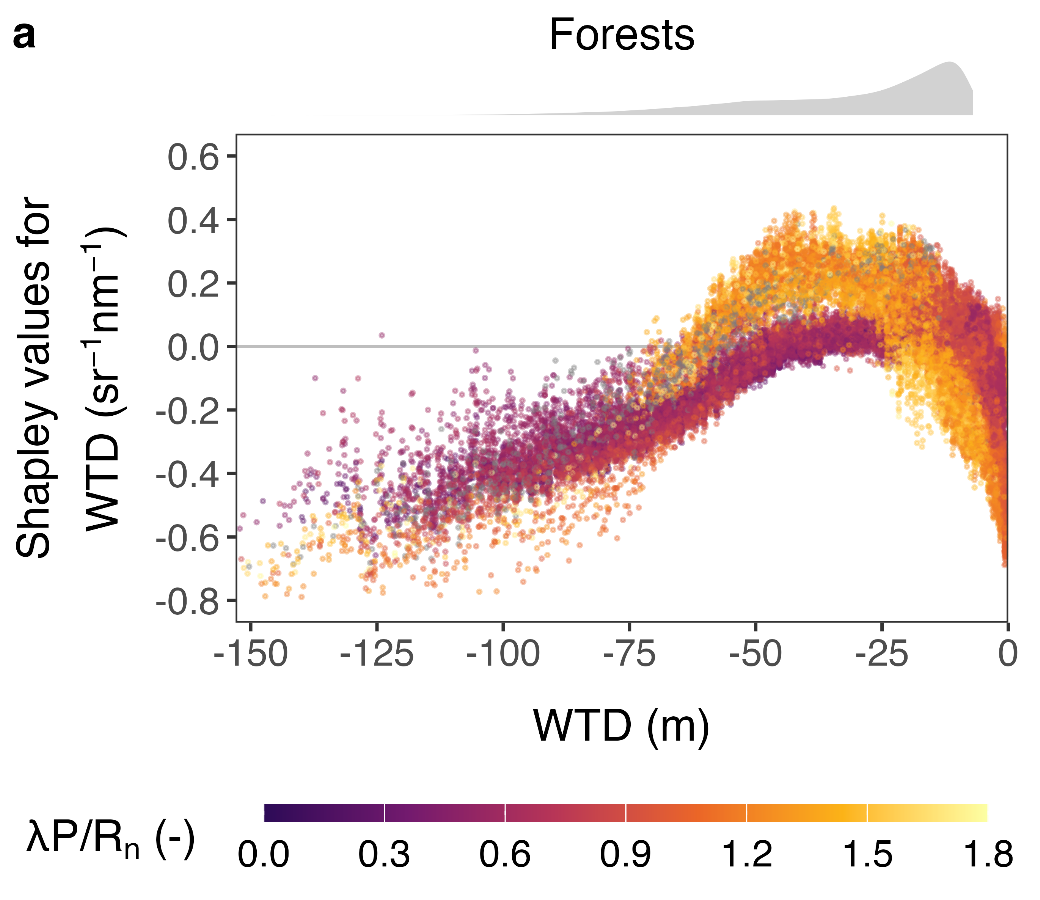
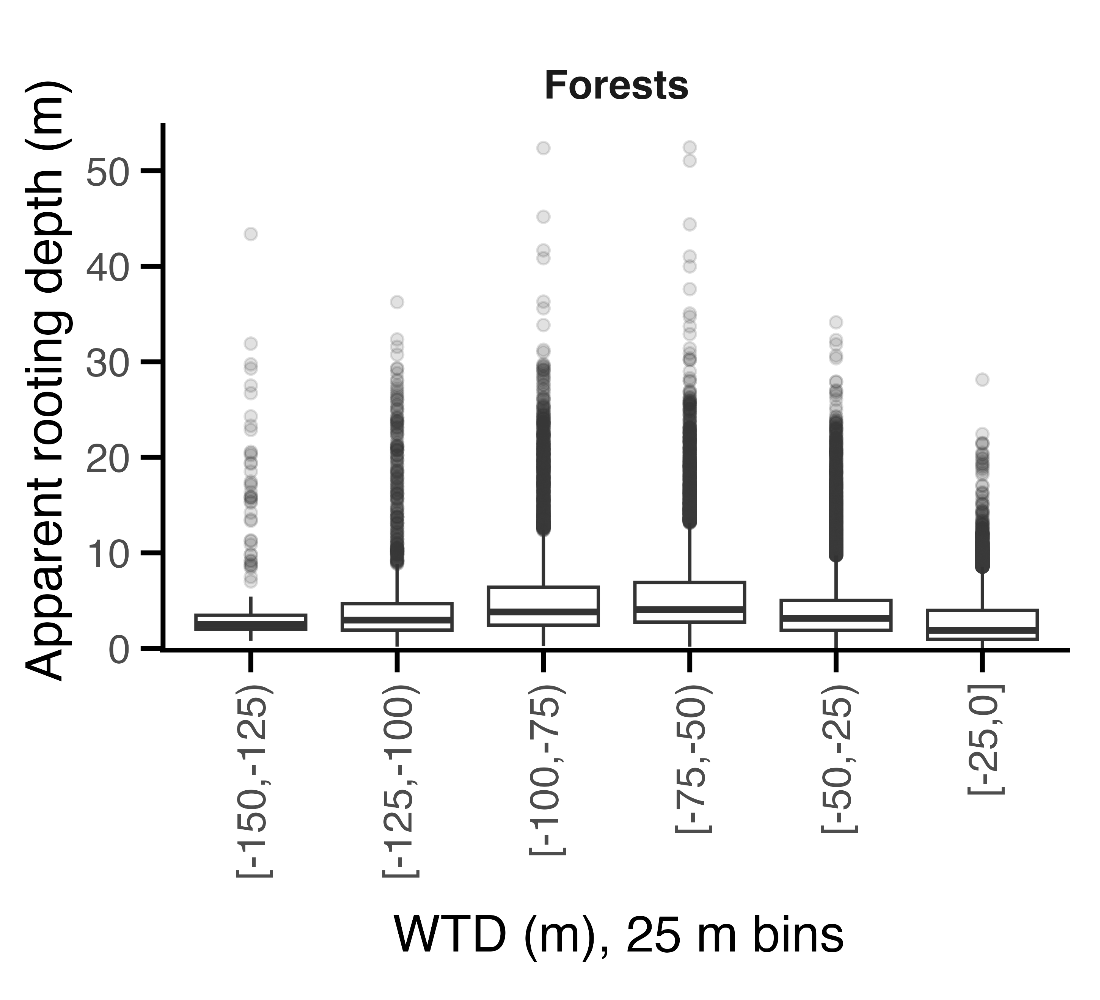
In Fig. 5, we plotted the Shapley dependence plots of water table depth along aridity gradients. Shapley dependence plots reveal the impact of a particular variable (i.e. water table depth) on the prediction (i.e. photosynthesis). We can see that the contribution attributed to water table depth changes at depths well beyond those commonly assigned to roots in land surface models, especially for forests. Supplementary Fig. 11 provides further context: apparent rooting depths tend to be greater in the water-table ranges where the modelled groundwater contribution changes most rapidly, and the distributions contain a small number of very deep estimates. This is consistent with previous work showing that subsurface hydrology regulates rooting strategies and that apparent rooting-depth estimates can reflect access to groundwater.
It's important to mention that the water table depths in Fig. 5 are not direct measurements of rooting depth. First, they represent averages over relatively large grid cells and cannot be directly matched to local rooting depths. Moreover, roots do not have to reach the saturated zone for groundwater to support photosynthesis. Water tables can regulate moisture in the unsaturated zone, supply the capillary fringe and affect water stored in weathered or fractured material. Hydraulic redistribution can also connect deep water stores to shallower roots. Our results therefore suggest that ecosystems may be connected to deeper water stores than conventional shallow soil representations capture.
For us, this is one of the most important implications of the study: a fixed, shallow soil column may exclude a much larger water reservoir connected across depths. Targeted field observations are needed to determine whether this connection depends on very deep roots, capillary transport, soil texture, rock moisture or a combination of these factors. Although our analysis cannot directly observe roots, it helps identify where connections to deeper water stores may matter most for vegetation.

Understanding how plant activity mediates the terrestrial water and carbon cycles under climate change has defined my work as a scientist and engineer. I have focused on how water availability shapes vegetation function at multiple scales, from leaf-level physiology to land–atmosphere exchanges.
I enjoy working in international and interdisciplinary environments and am eager to learn across different fields, with experience in academia, international cooperation, and the private sector. My passion for cultural exchange and communication has led me to become comfortable in several languages.
I am strongly motivated to advance our understanding of the complex physical environment to drive positive impact on global challenges.
Follow the Topic
-
Communications Earth & Environment
An open access journal from Nature Portfolio that publishes high-quality research, reviews and commentary in the Earth, environmental and planetary sciences.

Related Collections
With Collections, you can get published faster and increase your visibility.
High-resolution modeling for Earth system
Publishing Model: Open Access
Deadline: Feb 07, 2027
Soil microbiomes and carbon sequestration under global change
Publishing Model: Hybrid
Deadline: Mar 18, 2027