Twisting Heat to the Max: How Spring Turbulators and Nanofluids Are Revolutionizing Heat Exchangers 🚀
Traditional heat exchangers are hitting thermal limits. A new study shows how combining helical pipes, spring turbulators, and nanofluids smashes stagnant boundary layers, drastically boosting cooling efficiency for next-gen engineering systems.
Twisting Heat to the Max: How Spring Turbulators and Nanofluids Are Revolutionizing Heat Exchangers 🚀

Like

Share this post

Choose a social network to share with, or copy the URL to share elsewhere

This is a representation of how your post may appear on social media. The actual post will vary between social networks

Explore the Research

Multidisciplinary Digital Publishing Institute
Multidisciplinary Digital Publishing Institute Multidisciplinary Digital Publishing Institute

Investigation of Thermal and Hydraulic Performance in a Helical Two-Tube Heat Exchanger Equipped with Wire/Spring Turbulators

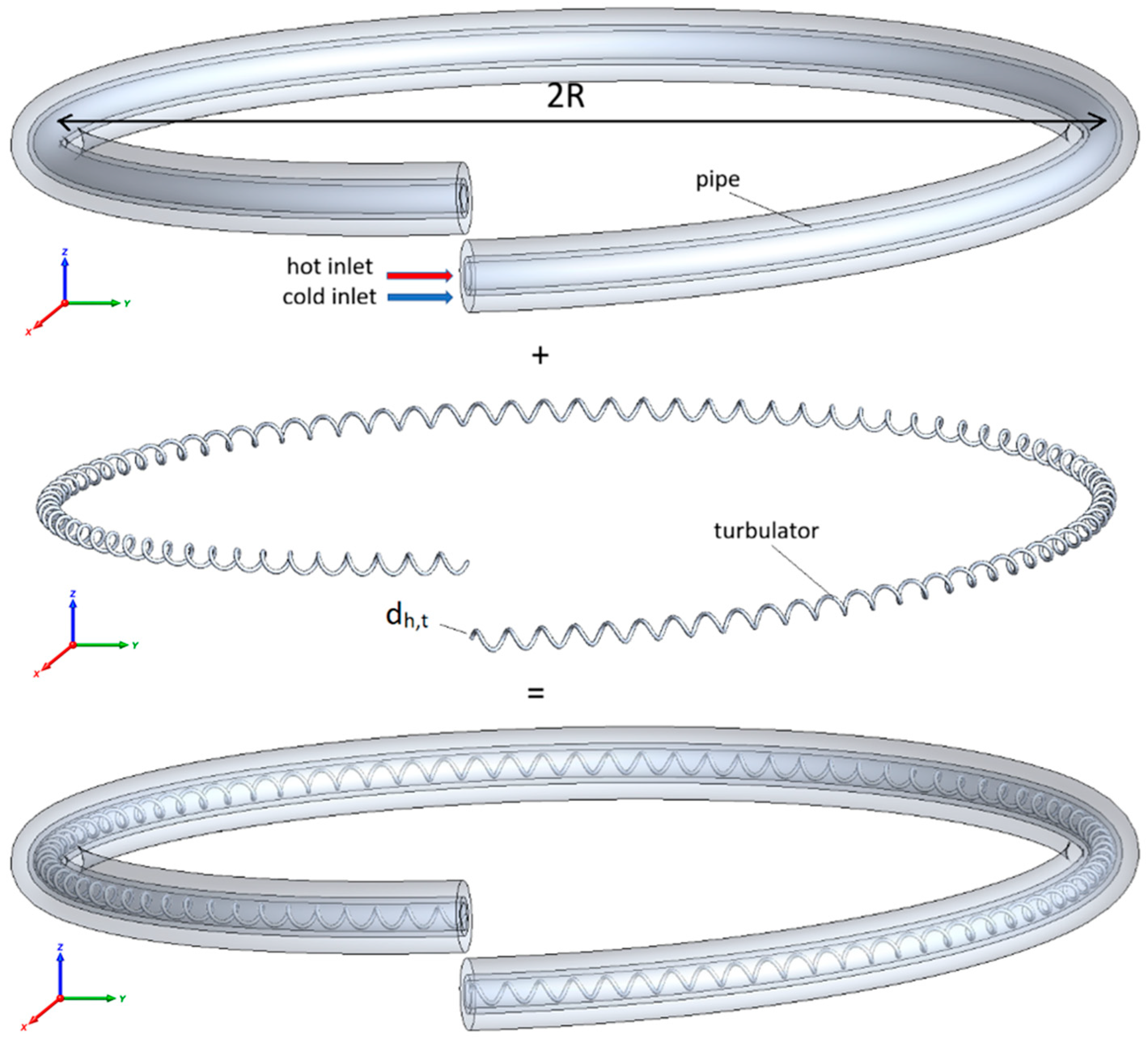
This study numerically investigated thermal enhancement in helical tube flows equipped with an embedded wire/spring turbulator. Five turbulator configurations (circular, square, and two different rectangular cross-sections) were examined for turbulent operation using water and three nanofluids (CuO–water, TiO2–water, and Al2O3–water). The insertion of the turbulator reorganized the flow and intensified near-wall mixing, which led to consistently higher heat-transfer performance as evidenced by enhanced Nusselt number (Nu) levels. However, these thermal gains were accompanied by additional hydraulic losses, reflected in increased friction factor (f) and pressure-drop penalties. The results also revealed that Nu increases with increasing Dean number, indicating that curvature-driven secondary motions and turbulence augmentation act synergistically in promoting convection. In contrast, the hydrodynamic cost intensifies with flow strength, producing a net decrease in thermal efficiency, η, with Reynolds number for all cases. This decline occurs because the pressure-drop growth rate exceeds the incremental heat-transfer improvement. Among the examined fluids, nanofluids generally provided higher η than water, while Al2O3–water exhibited the most favorable behavior among the nanofluids. To jointly account for thermal and hydraulic effects, the thermal performance factor (TPF) was evaluated and found to decrease with Reynolds number across all fluids, implying that heat-transfer benefits become less dominant at higher inertia. The combined results highlight that selecting the appropriate turbulator cross-section and working fluid is essential for achieving an efficient thermal–hydraulic equilibrium.

In our modern world, saving energy isn't just about reducing costs—it's a critical engineering challenge. Heat exchangers are the unsung heroes of industrial systems, working quietly behind the scenes in everything from automotive engines to massive power plants. But traditional configurations are reaching their thermal limits.
A recent study published in Applied Sciences reveals an ingenious way to dramatically boost cooling efficiency. By combining coiled helical pipes, custom-shaped spring inserts, and advanced nanofluids, researchers have unlocked a superior way to manage high-intensity thermal systems.