UNGA80, SDGs, and the Future of Women’s Health Research
Published in Sustainability and Public Health

 Sarah Chew supports the planning and execution of SWHR’s portfolio of programs. She performs cross-cutting work to assist in strategic planning and communications related to these programs.
UNGA80, SDGs, and the Future of Women’s Health Research
By Sarah Chew, MPH, Science Programs Manager, Society for Women’s Health Research
Women account for 49.7% of the world’s population and have a life expectancy of 76 years compared to men’s 71 years.1,2 Women also comprise 67% of the global health and social care workforce and perform 76% of unpaid care work globally.3 Yet, women and women’s health are inadequately considered and represented in the global health care and policy ecosystems. Women face unique health challenges due to biological sex differences in health and disease and sociocultural differences due to gender, which result in, among many things, women spending 25% more time in poorer health than men.4 Systemic gaps persist in research investment, inclusive and equitable policies, and workforce development and promotion for women. Through investing in women’s health globally, there are opportunities to improve quality of life, reduce health care costs, improve work productivity, and increase economic growth not just for women, but also for communities and countries.
Women’s health and women’s role in the health care ecosystem were central topics during the Science Summit at the 80th Session of the United Nations General Assembly. The September 2025 global gathering presented the opportunity for organizations committed to transformative change in women’s health to share insights, strategies, and models for women’s health advancement. Aligned with the Sustainable Development Goals (SDGs), many of this year’s UNGA80 Science Summit discussions illuminated how women’s health is influenced by and intertwined in all 17 SDGs, with a particular emphasis on the Goals 3 (good health and well-being), 5 (gender equality), and 10 (reduced inequalities).
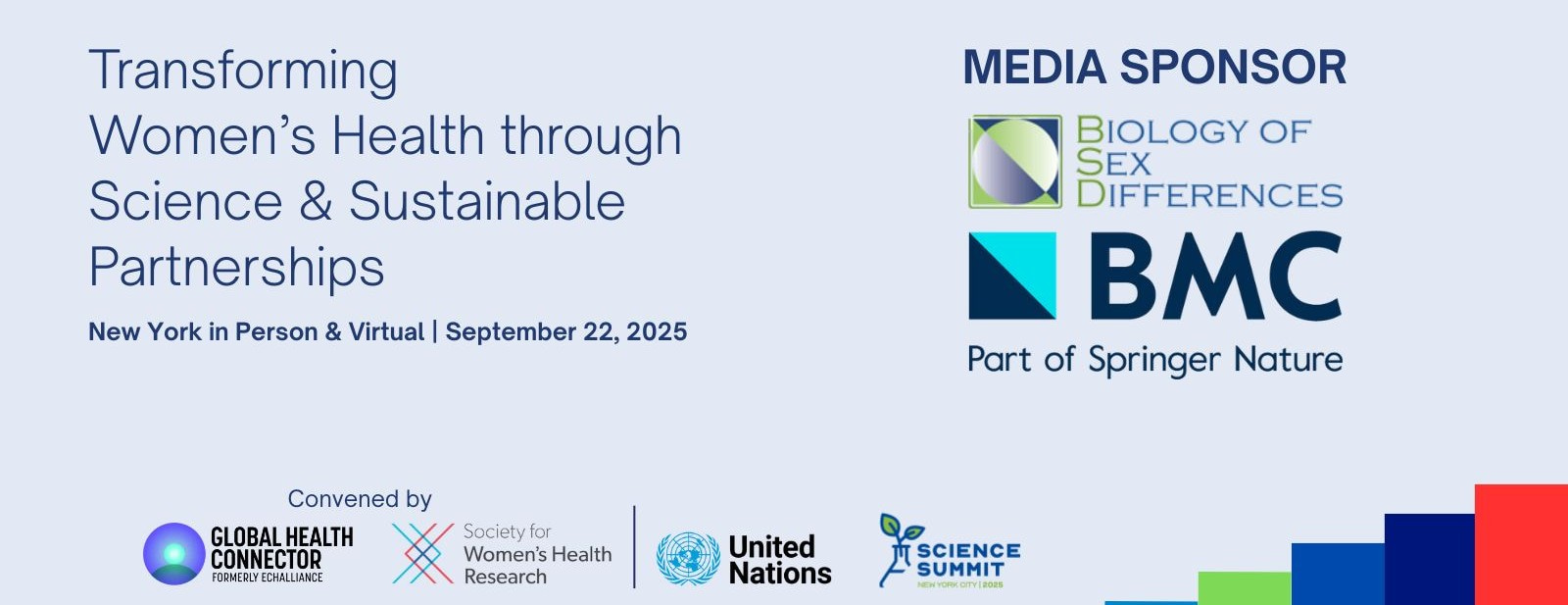
As part of UNGA80, the Society for Women’s Health Research (SWHR) and the Global Health Connector (GHC) organized a full day convening to elucidate key developments and opportunities to advance women’s health care and research. This unique opportunity offered the chance to illuminate gaps in global women’s health, initiate domestic and global collaborations, and inform the development of women’s health research and policy agendas for the UN and other prominent organizations in public and women’s health. During the SWHR-GHC convening, a gathering of global experts presented on models for translating innovation across borders, promoting workplace equity and support for women, empowering women in community-based care, establishing national priorities in women’s health, and leveraging public-private partnerships to close the gender health gap. Apparent throughout these discussions were parallels to the calls to action of SDGs 3, 5, and 10, and pathways to meet these SDGs through the lens of women’s health.
SDG #3 Good Health and Well-Being: Ensure healthy lives and promote well-being for all at all ages.
The SWHR-GHC convening was rooted in the understanding that women represent a significant portion of the global burden of disease, with notable differences in health outcomes between men and women.5 Globally, sex and gender influence health and well-being and result in women living longer, but in poorer health than men. Due to persistent underinvestment in sex and gender research by health ecosystems, there remain significant gaps in women’s health. These gaps are compounded by sociocultural influences, government priorities, and geographic contexts. For example, on the topic of neglected diseases, panelist Delali Attiogbe Attipoe, MB, MBA, North America Director of the Drugs for Neglected Diseases initiative, shared that women face the “double neglect” of low research investment in neglected disease treatments and clinical research restrictions on women of reproductive age – setting up an unreasonable expectation in which women often have to choose between medical treatments and their reproductive rights. Even when considering diseases and conditions that have seen greater investment, women suffer when innovations and interventions are not scaled accordingly or do not consider local ecosystems.
While these discussions highlighted the chasm between achieving SDG 3 and the current state of women’s health globally, there were also opportunities illuminated. In her remarks, CIHR Institute of Gender and Health Scientific Director Angela Kaida, PhD, purported, “if we count women, study women, care for women, include all women, and invest in women, we can close the women’s health gap.” SDG 3 can be achieved through consulting women in their local context to inform capacity building, diversify research investment, establish collaborations, improve regulatory pathways, and ensure sustainability of investments.
SDG #5 Gender Equality: Achieve gender equality and empower all women and girls.
The convening also examined how to achieve gender equality not only through elevating women to leadership positions in health care but also by addressing the impact of women’s health on the workplace. Discussions throughout the day highlighted how gender gaps and systemic barriers in health care business, policy, and decision-making can be improved by and for women.
In the health care workforce, equity cannot be achieved without addressing systemic barriers; barriers which limit women in a field where women deliver care and men lead it. Globally, women are underrepresented in health care leadership and under-considered in health care decisions. Historically, efforts to achieve gender equality in the health care workforce have incorrectly focused on the recipients of this change (women) and not focused on the root causes and structures. For example, women make up about 40% of the global workforce6, so when women’s health is not addressed in the workplace, it impacts families, companies, economies, and societies. According to a report by McKinsey Health Institute, closing the women’s health gap could add $1 trillion in annual global GDP by 20404; however, it is not just about the business case. The day’s discussions took this one step further, noting that addressing women’s health at work is an issue of morality, equality, and justice.
When considering how to achieve gender equality, particularly for women working in health, UN Women’s Director of Policy, Programme, and Intergovernmental Division Sarah Hendriks offered four ideas: 1) governments should implement policies for women’s leadership, 2) health institutions should track and report on women in leadership, 3) donors and partners should fund women’s health leadership programs, and 4) societies and individuals should challenge the biases and norms that reinforce inequalities. To achieve SDG 5, greater attention needs to be paid to role and health of women in the workplace, and companies, communities, and governments have key roles to play in challenging biases, implementing policies, and reporting outcomes.
SDG #10 Reduced Inequalities: Reduce inequality within and among countries.
Through convening conversations about different countries and cultures, inequalities were illuminated in research, science, health institutions, workplaces, governments, and societies. How these issues play out in each context is dependent on national priorities, public-private partnerships, and sociocultural dynamics. When considering how to address these inequalities in women’s health, they cannot be addressed in isolation. Women’s health inequities are pervasive throughout societies and across borders.
When considering how to address the inequalities in research in Canada specifically, Dr. Kaida offered that researchers and scientists need to be held accountable because science that does not consider sex and gender is “weak science.” When discussing the importance of community-centered care for women in Nigeria, H.E. Oluwatoyin Saraki, LLB, LLM, BL, FPH, suggested that stakeholder engagement and local investments build tenacity to solve health gaps. To change the systems that limit women leadership in Science, Technology, Engineering, Mathematics, and Medicine (STEMM) in the United States, Senior Advisor and Director for SEA Change at the American Association for the Advancement of Science Shirley Malcom, PhD, pushed the importance of evidence gathering and disaggregating data because the basis of change is “knowing where you are.” The solutions that arose in conversations to address SDG 10 were summarized to accountability, collaboration, stakeholder engagement, and evidence gathering.
Overall, the SWHR-GHC global gathering at the UNGA80 Science Summit underscored the urgent need to reimagine strategies and solutions to advance women’s health worldwide. Women continue to face disproportionate health burdens, systemic underinvestment, and structural barriers to representation and equity. However, through convenings like this, we can see that there are clear pathways toward progress, rooted in the SDG principles, especially goals 3, 5, and 10. Meaningful change is achievable – in this generation – through sustained investment in women’s health research, gender-equitable policies, inclusive leadership, and cross-sector collaborations.
References
- The World Bank Group. Life expectancy at birth, female (years). The World Bank DataBank. Accessed November 20, 2025. https://data.worldbank.org/indicator/SP.DYN.LE00.FE.IN
- The World Bank Group. Life expectancy at birth, male (years). The World Bank DataBank. Accessed November 20, 2025. https://data.worldbank.org/indicator/SP.DYN.LE00.MA.IN
- Health Workforce (HWF). Fair share for health and care: Gender and the undervaluation of health and care work. World Health Organization. March 12, 2024. Accessed November 21, 2025. https://www.who.int/publications/i/item/9789240082854
- World Economic Forum, McKinsey Health Institute. Closing the women’s health gap: A $1 trillion opportunity to improve lives and economies. January 17, 2024. Accessed November 20, 2025. https://www.weforum.org/publications/closing-the-women-s-health-gap-a-1-trillion-opportunity-to-improve-lives-and-economies/
- Patwardhan V, Gil GF, Arrieta A, et al. Differences across the lifespan between females and males in the top 20 causes of disease burden globally: a systematic analysis of the Global Burden of Disease Study 2021. Lancet Glob Health. 2024;9(5). doi:10.1016/j.lanrg-hg.2024.100094
- The World Bank Group. Labor force, female (% of total labor force). The World Bank DataBank. Accessed November 20, 2025. https://data.worldbank.org/indicator/SL.TLF.TOTL.FE.ZS
Follow the Topic
-
Biology of Sex Differences
This journal is unlike any other scientific journal: articles focus on sex differences in all aspects of an individual or organism. Everything from molecules to behavior and from studies of cellular function to clinical research studies are reported in this journal.

📢 Introducing: # Mental Health
Mental Health is a Topic created to increase visibility and impact of research in this area and facilitate exchange amongst researchers.
Continue reading announcementRelated Collections
With Collections, you can get published faster and increase your visibility.
Sex Differences in Metabolic Regulation and End-Organ Damage
Sex differences profoundly influence endocrine and metabolic regulation, shaping disease susceptibility, progression, and therapeutic responses. This Collection aims to highlight how hormonal and metabolic interactions contribute to sex-specific pathophysiology across a range of endocrine disorders and associated systemic complications.
Research topics of interest include mechanisms and therapies addressing hormonal and metabolic dysregulation observed in conditions such as polycystic ovary syndrome (PCOS), metabolic syndrome, diabetic nephropathy, thyroid disorders, Cushing’s syndrome, and hyperaldosteronism. Emphasis is also placed on how these disorders impact multiple organ systems including the cardiovascular and renal systems, resulting in sex-specific patterns of end-organ injury and disease progression. Original research, clinical trials, translational studies, and comprehensive reviews are welcome.
Subtopics include, but are not limited to:
- Hormonal regulation of glucose and lipid metabolism by estrogens, androgens, and progesterone
- Sex-specific metabolic adaptations in obesity, diabetes, and cardiovascular disease
- Neuroendocrine and inflammatory mechanisms linking hormones to metabolic dysregulation
- Cardiovascular and renal complications of endocrine dysfunction
- Neuroendocrine control of metabolic homeostasis
- Endocrine disorders with metabolic manifestations
- Sex-based differences in drug response and therapeutic outcomes
All submissions in this Collection undergo the journal’s standard peer review process. Similarly, all manuscripts authored by a Guest Editor(s) will be handled by the Editor-in-Chief. As an open access publication, this journal levies an article processing fee (details here). We recognize that many key stakeholders may not have access to such resources and are committed to supporting participation in this issue wherever resources are a barrier. For more information about what support may be available, please visit OA funding and support, or email OAfundingpolicy@springernature.com or the Editor-in-Chief.
Publishing Model: Open Access
Deadline: Nov 04, 2026
Sex Differences in Cardiovascular Disease
Sex differences play a crucial role in the development, presentation, and treatment of cardiovascular disease. Despite growing recognition of these differences, major gaps remain—particularly in understanding how biological sex and gender influence risk, diagnostics, disease mechanisms, and therapeutic outcomes. This Collection aims to address these gaps by bringing together high-quality research that advances sex-specific and gender-aware cardiovascular science.
Key areas of interest include the impact of hormonal transitions such as menopause, pregnancy-associated cardiovascular conditions, and the distinct mechanisms underlying female-predominant conditions such as HFpEF and microvascular dysfunction. Understanding these processes is essential for developing accurate risk prediction models and personalised treatment strategies.
Persistent gender disparities in diagnosis, management, and access to care also contribute to poorer outcomes—issues that remain central to achieving equitable cardiovascular health. By encouraging research across these domains, this Collection aims to support scientific progress and clinical innovation that benefit individuals of all sexes.
Possible topics include but are not limited to:
- Menopause and cardiovascular risk
- Pregnancy-associated cardiovascular disease
- Sex differences in heart failure with preserved ejection fraction (HFpEF)
- Sex differences in arrhythmias
- Microvascular dysfunction in women
- Sex-specific platelet reactivity
- Gender disparities in cardiovascular treatment
- Sex-specific cardiovascular risk prediction models
This Collection supports and amplifies research related to SDG 3, Good Health and Well-Being.
All submissions in this Collection undergo the journal’s standard peer review process. Similarly, all manuscripts authored by a Guest Editor(s) will be handled by the Editor-in-Chief. As an open access publication, this journal levies an article processing fee (details here). We recognize that many key stakeholders may not have access to such resources and are committed to supporting participation in this issue wherever resources are a barrier. For more information about what support may be available, please visit OA funding and support, or email OAfundingpolicy@springernature.com or the Editor-in-Chief.
Publishing Model: Open Access
Deadline: Mar 16, 2027