The story behind work "Unleashing the ultrasonic frequency as a preparative parameter in tailoring the surface morphology and hence charge storage in Co3O4:MnO2@CoMnO3 composite flexible electrodes for supercapacitors"
Published in Bioengineering & Biotechnology, Chemistry, and Materials



The Story Behind Our Work
The published work in ‘Discover Nano’ is rooted in a series of discussions and teamwork that bridged two different scientific perspectives clinical pharmacology and materials science. At the heart of this effort were the insights of Dr. Manjunath, ‘Principal Investigator’ of the ICMR-funded project and corresponding author of this work, and Dr. Amarsingh, ‘Project Research Scientist-II’ with expertise in ‘materials science’ as co-corresponding author together with their team member, Ms. Shweta ‘Project Research Scientist I’, they developed a scientific pathway that connected ‘biosensing’ and ‘energy storage’ through the unconventional use of ultrasonic-assisted synthesis.
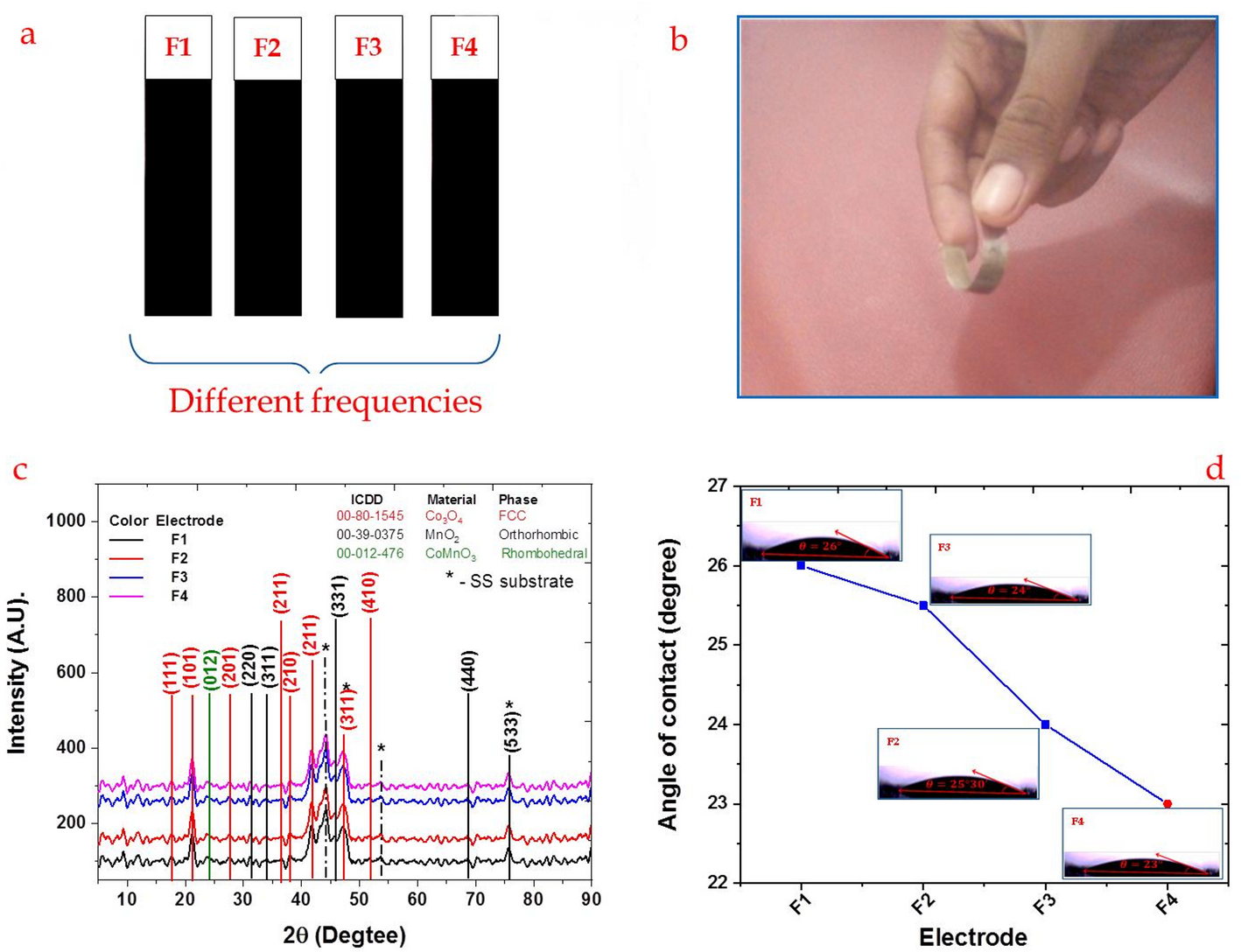
The journey began during the first team discussion, when Dr. Amarsingh highlighted the potential of ultrasonic techniques (ultrasonic chemical bath deposition UCBD) for electrode preparation. Drawing on his background in materials science, he proposed that ultrasound frequency could play a decisive role in governing the growth of electroactive materials. His view was that frequency could act as a hidden variable, directly influencing the nucleation and growth process, thereby creating significant changes in surface morphology. These morphological modifications, he suggested, would have a direct impact on electrochemical activity.
Dr. Manjunath, with his clinical pharmacology perspective, immediately recognized the importance of developing electrodes that could be customized for ‘biosensing applications’ under the ICMR project. He supported the idea of exploring ultrasonic-assisted synthesis, encouraging the team to prepare electrodes using this approach and then assess their electrochemical sensing performance. This initial stage focused on biosensing as the central application, with the expectation that improved surface morphology would enhance sensitivity.
As the work progressed, however, an important connection emerged. Dr. Amarsingh pointed out that the same surface morphological transitions that enhanced biosensing also had strong implications for energy storage applications. High surface area, controlled porosity, and interconnected growth patterns are equally crucial for ‘supercapacitive electrodes’. In the second team discussion, he suggested that the team should test the electrodes not only for sensing but also for energy storage.
This suggestion was met with encouragement from Dr. Manjunath, who valued the dual potential of the materials. With his support, Dr. Amarsingh and Ms. Shweta conducted systematic electrochemical tests to evaluate supercapacitive performance. The teamwork between the PI’s clinical insight, the material science-driven synthesis approach, and the experimental support from Ms. Shweta led to the fabrication of a symmetric supercapacitor device. The device demonstrated high charge storage capacity, confirming that ultrasound frequency is not only a synthesis parameter but also a powerful tool for tailoring electrode functionality across applications.
Challenges Along the Way
The biggest challenge was peaople questioning the objectivity of the work. It is obvious that question may be asked “The team working on electrochemical biosensing, in the clinical pharmacology laboratory in a cancer hospital where nobody can think of making energy storage devices, what these guys are doing? Are they loosing objectivity?”. This reminds the great words from Dr. Homi Bhabha “Even the best minds tend to loose objectivity in pursuit of excellence”. The path to these findings was not without challenges. Ultrasonic-assisted synthesis is highly sensitive to parameters such as solvent type, precursor concentration, and duration of sonication. At the early stages, the team observed inconsistencies in electrode performance, with some samples showing promising activity while others under identical conditions failed to deliver reproducible results. This prompted a more systematic examination of frequency as a standalone parameter, rather than treating ultrasound as a uniform technique.
Another challenge arose during electrode fabrication. Achieving mechanical stability while maintaining a porous, high-surface-area structure required several adjustments in preparation conditions. Ms. Shweta played a vital role in testing different batches of electrodes, carefully cataloging the variations in and electrochemical response. These iterative trials, though time-consuming, were essential in pinpointing the role of frequency in driving reproducible morphological transitions.
Energy storage testing also posed hurdles. The first few devices assembled showed limited capacitance retention, which highlighted the need to optimize electrode thickness and electrolyte compatibility. With careful adjustment, the team overcame these difficulties, ultimately achieving stable devices that confirmed the link between ultrasound frequency, morphology, and charge storage capability.
These challenges, rather than hindering progress, provided valuable insights that strengthened the final conclusions. They reinforced the importance of perseverance and systematic optimization in experimental science.
Broader Outlook
The outcomes of this study extend beyond the specific systems reported in the paper. The discovery that ultrasound frequency can be strategically used to tailor surface morphology provides a versatile tool for electrode design. This principle is not confined to biosensing or supercapacitors but can be applied across electrochemical technologies, from batteries to catalytic systems.
From the pharmacological perspective, the ability to fabricate electrodes with tunable morphology opens possibilities for highly sensitive biosensors capable of detecting biomarkers at low concentrations. This could significantly impact clinical diagnostics, where accuracy and reliability are paramount. From the materials science perspective, the demonstrated success in supercapacitive energy storage highlights the adaptability of the same electrodes to renewable energy technologies.
The dual applicability of these electrodes underscores an important message: advances in one field can often provide unexpected solutions in another. The teamwork between clinical pharmacology and materials science in this project reflects the type of interdisciplinary thinking required to address complex technological challenges.
Looking ahead, the team envisions extending this line of research toward multifunctional devices capable of integrating sensing and storage functions. Such devices could be transformative in fields like ‘wearable health monitoring’, point of care devices (POCD), modern glucose regulators etc. where biosensing and energy supply must coexist in compact, efficient platforms.
Behind the graphs, data, and conclusions presented in the published paper lies this story of teamwork, curiosity, and scientific openness. What began as a biosensing-focused study evolved into a broader exploration of material functionality, driven by the willingness to test ideas beyond their original scope. The work reflects how science often progresses not in linear paths, but through supportive discussions, shared perspectives, and the courage to explore new directions.
In the end, this study did more than demonstrate a successful device. It established ultrasound frequency as a strategic parameter for tailoring material growth, morphology, and electrochemical properties. It also highlighted how electrodes designed for biosensing could seamlessly transition into energy storage applications, emphasizing the versatility of ‘UCBD’. For the team, this understanding represents both a scientific contribution and a reminder that the most impactful discoveries often arise at the intersection of disciplines, guided by teamwork and shared vision.
The potential of muti-apllicability of the materials is keenly recognised by Professor Dr. Vikram Gota the 'Officer in-Charge' of Clinical Pharmacology laboratory who has appointed Dr. Amarsingh as 'ACTREC Post Doctoral Fellow' to continue his research after successful completion of the ICMR project. The journey of Materials Science with Medical science continues!
We are grateful to ‘Discover Nano’, to allow us to share ‘the journey’ where the details of our work are published because “The great joy is not when you reach the destination, but its along the journey”

Follow the Topic
-
Discover Nano
This is an interdisciplinary journal that publishes papers from all areas of nanoscience and nanotechnology.

Related Collections
With Collections, you can get published faster and increase your visibility.
Nanofluid Engineering for Sustainable Energy Systems
Nanofluid engineering is reshaping sustainable energy by mixing highly conductive nanoparticles into standard base fluids—like water or oil—to considerably enhance the heat transfer. Although empirical laboratory characterization demonstrates a 20% to 30% enhancement in thermal performance, commercial scalability remains constrained by critical transport phenomena. The collection will be focused on several aspects, but is not limited to:
- Stability issues: Nanoparticles have a habit of clustering together and settling out of the fluid over time, degrading performance.
- Micro-level behavior: The microscopic motion of nanoparticles enhances energy dispersion and prevents localized thermal bottlenecks.
- Increased pumping power penalties: Introducing these particles thickens the fluid (increasing its viscosity), which demands more energy to keep it moving through a system.
- Technological synergies. Engineers frequently combine nanofluids with passive heat transfer enhancement devices like turbulators.
- AI/ML techniques: To bridge the gap between lab and real-world application, machine learning / AI models can be employed to accurately predict complex fluid behaviors, allowing scientists to perfectly optimize nanoparticle size, shape, and concentration without endless, costly trial and error.
By collecting experimental/theoretical/numerical contributions from leading researchers, this Collection aims to serve as a valuable resource for both researchers and practitioners working in nanotechnology, thermal sciences, and materials engineering. Applications related to and proving improvements related to SDG 7: Affordable and Clean Energy and SDG 9: Industry, Innovation & Infrastructure are encouraged and prioritized.
Keywords: Physics Informed Machine Learning; Heat Transfer; New fluids; Convection; Thermophysical Properties; Phase Change Materials; Energy Efficiency; Sustainability.
This Collection supports and amplifies research related to SDG 7 and SDG 9.
Publishing Model: Open Access
Deadline: Feb 26, 2027
Green Nanomaterials: From Sustainable Synthesis to Eco-Friendly Applications
Discover Nano invites submissions for a Topical Collection focused on the exciting and rapidly evolving field of green nanomaterials. This collection aims to highlight the latest advancements in the synthesis, characterization, and application of nanomaterials that prioritize environmental sustainability and human health. Nanomaterials, with their unique properties, offer immense potential for addressing these challenges. However, the conventional methods for their synthesis and processing often involve hazardous chemicals and energy-intensive processes. This Topical Collection seeks to showcase research that explores alternative, eco-friendly approaches to nanomaterial production and utilization.
Keywords: Nanomaterials; green synthesis; eco-friendly; sustainable synthesis; one health; biogenic synthesis
This Collection supports and amplifies research related to SDG 6, SDG 7, SDG 9, SDG 12, and SDG 13.
Publishing Model: Open Access
Deadline: Nov 30, 2026