Unmasking Kolkata’s Air: Tracking Pollution Patterns and Hidden Drivers
Published in Earth & Environment and Sustainability

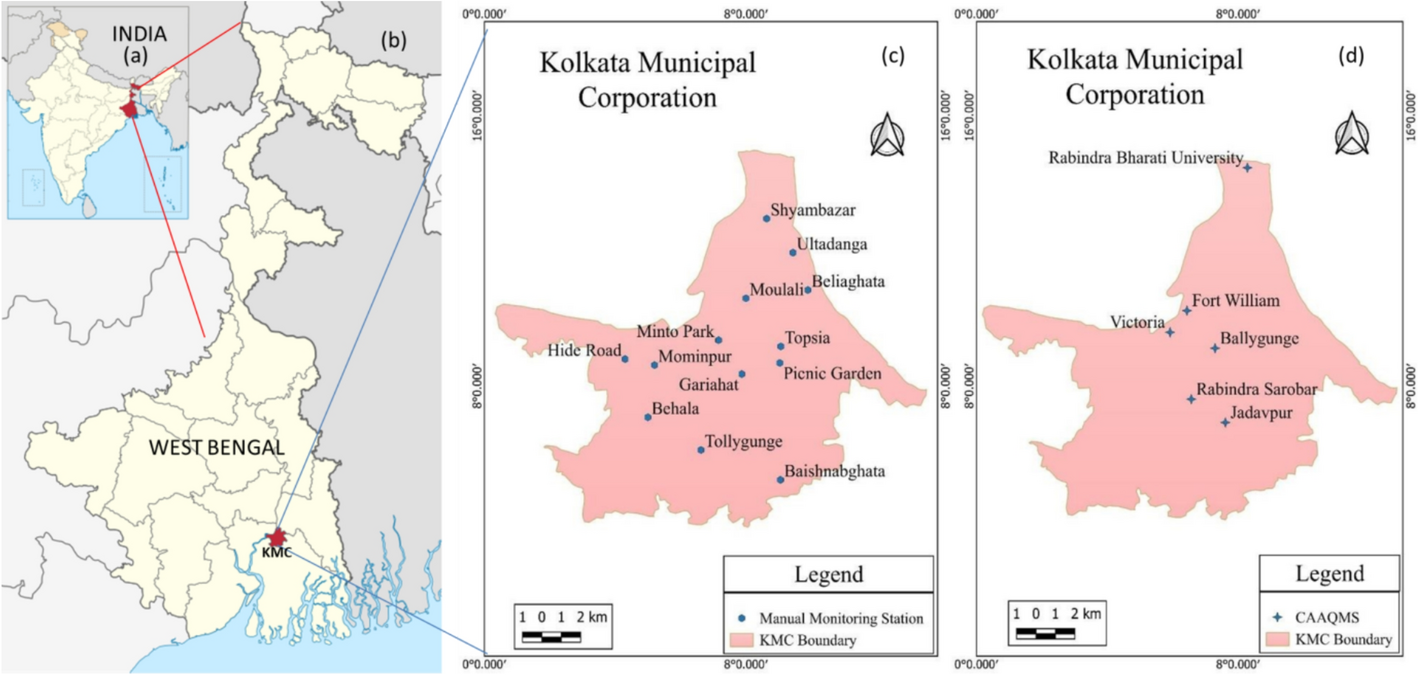

In eastern India, Kolkata stands as a city of deep cultural heritage and intellectual history, yet it now faces an escalating crisis of air pollution. Once celebrated for its artistic and academic vibrancy, the city of over four million residents is increasingly burdened by toxic gases and particulate matter that compromise daily life. A recent study led by Dr. Sumanta Das of the Ramakrishna Mission Vivekananda Educational and Research Institute, in collaboration with the West Bengal Pollution Control Board, offers one of the most comprehensive examinations yet of this invisible threat. Through the integration of five years of monitoring data, advanced geospatial techniques, and meteorological analysis, the research delivers a multidimensional portrait of Kolkata’s air and provides pathways toward targeted solutions.
The study is driven by an urgent national context: India accounts for 21 of the world’s 30 most polluted cities, and Kolkata consistently ranks among them. While Delhi’s notorious smog often dominates public attention, Kolkata’s long-term air quality dynamics have been less rigorously documented. Past studies tended to focus on specific seasons or short-term conditions, offering fragmented insights into a problem that unfolds continuously and is shaped by a range of human and climatic forces. Dr. Das and his team sought to bridge this gap by conducting a sustained, multi-year investigation that captures both the citywide extent of pollution and its shifting patterns over time.
What distinguishes this research is its methodological innovation. The team drew on data from thirteen manual air quality stations and seven automated continuous monitoring stations maintained by the Kolkata Municipal Corporation. These provided measurements of critical pollutants, including PM₂.₅, PM₁₀, nitrogen dioxide (NO₂), and sulfur dioxide (SO₂). Instead of analyzing these values in isolation, the researchers applied Inverse Distance Weighted interpolation, a geospatial method that transforms scattered readings into continuous surfaces. This enabled the creation of high-resolution pollution maps that reveal how contaminants accumulate and disperse across neighborhoods. By coupling these spatial models with meteorological records from the India Meteorological Department, the team was able to identify how weather and climate interact with emissions to shape Kolkata’s atmospheric health.
The results highlight persistent hotspots that encapsulate the diversity of Kolkata’s air quality challenges. Hide Road, an industrial belt adjacent to a thermal power plant; Shyambazar, a dense traffic interchange; Moulali, a mixed-use hub marked by informal waste burning; Ultadanga, a transport-heavy corridor with dense slums; and Minto Park, a construction-dominated commercial district—all consistently registered dangerous pollution levels. Each hotspot reflects a different facet of the problem: industrial emissions, vehicular congestion, informal settlement practices, or construction-related dust. These findings reveal that air pollution is not uniform but deeply tied to the city’s socioeconomic and spatial structures.
Particulate matter emerged as the most pressing pollutant. PM₁₀ levels routinely exceeded national safety thresholds, while PM₂.₅ concentrations in 2023 were particularly alarming, surpassing permissible limits at nearly every site. PM₂.₅ is especially dangerous due to its ability to penetrate deep into the respiratory system. High levels were recorded in Mominpur, Topsia, and Moulali—areas marked by a convergence of heavy traffic and informal housing. Nitrogen dioxide, primarily from vehicular combustion, spiked sharply in 2023, indicating a resurgence in emissions following the pandemic lockdowns. While sulfur dioxide was generally lower, its episodic surges in neighborhoods like Beliaghata, Behala, and Mominpur pointed to the continued role of small-scale industries and biomass burning.
The study also underscored the importance of meteorology as a governing factor in air quality. Pre-monsoon heat was associated with declines in PM₂.₅, likely due to enhanced vertical mixing and chemical breakdown in hotter conditions. Rainfall during the post-monsoon period acted as a natural purifier, washing pollutants from the air. Humidity, however, produced more complex effects: while it helped suppress particulate matter and nitrogen oxides, it correlated with higher sulfur dioxide levels during the monsoon, suggesting secondary chemical transformations. These nuanced seasonal dynamics demonstrate that Kolkata’s air cannot be disentangled from its climate rhythms, and effective management must align with these temporal cycles.
A particularly revealing aspect of the study was its ability to capture the pandemic’s imprint on the city’s air. In 2020 and 2021, lockdowns brought traffic and industry to a halt, and the air cleared significantly, offering residents a rare glimpse of a cleaner environment. Yet by 2023, as activity rebounded, pollution not only returned but in some areas exceeded pre-pandemic levels. This rebound highlights both the temporary nature of short-term improvements and the necessity of systemic reforms in sectors such as transport, industry, and waste management if lasting change is to be achieved.
Beyond documenting trends, the study contributes a framework for targeted policy action. By correlating pollutant profiles with neighborhood-specific conditions and meteorological drivers, it generates a detailed map of vulnerabilities and intervention points. Hide Road demands industrial emission control and cleaner energy transitions, Shyambazar and Ultadanga require transport reform and congestion management, Moulali calls for stricter regulation of waste burning and improved energy access in slum areas, while Minto Park illustrates the need for dust mitigation at construction sites and improved urban ventilation. These location-specific strategies move the discussion away from generic prescriptions toward precision-targeted governance.
The research also highlights the social inequities embedded in Kolkata’s pollution landscape. Many of the most polluted areas coincide with wards that have high concentrations of slum dwellers, who are simultaneously the most exposed and the least empowered to change conditions. Their reliance on biomass fuels and informal waste disposal contributes to emissions, but it also reflects structural inequalities in energy and housing access. By situating air pollution within these lived realities, the study frames clean air as both an environmental and social justice imperative.
Looking ahead, the scientists recommend strengthening Kolkata’s monitoring network through the integration of low-cost sensors and satellite-based observations to fill data gaps. They suggest employing advanced source apportionment methods such as Positive Matrix Factorization to precisely attribute pollutants to different sources. Coupling geospatial data with machine learning could further enhance predictive modeling, enabling early warning systems and proactive interventions. Such innovations would transform Kolkata into a model for sustainable urban air governance, with lessons applicable across the Global South.
More information:
Chakroborty, B., Rudra, K., Chakrabarty, D. et al. Decoding spatiotemporal dynamics of air pollution and its underlying drivers in Kolkata metropolitan area through integrated field investigation and geospatial analysis. Discov Cities 2, 77 (2025). https://doi.org/10.1007/s44327-025-00118-7

Follow the Topic
-
Discover Cities
This is a fully open access, peer-reviewed journal that supports multidisciplinary research and policy developments across the field of urban science.

Related Collections
With Collections, you can get published faster and increase your visibility.
Green Spaces and Sustainability in Cities
In recent decades, with the rapid development of urbanization, it has brought about rapid economic development and convenient life, while it has also brought a series of environmental problems, including global warming, air pollution, ecosystem chaos, biodiversity decline and other environmental problems, which will also lead to the physical and mental health of residents in cities. Green spaces in cities plays multiple roles in the city of ecological, social and economic services, is an integral part of the urban ecosystem, and plays an indispensable role in improving environmental problems and promoting sustainable development in cities.
This series aims to discuss the role of green spaces in alleviating environmental problems in cities, as well as research on the use and management of green spaces in sustainable urban development. Through this series of studies, we will explore how to better play the ecological and social service functions of green spaces in cities and promote the sustainable development of cities.
The research collected in this series includes, but is not limited to, the following topics:
• Evaluation of green spaces and ecological services value in cities;
• Evaluation the accessibility and equity of green spaces in cities;
• The impact of green spaces on microclimate in cities;
• Green spaces and health in cities;
• Green spaces and resilient cities;
• Green spaces and social justice;
• Green spaces and the well-being of residents in cities;
• Governing, planning and management of green spaces in cities.
• Green spaces in smart cities;
• Sustainable development in cities.
Keywords: Green space; Environmental sustainability; Climate change; Social justice; Resilient cities; Smart cities; Health; Urban planning; Urban service
Publishing Model: Open Access
Deadline: Jan 31, 2027
Improving Habitability in Informal Settlements: Challenges and Innovations
Rapid urbanization across the Global South has led to the proliferation of informal settlements, where over a billion people reside, often lacking adequate housing, basic infrastructure, and secure tenure. These communities are disproportionately vulnerable to multifaceted challenges, including the escalating impacts of climate change and significant health risks. While the scale of this issue is daunting, informal settlements are also sites of remarkable resilience and innovation. This Collection seeks to bring together cutting-edge research that explores both the persistent challenges and the novel strategies for improving habitability in these complex urban environments. We welcome original research articles, case studies, and review papers that address, but are not limited to, the following interconnected themes:
• Housing and Basic Infrastructure: Innovations in low-cost, sustainable housing materials and construction techniques; strategies for incremental upgrading of water, sanitation, and energy infrastructure.
• Climate Resilience and Adaptation: Community-based strategies for adapting to climate risks such as flooding and heat stress; the role of green infrastructure and nature-based solutions in enhancing resilience.
• Health and Well-being: Analysis of environmental health risks within settlements and interventions aimed at reducing exposure to pollutants and improving access to healthcare.
• Community and Planning: The role of participatory planning processes in slum upgrading projects; examining the effectiveness of community-led initiatives and institutional frameworks that support resident empowerment.
This Collection aims to foster a multidisciplinary dialogue, highlighting integrated approaches that bridge the gap between top-down policies and bottom-up community action. By showcasing evidence-based innovations and critically assessing existing challenges, we intend to provide a valuable resource for academics, policymakers, and practitioners dedicated to creating more equitable, resilient, and habitable cities for all.
Keywords: informal settlements; urban slums; global south; Sustainable Development; housing environment; infrastructure.
This Collection supports and amplifies research related to SDG 11.
Publishing Model: Open Access
Deadline: Mar 15, 2027