
Explore the Research

 nature.com
Page not found | Nature
Page not found
Lasers are extraordinarily precise tools, finding applications ranging from controlling single atoms to manufacturing silicon chips and probing extreme astrophysical conditions in the laboratory. At the highest intensities, quantum electrodynamics predicts that light can interact directly with the vacuum, converting light energy into matter. If we can achieve this, we can test theories about the fundamental nature of the universe. However, doing so requires a laser system a million times more intense than those currently available.
In 1985, Donna Strickland and Gérard Mourou discovered an ingenious way to increase laser intensities by splitting a laser pulse into parts and amplifying each one separately. This kept the intensity below the damage threshold of the amplifying crystals. After amplification, the parts are recombined. This led to a rapid increase in peak laser intensities and drove new research frontiers in high-energy-density physics. Forty years on, we have mostly harnessed the potential of this technology.
Strickland and Mourou were awarded a Nobel prize for their work, but the field now needs another paradigm shift.
Much like at CERN, where they have built ever larger particle accelerators, laser systems have grown in physical size to accommodate greater beam energies without sustaining damage. However, we cannot scale up our lasers a million times more. To probe the quantum vacuum, we must instead compress the energy we have to smaller volumes in space and time.
With this goal in mind, we study the reflection of a laser off a plasma surface moving at relativistic speeds. Often referred to as Einstein’s ‘flying mirror’, this compresses the reflected light temporally, and there is an upshift in its frequency. This relativistic Doppler shift is analogous to the changing pitch of an ambulance siren as it passes by. We observe that the reflected beam contains integer multiples, or harmonics, of the original laser frequency.

Raw image from a camera sensitive to extreme ultra-violet light. The radiation generated by the laser-plasma interaction is split into its frequency components, each harmonic of the laser pulse is observed as a single line on the detector.
The frequency upshift also allows us to focus the reflected beam to a smaller area, forming what is known as a ‘coherent harmonic focus’. In principle, this can boost the peak intensity by many orders of magnitude, bringing us closer to our ultimate goal.
However, for more than two decades, there has been a persistent gap between theory and experiment, with measured efficiencies falling short of expectations. Without high efficiency, the predicted intensity gains from spatiotemporal compression cannot be realised.
On our experiment, we discovered that the ultrafast temporal structure of the laser pulse, evolving on sub-picosecond timescales (roughly the time it takes light to cross the width of a human hair) has a dramatic effect on the harmonic generation efficiency.
I will never forget the night of this breakthrough. That evening, we made a subtle but deliberate change to our experimental setup. When we fired the laser, the camera lit up with harmonics. We were excited but also concerned that the signal might have been bright enough to damage the camera. We immediately had to open up the target chamber and adjust the camera filtering before we could confirm what we had seen. I remember waiting in anticipation for the target chamber to pump down to vacuum again while we talked about how this could change everything.
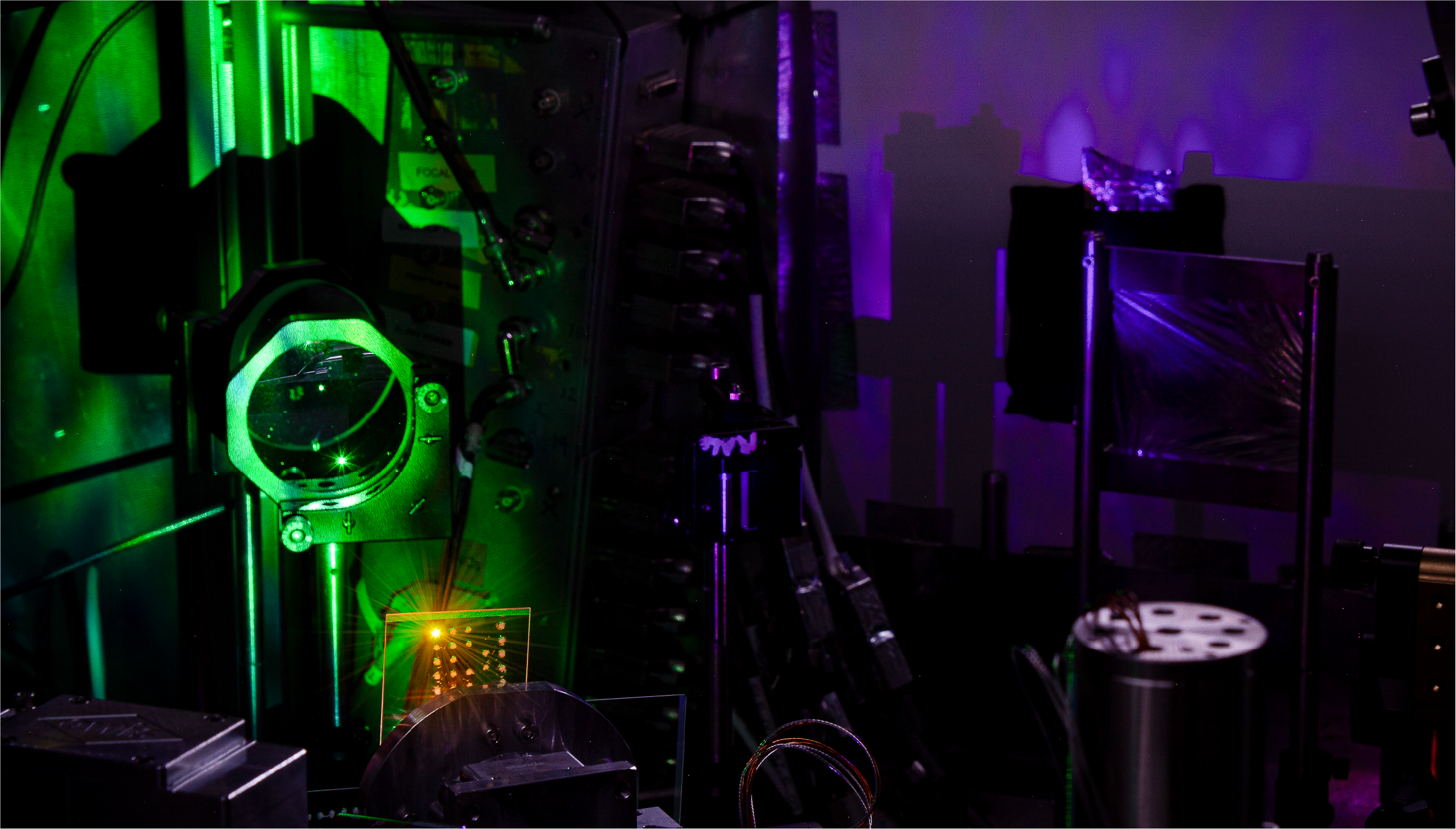
The vacuum chamber during the interaction. A relativistically intense laser pulse is focused on the glass target. The interaction generates a green glowing plasma and a purple harmonic beam that contains extreme coherent light fields.
Our results were reproducible and agreed with simulations of the interaction, which in turn predict that an intense coherent harmonic focus was possible in our experiment.
We had shown that this mechanism works.
There are still many challenges that must be faced before this source can be truly harnessed and ultimately, this source may require the development of specialised laser systems. However, if this work can be realised, then the pathway is open for the next generation of extreme field studies.

Follow the Topic
-
Nature
A weekly international journal publishing the finest peer-reviewed research in all fields of science and technology on the basis of its originality, importance, interdisciplinary interest, timeliness, accessibility, elegance and surprising conclusions.

Your space to connect: The Polarised light Hub
A new Communities’ space to connect, collaborate, and explore research on Light-Matter Interaction, Optics and Photonics, Quantum Imaging and Sensing, Microscopy, and Spectroscopy!
Continue reading announcement
Please sign in or register for FREE
If you are a registered user on Research Communities by Springer Nature, please sign in