VI Latin American Conference on Bioimpedance
Published in Bioengineering & Biotechnology, Chemistry, and Materials
CLABIO 2027 — Latin American Conference on Bioimpedance
Montevideo, Uruguay · 27–30 September 2027 · clabio.tec.br
A mature science, an immature market
Electrical bioimpedance is one of the few biomedical sensing techniques that is genuinely non-invasive, inexpensive to manufacture and buildable from widely available electronics. It underpins body composition analysis, lung monitoring by electrical impedance tomography, tissue characterisation, wearable physiological monitoring and quality control in food and pharmaceutical production.
Latin America has a solid research base in the field, with active groups across Brazil, Argentina, Mexico, Colombia and Uruguay, and a consistent record of publication. That base has not translated into products, companies and revenue at the same rate. The obstacle is rarely scientific. It is the distance between a working laboratory prototype and a registered, manufacturable, financed device — a distance measured in intellectual property strategy, regulatory pathways, manufacturing partners and capital.
CLABIO 2027 is organised around closing that distance.
The conference
CLABIO is the Latin American conference of the International Society for Electrical Bio-Impedance (ISEBI), the society that has run the ICEBI series since 1969. The two series alternate, giving the international bioimpedance community a reference meeting every one to two years. Previous CLABIO editions were held in Joinville (2012), Montevideo (2015), Manizales (2018), San Luis Potosí (2021) and Joinville (2024); Joinville also hosted ICEBI in 2019.
The 2027 edition is hosted by La Universidad de la República (Udelar), in partnership with the Universidade do Estado de Santa Catarina (UDESC) and University of Oslo (UiO).
What is different this time
Alongside the usual scientific programme — invited lectures, oral sessions and posters on instrumentation, biosensors, modelling, clinical and industrial applications — this edition adds a dedicated translational track:
- Demo Day — functional demonstrations of bioimpedance devices, biosensors and healthtech prototypes, presented to a panel of angel investors, corporate venture representatives and innovation funding agencies, with structured technical feedback to every team.
- Startup pitch session — pre-seed and seed-stage medical device and healthtech companies, selected by open call and prepared through mentoring.
- Business matchmaking — pre-scheduled bilateral meetings between researchers, companies, technology parks and investors.
- Technology exhibition — instrumentation manufacturers, technology-based companies, innovation parks and technology transfer offices, open throughout the four days.
- Entrepreneurship track for graduate students — technology validation and TRL scales, deep-tech business modelling, and the economics of funding medical hardware.
- Intellectual property and technology transfer sessions, run by technology transfer offices, including a walk-in desk for preliminary patentability screening.
- Regulatory panel on the classification, testing requirements and registration pathway for bioimpedance devices, including software as a medical device and AI-enabled products.
Who should attend
Researchers and graduate students in biomedical, electrical and computer engineering, medical physics, biology, chemistry and medicine; instrumentation and healthtech companies; technology transfer offices; investors with a deep-tech or health thesis; and regulators and health system managers working on medical device adoption.
Participation
The conference language is English, with simultaneous translation in the public policy and regulatory sessions. Plenary sessions, the Demo Day and the regulatory panel will be streamed live and free of charge. Accepted full papers will appear in peer-reviewed open-access proceedings, with abstracts published in an ISBN-registered volume; authors of selected papers will be invited to submit extended versions to a specialist journal.
The call for papers, the startup selection call and the exhibitor call open in early 2027. Registration fees will be reduced for students from all regions of Brazil and Latin America, and travel support will be available for a limited number of students from Brazil's North, Northeast and Central-West regions.
CLABIO 2027 wesite: clabio.tec.br
CLABIO 2027 email: clabio.udesc2027@gmail.com
Chair: Prof. Dr. Franco Simini (simini@fing.edu.uy)
Co-Chair: Prof. Dr. Pedro Bertemes-Filho (pedro.bertemes@udesc.br)
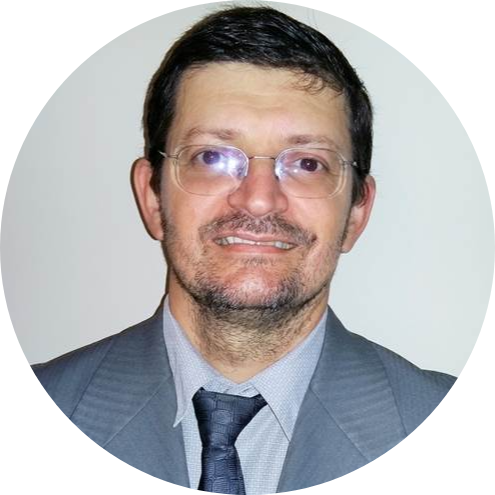
Over the last decade, he has been working with electrical impedance spectroscopy related to the characterization of tissue. He coordinates a project working with electrical cervical cancer diagnosis by using an impedance probe for taking the measurements of 500 women from 5 hospitals in the state of Santa Catarina (Brazil). He is a titular Professor at the State University of Santa Catarina (UDESC) lecturing electrical instrumentation for undergraduate, Master and PhD students students in the Department of Electrical Engineering. Leader of the research group on Biomedical Engineering at UDESC and member of the University Ethic Committee. He has done postdoctoral studies at the University of São Paulo in 2003, working with the development of an Electrical Impedance Tomograph. Recently, he was a visiting researcher fellow at the University of Sheffield, working with electrical bioimpedance for the early detection of premature birth. He has been peer review of over 10 international journals related to the field of Biomedical Engineering, as well as ad hoc consultant of 5 national research agencies in Brazil. Member of the Brazilian Society of Biomedical Engineering (SBEB), the International Society of Electrical Bioimpedance (ISEBI), the Canadian Medical and Biological Engineering Society (CMBES) and the Institute of Electrical and Electronics Engineers (IEEE). Also, he is a member of the editorial advisory board of the "Revista Ingeniería Solidaria" (ISSN 1900-3102) and section editor of the International Journal of Electrical Bioimpedance (IJEB). From 2016 he is secretary of the International Society of Electrical Bioimpedance (ISEBI) and member of the International Committee for Promotion of Research in Bio-Impedance (ICPRBI).