Vulnerability Is Not Static
Published in Earth & Environment and Sustainability


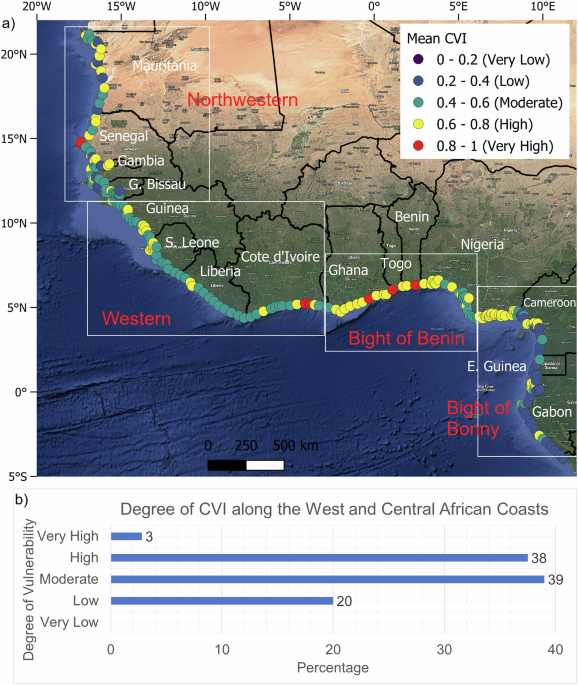

Along the coast, vulnerability is not a permanent state. It changes with the seasons, ocean conditions, shifting human pressures, and increasingly climate change. A community that appears relatively safe at one time of year can become highly exposed only a few months later. Yet most coastal vulnerability assessments produce static snapshots that rarely capture these dynamics. That disconnect became the starting point for our study, Climate-induced sea level rise amplifies coastal vulnerability across West and Central Africa.
The idea grew from years of working on African coastlines, where the impacts of coastal change are impossible to ignore. During fieldwork and research collaborations across the region, spanning Senegal, Côte d’Ivoire, Ghana, Togo, Benin, Nigeria, and Cameroon, I repeatedly encountered communities facing erosion, flooding, damaged infrastructure, and shrinking shorelines. Residents often described the sea as becoming more unpredictable. Roads were washed away more frequently. Properties that were once considered safe suddenly became exposed.
What struck me was that these observations were often seasonal and episodic. People knew which months brought the highest risk, but our scientific tools were not always capturing that reality.
We wanted to change that.
Our study covers the coastline from Mauritania to Gabon and introduces a temporally resolved Coastal Vulnerability Index that allows vulnerability to be examined across seasonal, interannual, and long-term timescales between 1993 and 2020. Instead of treating vulnerability as fixed, we combined changing physical factors such as sea level anomalies, wave energy, tides, shoreline change, and coastal slope with socioeconomic indicators including population density and settlement patterns. The analysis covered 257 locations distributed along the coast.
What emerged was a much more dynamic picture of coastal risk.
One of our clearest findings was that vulnerability increases substantially during the rainy season. Across much of West and Central Africa, vulnerability peaks between June and November, with September and October standing out as particularly critical months. More than 40% of the coastline experiences high to very high vulnerability during this period.
Although this may seem intuitive, it has important implications. Coastal adaptation is often planned around average conditions, but communities experience impacts during specific periods of heightened vulnerability. Knowing when risk is amplified could help improve preparedness, early-warning systems, and emergency response.
The regional contrasts were equally revealing.
The Bight of Benin consistently emerged as the most vulnerable section of the coastline, while the Bight of Bonny exhibited generally lower vulnerability levels. The northwestern and western sectors occupied an intermediate position.
As we examined the long-term record, another pattern became impossible to overlook.
Over the 28-year study period, overall coastal vulnerability increased by 7.6%. Physical vulnerability increased by 4.6%, while social vulnerability rose by 10.5%.
Initially, I expected several factors to contribute roughly equally to this trend. Instead, one driver stood out above all others.
Sea level anomalies increased by more than 40% during the study period and accounted for nearly 70% of interannual variability in coastal vulnerability. In other words, sea level rise and related sea level fluctuations are increasingly shaping how vulnerable the region's coastlines become.
As scientists, we often talk about sea level rise in millimetres per year. Those numbers can feel abstract. But while analysing these results, I found myself thinking less about the statistics and more about what they represent.
Across West Africa, rapid urbanisation continues to draw people toward the coast. Major cities such as Lagos, Accra, Abidjan, Lomé, Cotonou, and Douala continue to expand. Economic opportunities, ports, tourism, and infrastructure are concentrated in coastal zones. As a result, rising sea levels are interacting with growing exposure. The problem is not simply that the ocean is rising. It is that more people, assets, and livelihoods are occupying spaces where climate-related hazards are intensifying.
One of the most rewarding parts of this work was seeing the index correspond with real-world impacts.
Rather than evaluating vulnerability in isolation, we validated our findings against documented reports of flooding, displacement, and infrastructure damage. The periods identified as highly vulnerable by the index closely aligned with periods when impacts were reported most frequently.
This was particularly evident in the Bight of Benin, where reported displacement reached nearly 600,000 people, far exceeding levels observed in other sectors.
For me, this was perhaps the most satisfying moment in the project. Scientific indices are often criticized for being detached from reality. Seeing the temporal patterns in our vulnerability assessment reflected in documented societal impacts provided confidence that the framework was capturing something meaningful about how risk unfolds along the coast.
Another unexpected outcome was the strong influence of large-scale climate variability. We found that the Atlantic Meridional Mode (AMM) and the North Atlantic Oscillation (NAO) exert significant control on coastal vulnerability across much of the region. These climate patterns, operating across entire ocean basins, help shape sea level variability and wave conditions that eventually influence local exposure to coastal hazards.
I find this aspect particularly fascinating because it illustrates how connected our coastlines are to global climate systems. A fishing community in the Gulf of Guinea may be experiencing impacts linked to atmospheric and oceanic processes occurring thousands of kilometres away.
The paper also reflects a broader journey in my own research. In recent years, I have worked on assessments of coastal vulnerability, future socioeconomic exposure, shoreline dynamics, and sea level variability in West Africa. This study felt like a natural convergence of those efforts. It brought together physical oceanography, coastal geomorphology, climate science, and human exposure into a single framework designed not simply to describe risk, but to understand how risk evolves through time.
Ultimately, the message of this paper is straightforward.
Coastal vulnerability in West and Central Africa is neither static nor solely determined by geography. It changes through time, responds to climate variability, and is increasingly amplified by rising sea levels. At the same time, growing coastal populations and expanding development are increasing the societal consequences of those hazards.
For coastal communities, the future will not be shaped by sea level rise alone. It will be shaped by the interaction between environmental change and human decisions. Understanding that interaction is essential if we are to move from reacting to disasters toward anticipating them.
That, ultimately, is what I hope this research contributes: not simply another map of vulnerability, but a better understanding of when risks emerge, why they arise, and how we might prepare for them before they become crises.
Follow the Topic
-
Communications Sustainability
An open-access journal publishing high-quality, editorially selected and peer-reviewed advances in all sustainability-related areas of science, including the natural and social sciences as well as engineering.

What are SDG Topics?
An introduction to Sustainable Development Goals (SDGs) Topics and their role in highlighting sustainable development research.
Continue reading announcement


