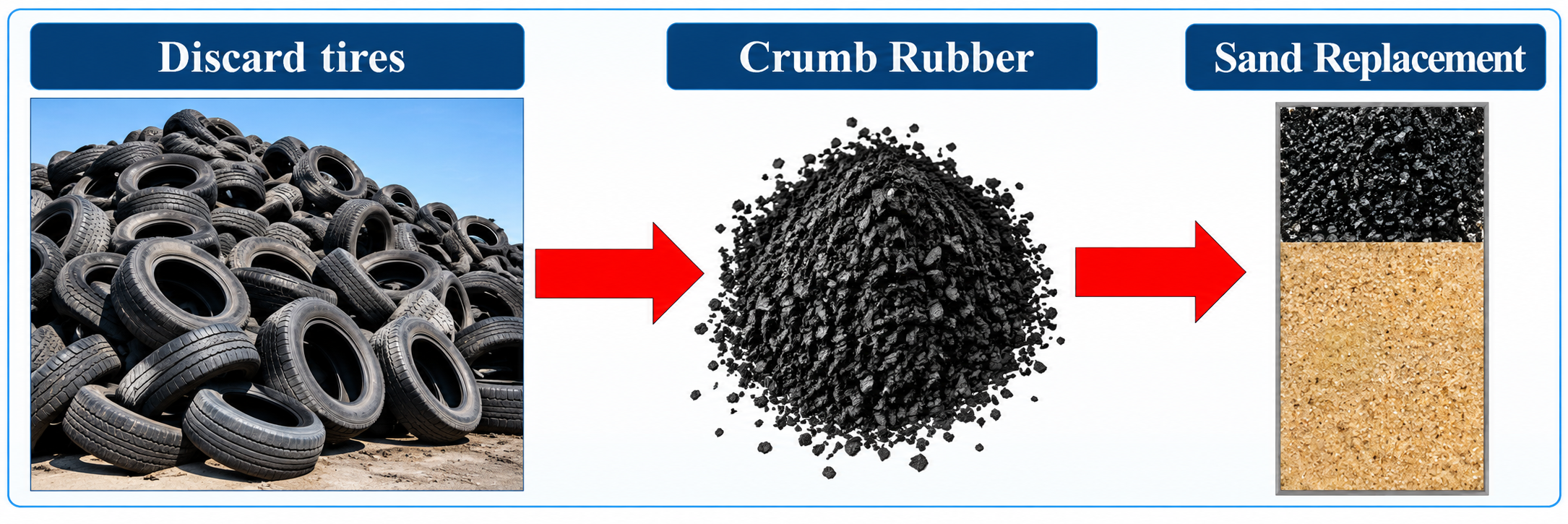
Yet, using rubber particles from discarded tires in concrete has become increasingly common, mainly because population growth and more vehicles in use have led to the annual production of large amounts of waste tires.
In many countries worldwide, disposing of waste tires has become a major environmental concern. Research and statistical information show that dumping used tires in uninhabited areas or even in the sea poses environmental risks. Other problems include burning waste tires as fuel in furnaces, which can cause fires and environmental pollution. Furthermore, waste tires offer suitable habitats for mosquitoes and other insects, and because they decompose slowly, they can stay in the environment for many years.
One possible solution is to recycle used tires and use them to produce construction materials. The tires can be handled by means of automated machinery in order to obtain rubber particles or rubber crumbs. These materials can then be used in a number of engineering applications, such as building retaining walls, asphalt mixtures, concrete fillers, or partial substitutes for natural aggregates.
Studies investigating the properties of rubberized concrete have generally focused on three major issues. First, researchers have examined whether rubber particles can replace conventional coarse aggregate (gravel) or fine aggregate (sand). Second, they have investigated the appropriate replacement percentage and how the replacement method affects the resulting concrete's properties. Third, researchers have extensively investigated how rubber particle size affects the mechanical and other performance characteristics of concrete.
Early experiments demonstrated that larger rubber particles could have a positive effect on a material's ability to resist impacts and dynamic loading. But it was found that the use of relatively large rubber particles, especially those with sizes similar to that of coarse aggregate and generally greater than about 4.75 mm, led to a marked decrease in the compressive and tensile strengths of concrete.
As a result, later research focused on replacing some fine aggregate (sand) with smaller rubber particles as a way to reduce strength loss. Generally, studies on rubberized concrete have shown that this type of concrete offers good resistance to impact and dynamic loading, as well as improved energy-absorption capacity.
Because of these characteristics, rubberized concrete may be suitable for applications where energy absorption and impact resistance are important, such as concrete pavements, barriers, and highway median barriers, since its ability to absorb impact energy can enhance safety in the event of a vehicle collision. It could also be considered for certain structures and protective components that require impact resistance.
Research and development in this area is ongoing, with a special focus on improving the mechanical properties of rubberized concrete by adding other materials. To boost the overall performance of rubberized concrete, researchers have explored a variety of fibers, supplementary cementitious materials, and other modifiers.
In general, earlier studies indicate that the quantity of rubber used in concrete must be carefully controlled; in most instances, rubber content should not exceed about 30% by volume of the aggregate. On the other hand, fine rubber particles of the right size—typically smaller than 1 mm—can help reduce the negative impact on mechanical strength.
There is an increasing need in Iraq for scientific activity to be strengthened in order to obtain reliable data on the geographical distribution and amounts of waste tires that are available for recycling, and steps should also be taken to set up and support special facilities which are capable of collecting, processing, and converting waste tires into rubber crumbs for use in engineering applications.
Therefore, more research into rubberized concrete should be carried out if it is to be used more widely in construction, to make use of its potential thermal and acoustic insulation properties, as well as its impact resistance and energy absorption.