What comparative genomics taught us about the vaginal commensal Lactobacillus crispatus
Published in Microbiology
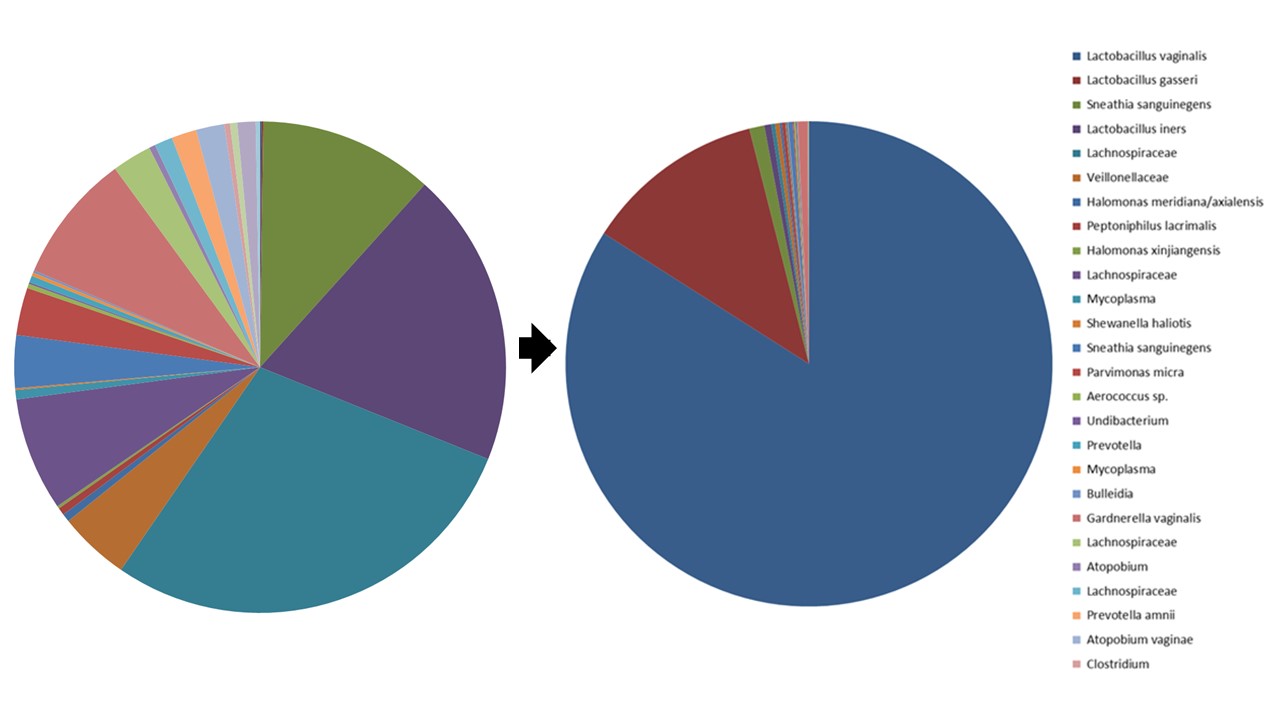


Well, by the use of cultivation techniques, my research team was able to demonstrate the transition from a dysbiotic vaginal microbiota (DVM) obtained from a vaginal swab to a ‘healthy’ bacterial community dominated by lactobacilli (LVM). A dysbiotic vaginal microbiota, also known as bacterial vaginosis (BV), is a highly diverse bacterial population depleted from Lactobacillus. Bacterial vaginosis is associated with an increased risk for sexually transmitted diseases including HIV, decreased fertility rates, and adverse pregnancy outcomes. All we need to do next is to disperse the obtained population of vaginal bacteria – note this well - the woman’s own bacteria into a vaginal gel and use this for a personalised BV-treatment.
Too good to be true? The first cracks appeared when I was drinking a cocktail on the roof garden after my talk at the conference reception and an expert in the field approached me. ‘Very nice story’, he said, ‘but your idea will never work’. I swirled the content of my glass as if the sound generated by the ice blocks in my cocktail would act as some kind of spell to blow away his last words. He continued ‘The lactobacilli you are cultivating from the host have lost the ability to dominate the microbial population. The problem is in their genes. Their population will never sustain in vivo’. I took another sip of my Martini on the rocks and assured the expert that I was definitely going to look into this. And so we did. In the laboratory, we selected Lactobacillus crispatus strains from a dysbiotic vaginal microbiota (DVM) and Lactobacillus dominated microbiota (LVM) and systematically checked for differences in the two groups of strains by comparative genomics.
What appeared to be the case? To our big surprise this was not about LVM-strains losing a genetic property, it was about the DVM-strains gaining one. We found a novel glycosyltransferase gene that was more prevalent among strains isolated from DVM. All speculation at this point, nonetheless this could indicate that, as the vaginal niche in a dysbiotic state is under immune pressure, this gene mediates variation in cell surface glycoconjugates. In other words, this gene encodes for the ability of Lactobacillus crispatus to change its coat making the bacterium invisible to the immune system. A selective advantage for survival under these conditions. Thus, if this appears to be true, the expert is half right. Simple enrichment by cultivation in the lab will not work. We will need to deliberately select for L. crispatus strains containing the glycosyltransferase gene allowing the transition from an inflammatory state of bacterial vaginosis to a Lactobacillus-dominated state. This new insight resulted from a clever comment by an expert at a conference five years ago and the fantastic effort of the researchers who took part in this investigation. Our research appeared in the open access journal Microbiome earlier this week.
Reference
Kort R. Personalized therapy with probiotics from the host by TripleA. Trends Biotechnol. 2014 Jun;32(6):291-3. doi: 10.1016/j.tibtech.2014.04.002.

Follow the Topic
-
Microbiome
This journal hopes to integrate researchers with common scientific objectives across a broad cross-section of sub-disciplines within microbial ecology. It covers studies of microbiomes colonizing humans, animals, plants or the environment, both built and natural or manipulated, as in agriculture.

Related Collections
With Collections, you can get published faster and increase your visibility.
Oncobiome
This collection of papers delves into the burgeoning field of oncobiome research, exploring the intricate relationship between cancer and the microbiome. The oncobiome encompasses the diverse microbial communities residing in and on the human body, which influence cancer development, progression, and treatment responses. By examining these interactions, our aim is to unravel the complex mechanisms through which the microbiome impacts oncogenesis and therapeutic outcomes.
This compilation highlights cutting-edge research, offering insights into potential diagnostic markers and novel therapeutic strategies, thereby advancing our understanding of cancer biology and paving the way for innovative, microbiome-targeted cancer treatments.
This is a cross-journal collection between:
Experimental Hematology and Oncology
Articles will undergo the standard peer-review process of the journal to which they are submitted and are subject to either the BMC editorial policies or those of BJC Reports. Articles will be added to the Collection as they are published. The Editors have no competing interests with the submissions which they handle through the peer review process. The peer review of any submissions for which the Editors have competing interests is handled by another Editorial Board Member who has no competing interests.
Publishing Model: Open Access
Deadline: Ongoing
The Apple Microbiome
Microbiome and Environmental Microbiome are calling for submissions to our Collection on the Apple Microbiome.
With world apple production estimated at 84 million tons, the microbiome of the apple has significant implications for agriculture, food security, and human health. Understanding the complex interactions between apple plants and their associated microbial communities can lead to improved crop management strategies, enhanced fruit quality and longevity, and sustainable agricultural practices. Recent advances have highlighted the role of specific bacteria and fungi in promoting plant health and resilience against specific pathogens. Moreover, detailed profiling of these microbial communities, revealing their diversity and functional potential facilitate exciting future developments, such as the identification of beneficial microbial consortia for biocontrol and the formulation of tailored probiotic treatments for both plants and humans. By advancing our collective understanding in this area, we can work towards a more sustainable and resilient agricultural system.
Topics of interest include but are not limited to:
-Microbial diversity and function associated with apples
-Effects of soil health and rhizosphere interactions on apple production
-Impact of climate change on the apple microbiome
-Role of the apple microbiome in fruit quality
-Microbiome-driven strategies for disease resistance
This collection is open for submissions from all authors on the condition that the manuscript falls within both the scope of the collection and the journal it is submitted to.
All submissions in this collection undergo the relevant journal’s standard peer review process. Similarly, all manuscripts authored by a Guest Editor(s) will be handled by the Editor-in-Chief of the relevant journal. As an open access publication, participating journals levy an article processing fee (Microbiome, Environmental Microbiome). We recognize that many key stakeholders may not have access to such resources and are committed to supporting participation in this issue wherever resources are a barrier. For more information about what support may be available, please visit OA funding and support, or email OAfundingpolicy@springernature.com or the Editor-in-Chief of the journal where the article is being submitted.
Publishing Model: Open Access
Deadline: Sep 30, 2026