What If Smart Devices Could Watch Each Other’s Backs?
Published in Electrical & Electronic Engineering and Mathematical & Computational Engineering Applications



A message takes a wrong turn
Imagine a hospital at three in the morning. A monitoring device sends an update. Somewhere between the bedside and the receiving system, the message takes an unexpected turn.
Nothing explodes. No screen announces an attack. Yet a question suddenly matters: can the next device in the chain still be trusted?
This is an imagined scene, not an incident reported in the study. It is a way into the problem examined by Yashwant Aditya and Priyank Jain in Scientific Reports: defending connected devices against attacks that exploit their communication pathways.
The intriguing part of this research is not simply another algorithm. It is the decision to treat a network less like a collection of isolated machines—and more like a community.
Beyond locking the front door
Consider a city with excellent locks but unreliable road signs. A delivery can leave a secure building and still be diverted before reaching its destination.
That distinction helps explain the paper’s focus on Fork Attacks: attacks described in the study as splitting communication pathways to undermine network integrity and confidentiality. Protecting a message and protecting its journey are related tasks, but they are not the same task.
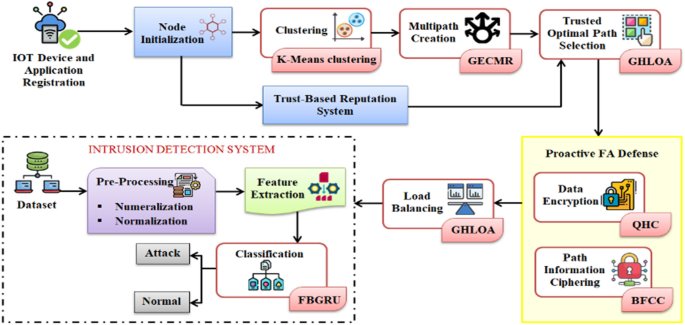
The research brings encryption, trust-aware routing and intrusion detection into one framework rather than treating them as separate defenses. Its central design question can be expressed simply:
What if devices could make better decisions about whom to trust, which route to use and when to raise an alarm?
A neighbourhood, not a fortress
Think about choosing someone to carry an important parcel. Distance matters, but so does reliability. The closest person is not automatically the best choice.
The framework applies a computational version of that intuition: devices are grouped into clusters, and routing decisions incorporate reputation-related information, including uptime, energy levels and communication reliability. Here, “social” does not mean social media or machines with human feelings; it describes the architecture’s use of relationships and collective trust evaluation.
The neighbourhood analogy also reveals a difficult question. A reputation score is useful only if it measures something meaningful. Does a device look unreliable because it is malicious, because its battery is failing, or because its connection is poor?
That is an invitation to researchers beyond cybersecurity. Reliability engineering, distributed systems and the study of cooperation offer different ways to interrogate the same design choice.
Protecting both letter and envelope
Another useful analogy is a letter. Its contents matter, but so does the address on the envelope. Hiding one does not automatically hide the other.
The paper separates these concerns through Quantum Hannorentz Cryptography, or QHC, for data protection, and Bigram Frequency-Based Caesar Cipher, or BFCC, for concealing path information. It also adds an intrusion detector built around a modified gated recurrent neural network, named FBGRU, to identify suspicious traffic.
The interesting research story lies in those connections: routing chooses where information travels, cryptography protects information, and detection looks for signs that something is wrong. The framework attempts to make those functions work together.
For cryptographers, this raises questions about security assumptions. For machine-learning researchers, it raises questions about what a detector actually learns. For network engineers, it raises the practical question: what does protection cost in time and computation?
Reading the numbers carefully
The study reports detection accuracy of 99.61% on the Cybersecurity Attack Dataset and 99.32% on UNSW-NB15, using an 80:20 training–testing split. These are results from the reported evaluation—not a guarantee of identical performance in a hospital, factory or city network.
That distinction is where the next chapter becomes interesting. How would the system respond to unfamiliar attacks, changing traffic or devices with much less computing power? How would false alarms affect the people responsible for keeping services running?
Similarly, a proposed cipher or a high experimental security score should invite scrutiny, not end it. Independent cryptanalysis and deployment-specific testing remain important questions before practical adoption.
The conversation beyond cybersecurity
The paper identifies blockchain-backed, tamper-resistant logging of defense actions as a future direction. Such a record could support another useful question: not only whether a network responded, but whether its decisions can later be examined and explained.
That question connects security with accountability—and gives researchers from several communities a reason to join the conversation.
The most compelling possibility is not a network that trusts everything. It is a network designed to question trust before forwarding the next message.
If a smart network could watch its neighbours, what evidence should persuade it to trust them?
Related publication: An enhanced proactive social defense mechanism for Fork attack in IoT network using QHC and BFCC, by Yashwant Aditya and Priyank Jain, Scientific Reports.
Follow the Topic
-
Scientific Reports
An open access journal publishing original research from across all areas of the natural sciences, psychology, medicine and engineering.

Related Collections
With Collections, you can get published faster and increase your visibility.
Cancer Prevention and Control
Publishing Model: Hybrid
Deadline: Feb 19, 2027
Healthy Aging
Publishing Model: Open Access
Deadline: Dec 31, 2026