What if we have misunderstood competition?
Published in Economics


This article did not begin by trying to demonstrate that “competition is bad.” The question emerged from a more basic contradiction I had encountered for years in my work on economic ecosystems.
We constantly hear about innovation, entrepreneurial, or business ecosystems. Yet much of the literature continues to use the word ecosystem as an analogy: firms, institutions, and entrepreneurs behaving like organisms within a biological ecosystem.
But when their structures are studied empirically, that explanation becomes insufficient. Economic ecosystems are composed of heterogeneous agents that depend on one another, exchange resources, adapt, generate emergent properties, and respond to feedback processes. Their behavior is nonlinear. They display the characteristics we expect to find in a complex adaptive system.
If “ecosystem” were only a metaphor, we could abandon it without much consequence. If it describes a real complex system, things change. It is no longer so simple.
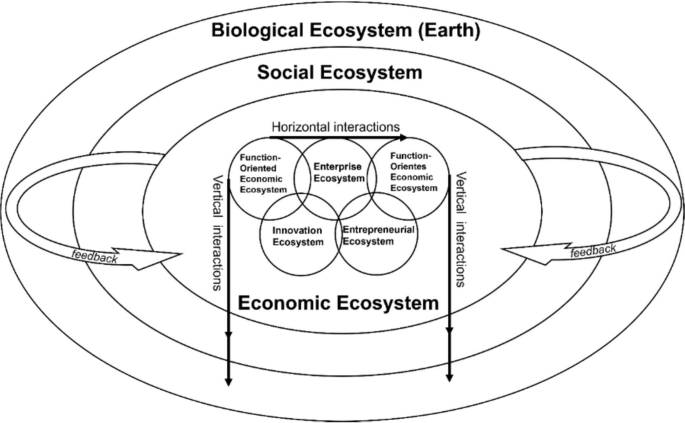
The economy, moreover, does not exist in a vacuum. Economic activity takes place within society and materially depends on biological systems. Food, energy, minerals, and virtually every resource used in production ultimately has a biophysical origin. At the same time, economic decisions modify the social structures and environment on which they depend.
Panarchy theory allowed us to represent this relationship as nested systems: economic ecosystems within social systems, and those, in turn, within the biosphere, with feedback operating across scales, as Holling proposed more than two decades ago and Levin and colleagues later developed. The market does not end where society begins, and society does not end where the biosphere begins.
Here, an epistemological problem emerged that we needed to resolve before going any further.
Philosophy of science has long criticized attempts to transfer principles across disciplines as if they were universal laws. Mirowski, for example, showed the problems arising from the historical aspiration of certain economic approaches to construct a kind of social physics. Cartwright, from a different perspective, questioned the assumption that models built under particular conditions can simply be applied to different contexts.
Our argument does not do that.
We are not taking a law from biology and applying it to a social science, much less one from physics. The issue is ontological. As Bunge argued through systemism, the economic, political, cultural, and biological components of a society can be analytically distinguished, but do not operate as independent realities. Boulding expressed something similar decades earlier when he described the economy as part of the total social system. From a panarchical perspective, the economic system is materially embedded within broader social and biophysical systems.
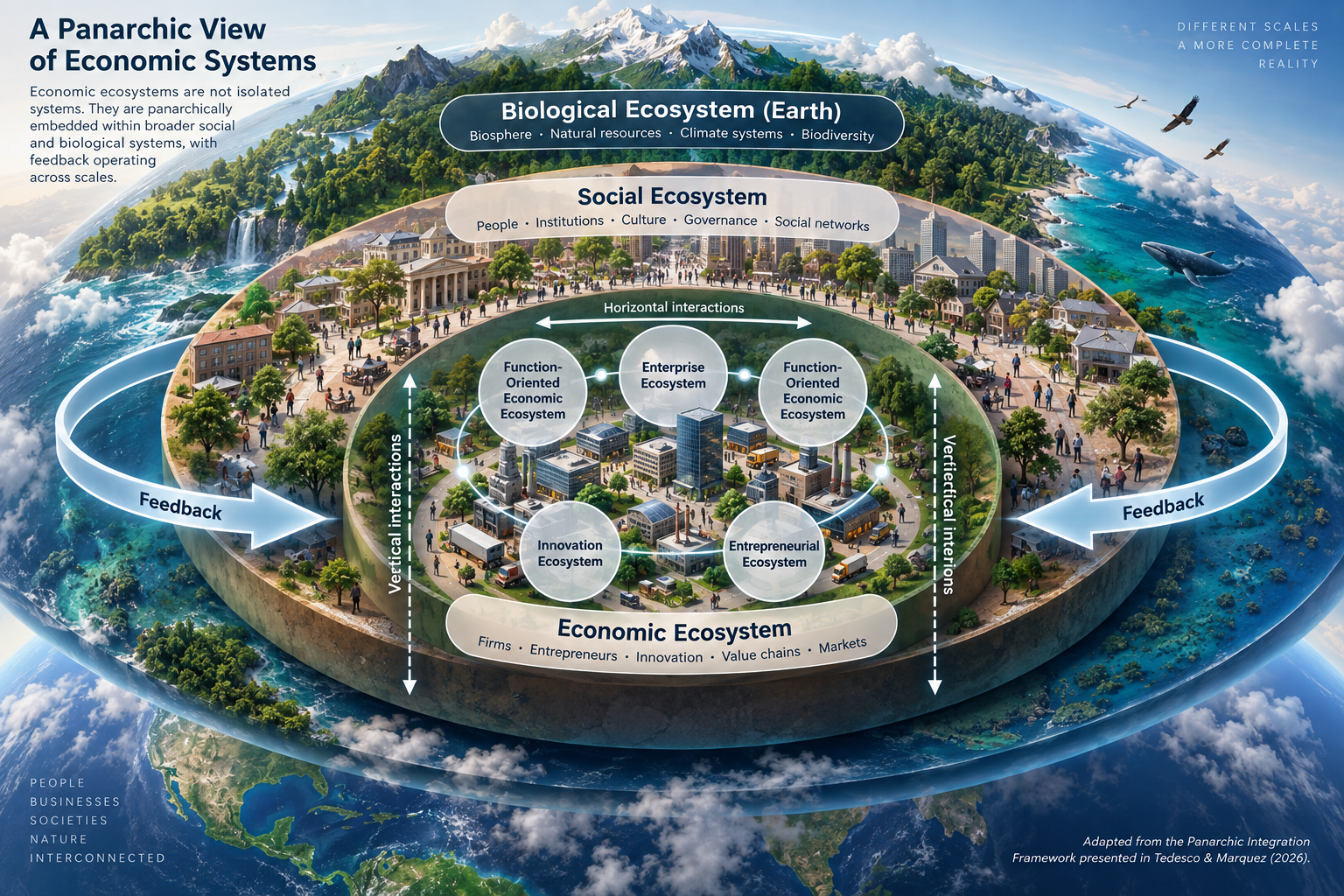
So this is not a problem of different domains, but of where we draw the boundaries of a system. If those boundaries do not exist as independent realities, we should not make different ontological assumptions about the interactions within them. A methodological boundary should not lead us to classify the same interaction differently.
It is precisely this continuity that makes the following question possible.
In ecology, interactions are commonly classified by their direct effects on those involved. Mutualism and cooperation are +/+; predation and parasitism are +/−; competition is −/− because the interaction itself imposes erosive costs on participants competing for resources.
So, if economic ecosystems are also complex adaptive systems and are not ontologically separate from the systems in which they are embedded, why should the same interaction change sign and classification when the competing agents are firms or people?
To answer this question, we reviewed 198 works from economics, management, biology, ecology, complexity science, and philosophy of science. What began as a question about competition forced us to reconsider what we mean by an economic ecosystem and where we place its boundaries.
The peer-review process also led us to sharpen a distinction that became fundamental: classifying competition as a −/− interaction does not mean claiming that competition cannot generate gains for those who compete. Nor does it deny that innovation or increased income for particular agents may emerge in competitive contexts.
These are two different levels of analysis.
One thing is the perceived gain of those who compete. Another is the emergent outcome of the system as a whole. Moderate competition can coexist with a resilient ecosystem, as can predation or parasitism. That does not mean competition stops imposing erosive costs on those involved.
So the problem is no longer competition or no competition. The question becomes how much.
If competitive relationships increase in number, intensity, or exclusionary capacity, is there a point beyond which they reduce diversity, resilience, or adaptive capacity? Ecological evidence shows that interaction configurations matter for systemic stability.
The article proposes a conceptual index to make this hypothesis explicit and allow it to be measured, simulated and, if necessary, refuted. We do not claim to have identified such a threshold. Nor do we know whether a universal one exists, something I consider unlikely, or whether it depends on each ecosystem’s topology and initial conditions. That is part of another study underway.
That is now the most interesting part of the problem.
For a long time, mainstream economic debate has asked how to increase competition. We have created institutions to encourage it, while also creating others to regulate its effects: antitrust laws, laws promoting social equality, and laws limiting environmental damage. Perhaps we need to ask an earlier question: how much competitive pressure can an economic system absorb before it begins to lose what allows it to continue adapting?
Finally, two tangential questions emerged. First, we need to revisit what our framework interprets as the mutualistic (+/+) logic underlying good old Adam Smith’s model of voluntary exchange, and how easily that interaction moves toward competition, predation, and parasitism. Deeply asymmetric relationships between agents, regardless of perceived gains, do not fit comfortably within beneficial interactions.
The second concerns “market failures” and “externalities.” If, ontologically, we are speaking of a single panarchically integrated system, external to what analytical boundary? What appears external to a market transaction may not be external to the broader system in which it is embedded. Perhaps what we are actually observing are emergent phenomena produced by unstable systemic configurations that continuously feed back into one another.