What if we have misunderstood competition?
Published in Economics




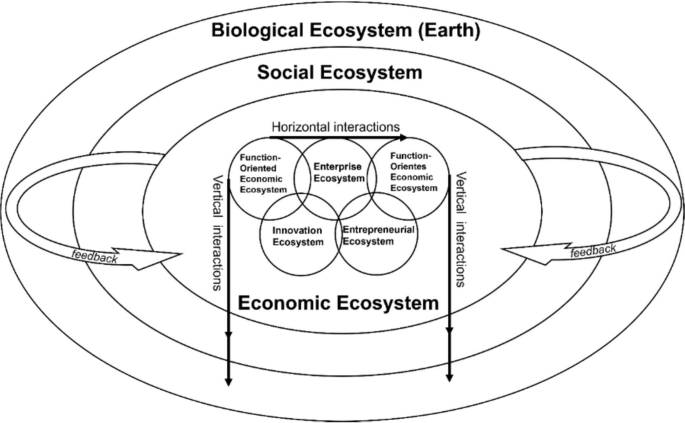

This article did not begin by trying to demonstrate that “competition is bad.” The question emerged from a more basic contradiction I had encountered for years in my work on economic ecosystems.
We constantly hear about innovation, entrepreneurial, or business ecosystems. Yet much of the literature continues to use the word ecosystem as an analogy: firms, institutions, and entrepreneurs behaving like organisms within a biological ecosystem.
But when their structures are studied empirically, that explanation becomes insufficient. Economic ecosystems are composed of heterogeneous agents that depend on one another, exchange resources, adapt, generate emergent properties, and respond to feedback processes. Their behavior is nonlinear. They display the characteristics we expect to find in a complex adaptive system.
If “ecosystem” were only a metaphor, we could abandon it without much consequence. If it describes a real complex system, things change. It is no longer so simple.
The economy, moreover, does not exist in a vacuum. Economic activity takes place within society and materially depends on biological systems. Food, energy, minerals, and virtually every resource used in production ultimately has a biophysical origin. At the same time, economic decisions modify the social structures and environment on which they depend.
Panarchy theory allowed us to represent this relationship as nested systems: economic ecosystems within social systems, and those, in turn, within the biosphere, with feedback operating across scales, as Holling proposed more than two decades ago and Levin and colleagues later developed. The market does not end where society begins, and society does not end where the biosphere begins.
Here, an epistemological problem emerged that we needed to resolve before going any further.
Philosophy of science has long criticized attempts to transfer principles across disciplines as if they were universal laws. Mirowski, for example, showed the problems arising from the historical aspiration of certain economic approaches to construct a kind of social physics. Cartwright, from a different perspective, questioned the assumption that models built under particular conditions can simply be applied to different contexts.
Our argument does not do that.
We are not taking a law from biology and applying it to a social science, much less one from physics. The issue is ontological. As Bunge argued through systemism, the economic, political, cultural, and biological components of a society can be analytically distinguished, but do not operate as independent realities. Boulding expressed something similar decades earlier when he described the economy as part of the total social system. From a panarchical perspective, the economic system is materially embedded within broader social and biophysical systems.
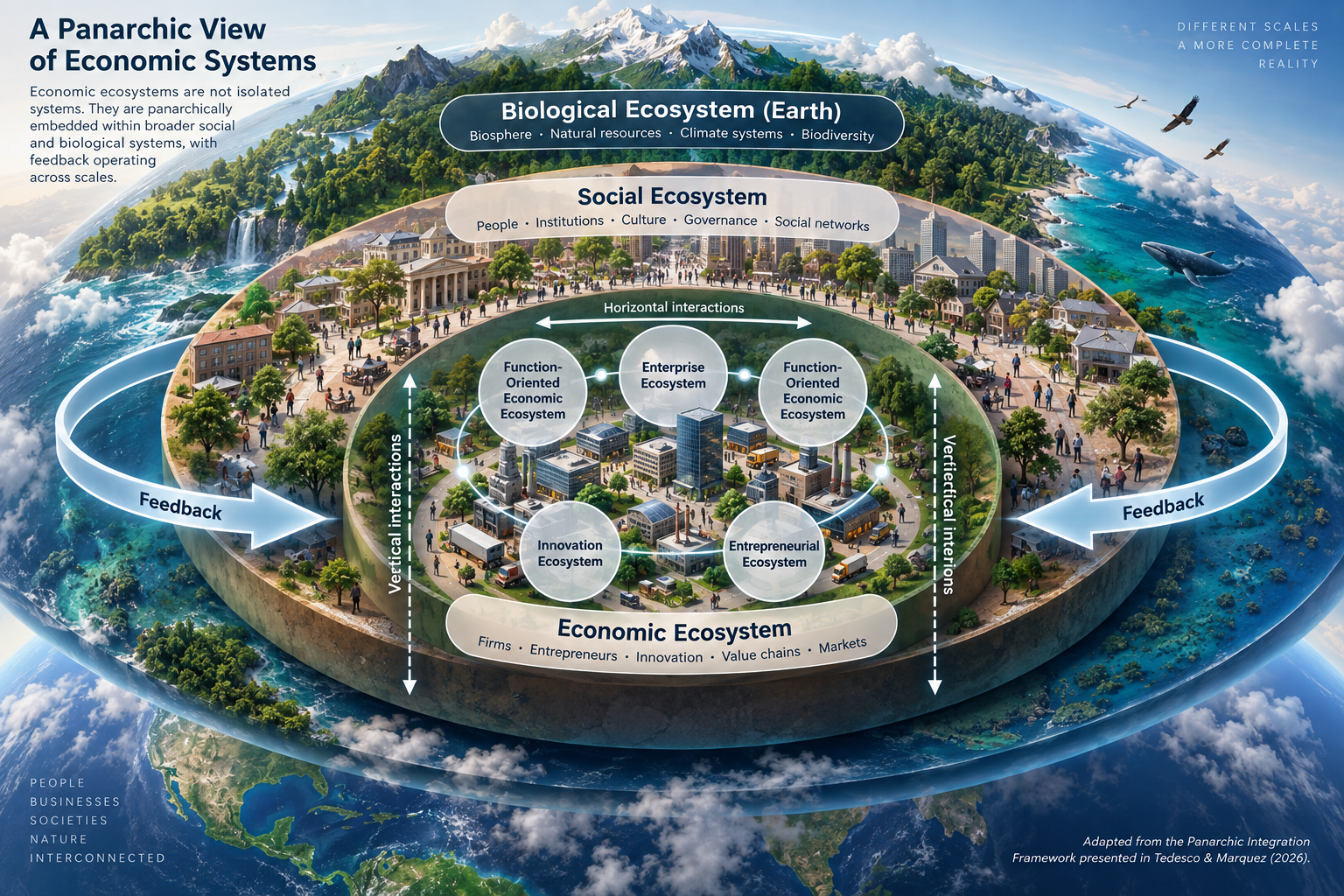
So this is not a problem of different domains, but of where we draw the boundaries of a system. If those boundaries do not exist as independent realities, we should not make different ontological assumptions about the interactions within them. A methodological boundary should not lead us to classify the same interaction differently.
It is precisely this continuity that makes the following question possible.
In ecology, interactions are commonly classified by their direct effects on those involved. Mutualism and cooperation are +/+; predation and parasitism are +/−; competition is −/− because the interaction itself imposes erosive costs on participants competing for resources.
So, if economic ecosystems are also complex adaptive systems and are not ontologically separate from the systems in which they are embedded, why should the same interaction change sign and classification when the competing agents are firms or people?
To answer this question, we reviewed 198 works from economics, management, biology, ecology, complexity science, and philosophy of science. What began as a question about competition forced us to reconsider what we mean by an economic ecosystem and where we place its boundaries.
The peer-review process also led us to sharpen a distinction that became fundamental: classifying competition as a −/− interaction does not mean claiming that competition cannot generate gains for those who compete. Nor does it deny that innovation or increased income for particular agents may emerge in competitive contexts.
These are two different levels of analysis.
One thing is the perceived gain of those who compete. Another is the emergent outcome of the system as a whole. Moderate competition can coexist with a resilient ecosystem, as can predation or parasitism. That does not mean competition stops imposing erosive costs on those involved.
So the problem is no longer competition or no competition. The question becomes how much.
If competitive relationships increase in number, intensity, or exclusionary capacity, is there a point beyond which they reduce diversity, resilience, or adaptive capacity? Ecological evidence shows that interaction configurations matter for systemic stability.
The article proposes a conceptual index to make this hypothesis explicit and allow it to be measured, simulated and, if necessary, refuted. We do not claim to have identified such a threshold. Nor do we know whether a universal one exists, something I consider unlikely, or whether it depends on each ecosystem’s topology and initial conditions. That is part of another study underway.
That is now the most interesting part of the problem.
For a long time, mainstream economic debate has asked how to increase competition. We have created institutions to encourage it, while also creating others to regulate its effects: antitrust laws, laws promoting social equality, and laws limiting environmental damage. Perhaps we need to ask an earlier question: how much competitive pressure can an economic system absorb before it begins to lose what allows it to continue adapting?
Finally, two tangential questions emerged. First, we need to revisit what our framework interprets as the mutualistic (+/+) logic underlying good old Adam Smith’s model of voluntary exchange, and how easily that interaction moves toward competition, predation, and parasitism. Deeply asymmetric relationships between agents, regardless of perceived gains, do not fit comfortably within beneficial interactions.
The second concerns “market failures” and “externalities.” If, ontologically, we are speaking of a single panarchically integrated system, external to what analytical boundary? What appears external to a market transaction may not be external to the broader system in which it is embedded. Perhaps what we are actually observing are emergent phenomena produced by unstable systemic configurations that continuously feed back into one another.

Follow the Topic
-
Journal of Evolutionary Economics
This journal promotes the application of evolutionary theory and methods to economics, with special attention to disequilibrium processes and the role of innovation and new technologies in economic dynamics.

Related Collections
With Collections, you can get published faster and increase your visibility.
Capitalism and Democracy: Paradigm Shifts and Creative Transformations
This collection is only for submissions presented (as poster or as papers) at the 2026 conference of the International Joseph A. Schumpeter Society in Strasbourg.
Publishing Model: Hybrid
Deadline: Oct 31, 2026
Evolutionary Innovation Dynamics between - Routines, Competition, Collaboration and Institutions
Basic Idea
Routines, interactions, and institutions are intrinsically interwoven, collectively shaping innovation dynamics and economic change. Rules, created and carried by heterogeneous actors - individuals and organizations - provide the structural framework within which the system evolves (Dopfer & Potts, 2008). Actors such as companies or universities use routines, i.e. rule-based patterns, guiding their behaviour in a systematic, repetitive and recognizable way (Nelson & Winter, 1982). Routines can be a stabilizing factor (Nelson & Winter, 1982) but also a source of conflicts between individuals or organizations in an ever changing environment (Pentland & Feldman, 2005). Routines, including consumption patterns, often already determine the direction of technological and scientific change before individuals and organizations move into cooperation or competition (Di Stefano et al., 2012). These modes of interaction are also fundamental to economic change, influencing the diversity of actors by either decreasing or increasing their heterogeneity (Cantner, 2016). As innovation ecosystems vary, they require distinct dynamic strategies that effectively balance cooperation and competition (Hannah & Eisenhardt, 2018). Institutions, in turn, provide formal (e.g. laws) and informal rules (e.g. codes of conduct) for innovative ecosystems (Lundvall, 2016) and simultaneously serve as frameworks that facilitate, and are shaped by, interactions among heterogeneous agents of change. Within this context, policy measures function as strategic routines that alter selection environments, generate variation, and reconfigure institutions to provide directionality (Nelson & Winter, 1982; Karo & Kattel, 2018).
Scope
We invite contributions studying evolutionary innovation dynamics conceptually/theoretically and/or empirically. This collection will put together a series of work contributing to the understanding of the following and related topics:
- Behaviour of individuals or organisations and the creative destruction of routines
- Institutions and their creative destruction driving evolutionary dynamics
- Evolutionary innovation dynamics of organisations, institutions, and/or systems
- Co-evolution between micro-behaviour and meso- or macro-processes
- Policy as driver of innovation dynamics in theory and practice
We encourage using different approaches including (simulation) models, surveys, multi-level studies, experiments, case studies and other designs.
Time Schedule and Review Process
- Call for Papers opening October 17, 2025
- Submissions to the Special Issue until September 30, 2026, the latest
- Continuous reviewing, decision and publication process, i.e. publication shortly after acceptance
Background
The special issue is an initiative of the Committee of Evolutionary Economics of the Verein für Socialpolitik. While those presenting papers at the two annual conferences of the committee in 2025 and 2026 are encouraged to submit, the call is open for everyone who wants to contribute to the collection on Evolutionary Innovation Dynamics between Routines, Competition, Collaboration and Institutions.
Submission Process
JEEC standard peer reviewing
Key references
Cantner, U. (2016). Foundations of economic change - an extended Schumpeterian approach. Journal of Evolutionary Economics, 26(4), 701-736. https://doi.org/10.1007/s00191-016-0479-z
Di Stefano, G., Gambardella, A., & Verona, G. (2012). Technology push and demand pull perspectives in innovation studies: Current findings and future research directions. Research Policy, 41(8), 1283-1295. https://doi.org/10.1016/j.respol.2012.03.021
Dopfer, K., & Potts, J. (2008). The General Theory of Economic Evolution. Routledge.
Hannah, D. P., & Eisenhardt, K. M. (2018). How firms navigate cooperation and competition in nascent ecosystems. Strategic Management Journal, 39(12), 3163-3192. https://doi.org/10.1002/smj.2750
Karo, E, Kattel, R. (2018). The Bit and the Rainforest: Towards an Evolutionary Theory of Policy Capacity. UCL Institute for Innovation and Public Purpose, IIPP Working Paper Series (IIPP WP 2018-03). http://www.ucl.ac.uk/bartlett/public-purpose/wp2018-03
Lundvall, B. A. (2016). Innovation as an interactive process: from user-producer interaction to the national system of innovation. In B. A. Lundvall (Ed.), The Learning economy and the economics of hope (pp. 369). Anthem Press. https://library.oapen.org/bitstream/handle/20.500.12657/31613/1/626406.pdf#pag e=78
Nelson, R. R., & Winter, S. G. (1982). An Evolutionary Theory of Economic Change. Belknap Press/Harvard University Press.
Pentland, B. T., & Feldman, M. S. (2005). Organizational routines as a unit of analysis. Industrial and Corporate Change, 14(5), 793-815. https://doi.org/10.1093/icc/dth070
Publishing Model: Hybrid
Deadline: Sep 30, 2026