When a vitamin A metabolite puts the brakes on virus-driven inflammation
Published in Biomedical Research


Severe viral infections are often viewed through the lens of viral replication: the more virus, the worse the disease. But clinicians and immunologists know that this is only part of the story. In many life-threatening infections, tissue damage and death are driven not solely by the pathogen, but by an uncontrolled host inflammatory response. Cytokines that are essential for antiviral defence can, when produced in excess, become destructive.
This problem is particularly evident in severe fever with thrombocytopenia syndrome, or SFTS, an emerging tick-borne disease caused by severe fever with thrombocytopenia syndrome virus (SFTSV). Patients with severe disease can develop high fever, thrombocytopenia, coagulation abnormalities, multi-organ injury and systemic inflammatory response syndrome. There is currently no specific antiviral therapy or licensed vaccine. For many patients, treatment remains largely supportive.
Our work, recently published in Nature Microbiology, began with a simple question: could the host’s metabolic state influence whether antiviral inflammation remains protective or becomes pathogenic?
A clue from patient metabolism
Vitamin A is best known for its roles in vision, development and immune homeostasis. Its active metabolite, all-trans retinoic acid (ATRA), has long been studied in mucosal immunity and immune regulation. However, whether retinoic acid metabolism changes during acute systemic viral infection — and whether such changes contribute to inflammatory pathology — was much less clear.
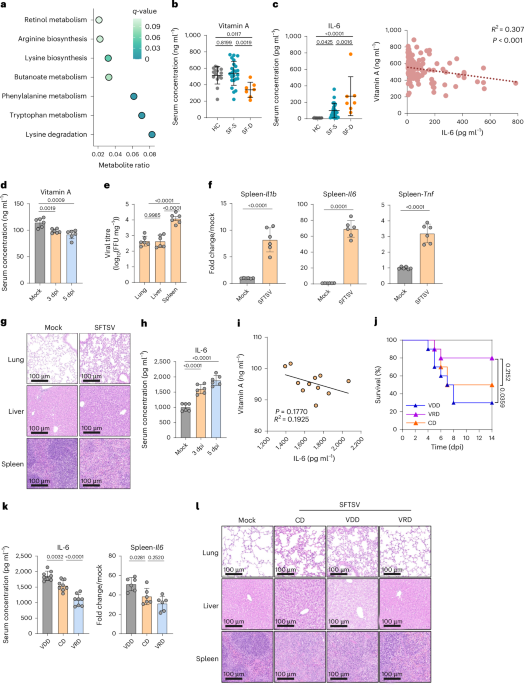
When we examined serum samples from patients with SFTSV infection, one signal stood out. Patients who died from the infection had markedly lower levels of vitamin A and ATRA than survivors and healthy controls. These reductions were associated with higher IL-6 levels and more severe systemic inflammation.
At this stage, the observation was intriguing but incomplete. Human samples can reveal correlations, but they cannot easily tell us causality. Did patients enter infection with lower vitamin A reserves? Did severe infection consume or disrupt vitamin A metabolism? Or were both processes involved? Without pre-infection samples, this is a difficult question to answer directly in humans.
This became one of the central challenges of the project.
From correlation to causality
To move beyond association, we turned to a mouse model of SFTSV infection. The model reproduced a key feature observed in patients: infection led to a sustained decrease in circulating vitamin A and ATRA. Mice maintained on a vitamin A-deficient diet developed more severe inflammatory injury after infection, whereas vitamin A or ATRA supplementation reduced inflammatory cytokine production, alleviated tissue damage and improved survival.
One result was particularly important for how we interpreted the study: ATRA did not significantly reduce viral load. Its protective effect was therefore unlikely to reflect direct antiviral activity. Instead, ATRA appeared to act on the host response itself.
This distinction shaped the rest of the project. We were not looking at ATRA as a conventional antiviral compound. We were asking how an endogenous metabolite could tune the inflammatory response during severe viral infection.
How SFTSV depletes retinoic acid
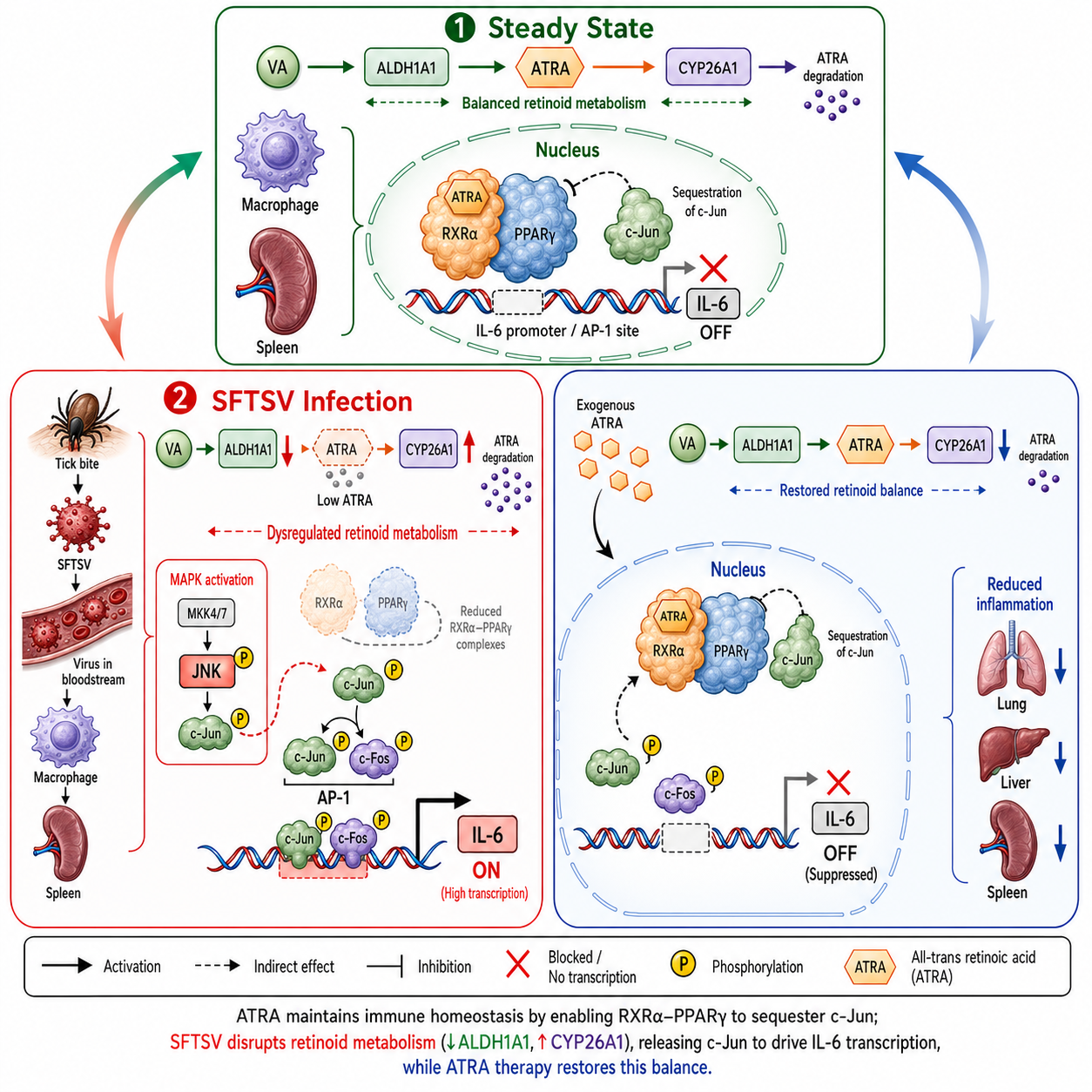
The next question was how SFTSV infection reduced ATRA levels. Retinoic acid abundance is controlled by a balance between synthesis and degradation. In macrophages and infected tissues, we found that SFTSV shifted this balance in two directions: it decreased expression of ALDH1A1, an enzyme involved in ATRA synthesis, and increased expression of CYP26A1, an enzyme that promotes ATRA degradation.
In other words, infection both limited ATRA production and accelerated its breakdown.
Pharmacological manipulation of this pathway supported the functional importance of this metabolic shift. Inhibiting ATRA synthesis enhanced inflammatory responses, whereas blocking ATRA degradation increased ATRA availability and reduced cytokine expression. These findings suggested that ATRA depletion was not merely a passive biomarker of severe disease, but part of a metabolic-immune circuit that influences inflammatory outcome.
A non-classical mechanism in macrophages
Macrophages are central drivers of inflammatory cytokine production during SFTSV infection. When we treated infected macrophages with ATRA, expression of inflammatory mediators such as IL-6 was strongly suppressed, again without reducing viral replication.
Transcriptomic and signalling analyses pointed us toward the MAPK/AP-1 pathway. AP-1 is a major inflammatory transcription factor complex, and c-Jun is one of its key components. In many settings, AP-1 activation drives expression of cytokines that contribute to inflammatory amplification.
What surprised us was how ATRA interfered with this pathway.
ATRA is classically known to act through retinoid receptors to regulate gene transcription. In our study, however, ATRA acted through a non-canonical mechanism. It bound RXRα and promoted formation of an RXRα-PPARγ complex in macrophages. This complex then interacted with c-Jun, reducing c-Jun binding to promoters of inflammatory genes such as IL6. The result was suppression of AP-1-driven inflammatory transcription.
Put simply, ATRA did not shut down macrophage immunity globally. Instead, it helped redirect a specific inflammatory transcriptional programme by limiting access of c-Jun to its target genes.
This specificity mattered to us. Broad immunosuppression during viral infection can be dangerous. A host-directed strategy is more attractive if it dampens damaging inflammation while preserving essential antiviral defence.
The experiments that took the longest
The most difficult part of the study was not identifying the pathway, but proving that it mattered in vivo.
Several questions came up repeatedly during the work and the review process. Was the effect of ATRA reproducible across systems? Was PPARγ truly required? Was the RXRα-PPARγ-c-Jun interaction functionally relevant, or only an in vitro observation? Could the improved survival simply reflect indirect effects on viral burden?
To address these concerns, we had to approach the mechanism from multiple directions. We used macrophage-specific PPARγ-deficient mice to test cell-type dependence. We used pharmacological antagonists to perturb the pathway. We used biochemical pull-down assays with biotinylated ATRA to examine receptor engagement. We used chromatin assays to ask whether c-Jun occupancy at inflammatory gene promoters was altered.
Not every experiment worked the first time, and not every result was immediately easy to interpret. Separating metabolism, inflammation, tissue injury and infection is inherently difficult because these processes reinforce one another. The study became stronger only after we learned to test the same idea at different levels: patient samples, infected animals, primary macrophages and molecular interaction assays.
The review process also pushed us to be more cautious. We could show that SFTSV infection depletes ATRA in mice and that restoring ATRA is protective in this model. We could show that low ATRA in patients is associated with severe disease. But we cannot yet say, in humans, whether pre-existing vitamin A deficiency predisposes individuals to fatal infection. That will require prospective clinical studies.
Why this matters beyond SFTSV
Our study identifies ATRA as an immunometabolic regulator of systemic inflammation during SFTSV infection. More broadly, it supports the idea that host metabolites are not simply by-products of infection or nutritional status. They can act as checkpoints that determine how strongly immune cells respond.
This has potential implications beyond SFTS. AP-1-driven inflammatory responses are activated in many severe viral diseases, including viral haemorrhagic fevers and severe respiratory infections. Whether the same ATRA–RXRα–PPARγ–c-Jun axis operates in those settings remains to be tested. But the principle is worth considering: restoring a depleted host metabolite may help restrain damaging inflammation without directly targeting the virus.
There are also translational questions. Could circulating vitamin A or ATRA levels help identify patients at risk of severe inflammatory disease? What is the optimal timing and dose for ATRA intervention? Would ATRA need to be combined with antiviral agents or other immunomodulatory therapies? And can this pathway be safely manipulated in patients with acute infection?
ATRA is already used clinically in other contexts, most notably acute promyelocytic leukaemia. This does not mean it can be immediately applied to SFTS. Acute viral infection is a very different setting, and safety, timing and patient selection will be critical. Nevertheless, the availability of ATRA as a well-characterized compound makes the pathway experimentally and clinically tractable.
Looking ahead
For us, the most exciting aspect of this work is the connection it draws between nutrition-derived metabolism, nuclear receptor biology and virus-induced cytokine storm. SFTSV infection disrupts retinoic acid homeostasis; loss of ATRA removes a brake on macrophage AP-1 activity; restoring ATRA re-engages this brake through RXRα, PPARγ and c-Jun.
This framework does not solve all questions about SFTS pathogenesis. But it offers a new way to think about severe viral inflammation. Instead of asking only how to eliminate the virus, we may also need to ask how to restore the host metabolic signals that keep inflammation under control.
In severe infection, the difference between protection and pathology can be a matter of balance. Our study suggests that ATRA is one molecule capable of shifting that balance.

Our laboratory focuses on elucidating how gut commensal bacteria and their metabolites orchestrate host antiviral mucosal immunity to combat enteric viral infections. We aim to decipher the molecular mechanisms by which microbial metabolites—such as short-chain fatty acids, bile acids, and aromatic amino acids—directly or indirectly modulate intestinal epithelial and innate immune cell functions under infectious or inflammatory conditions.
Follow the Topic
-
Nature Microbiology
An online-only monthly journal interested in all aspects of microorganisms, be it their evolution, physiology and cell biology; their interactions with each other, with a host or with an environment; or their societal significance.

Please sign in or register for FREE
If you are a registered user on Research Communities by Springer Nature, please sign in