When Extraordinary Effort Becomes the Operating Model
Published in Healthcare & Nursing, Public Health, and Education

Explore the Research
Just a moment...
academic.oup.com
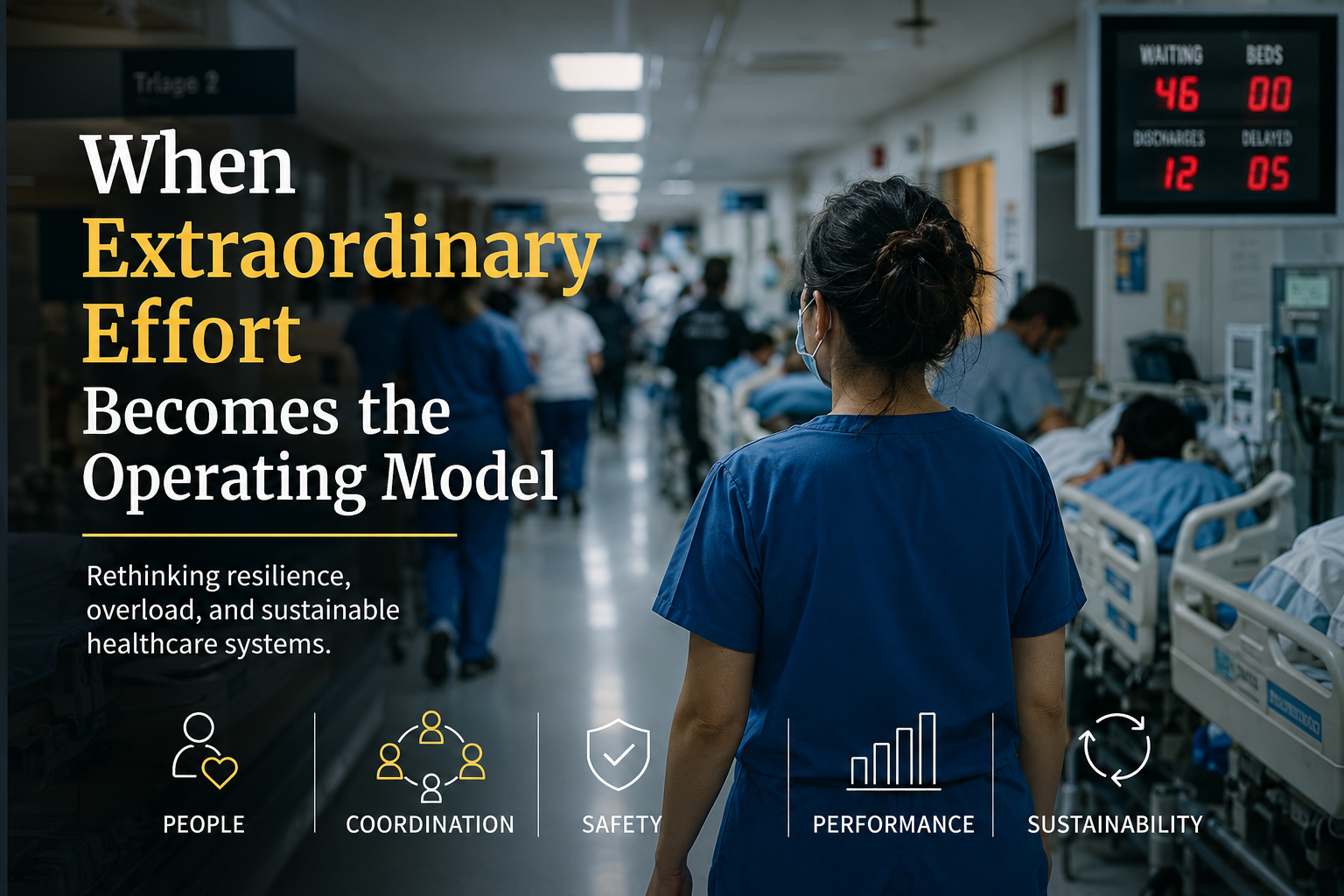
One of the most dangerous moments in healthcare organizations is when extraordinary effort stops being perceived as extraordinary.
In many hospitals, professionals adapt continuously to overcrowding, operational fragmentation, staffing shortages, delayed discharges, communication failures, and constant pressure.
At first, these adaptations are interpreted as resilience.
Over time, however, something more complex can happen:
extraordinary effort gradually becomes incorporated into the operational model itself.
Teams begin to normalize:
- working permanently under overload;
- managing patients in corridors;
- functioning with reduced operational visibility;
- compensating for fragmented processes through individual effort alone.
The problem is that systems sustained mainly by continuous adaptation eventually become fragile.
Not because professionals lack competence or commitment.
But because chronic overload progressively affects coordination, communication, decision-making, and organizational reliability.
One of the most important lessons I learned working in Brazilian hospitals is that resilience should not be confused with the ability to tolerate unsafe pressure indefinitely.
Sustainable healthcare systems are not the ones that require constant heroism.
They are the ones capable of maintaining safe coordination, governance, operational intelligence, and predictability even during periods of saturation.
Perhaps one of the greatest risks in healthcare management is when exhaustion becomes invisible because it has become routine.
And maybe one of the greatest responsibilities of leadership is recognizing when adaptation is no longer resilience — but a warning sign of systemic fragility.
References
-
Organizational Maturity as a Tool for Quality Governance: A Longitudinal Study in a Brazilian Hospital
https://doi.org/10.1093/ijcoms/lyag022 -
To Err Is Human: Building a Safer Health System
https://nap.nationalacademies.org/catalog/9728/to-err-is-human-building-a-safer-health-system -
The association between emergency department crowding and adverse patient outcomes: a systematic review
https://intjem.biomedcentral.com/articles/10.1186/s12245-018-0198-9 -
Resilient Health Care
https://link.springer.com/book/10.1007/978-1-4094-3051-2

Follow the Topic
Related Collections
With Collections, you can get published faster and increase your visibility.
Use of AI in Medical Education: Embracing Responsible Innovation
This collection in the International Journal of Emergency Medicine invites medical educators and researchers to explore the wide range of applications of artificial intelligence (AI) in medical education. Areas of interest include the creation and adoption of new curricula, educational frameworks, and digital learning systems; assessment of medical trainee performance; innovations in medical education and training; and ethical considerations in the age of human-centered AI.
All submissions in this collection undergo the journal’s standard peer review process. Similarly, all manuscripts authored by a Guest Editor(s) will be handled by the Editor-in-Chief. As an open access publication, this journal levies an article processing fee (details here). We recognize that many key stakeholders may not have access to such resources and are committed to supporting participation in this issue wherever resources are a barrier. For more information about what support may be available, please visit OA funding and support, or email OAfundingpolicy@springernature.com or the Editor-in-Chief.
Publishing Model: Open Access
Deadline: Aug 11, 2026
Public health response to disasters and crises: effective interventions during and after emergencies
The International Journal of Emergency Medicine is calling for a Collection on “Public health response to disasters and crises: effective interventions during and after emergencies”. Disasters, whether caused by natural hazards, technological failures, armed conflict, pandemics, or other large-scale emergencies, pose significant challenges to public health systems worldwide. These events can overwhelm healthcare infrastructure, disrupt essential services, and exacerbate existing health inequalities. In recent decades, the frequency, complexity, and global impact of such crises have increased, highlighting the urgent need for evidence-based, coordinated public health responses.
This collection aims to bring together high-quality research and reviews that explore effective public health interventions before, during, and after disasters and crises of all types. We are particularly interested in interdisciplinary approaches that bridge emergency medicine, public health, disaster risk reduction, and health systems strengthening. Special attention will be given to work that evaluates real-world interventions, informs policy, and offers scalable, sustainable solutions for diverse populations. We welcome submissions addressing, but not limited to:
• Public health preparedness and emergency planning
• Health system resilience and surge capacity
• Community-based disaster response strategies
• Risk communication and public engagement during crises
• The intersection of emergency care and chronic disease management in disasters
• Coordination between health, humanitarian, and civil protection sectors
• Lessons learned from recent complex emergencies, including pandemics, conflicts, and climate-related events
By showcasing diverse experiences and innovations from around the world, this collection seeks to inform and improve public health action across the full disaster cycle, from mitigation and preparedness to response and recovery.
This Collection supports and amplifies research related to SDG 1, No Poverty, SDG 3, Good Health and Well-Being, SDG 11, Sustainable Cities and Communities, SDG 13, Climate Action, SDG 16, Peace, Justice, and Strong Institution.
All submissions in this collection undergo the journal’s standard peer review process. Similarly, all manuscripts authored by a Guest Editor(s) will be handled by the Editor-in-Chief. As an open access publication, this journal levies an article processing fee (details here). We recognize that many key stakeholders may not have access to such resources and are committed to supporting participation in this issue wherever resources are a barrier. For more information about what support may be available, please visit OA funding and support, or email OAfundingpolicy@springernature.com or the Editor-in-Chief.
Publishing Model: Open Access
Deadline: Jun 12, 2026
Please sign in or register for FREE
If you are a registered user on Research Communities by Springer Nature, please sign in