What Brazilian hospitals taught me about resilience under pressure
Published in Public Health, Education, and Business & Management

Several studies have associated emergency department overcrowding, operational fragmentation, and staff overload with patient safety risks, delayed care, communication failures, and burnout in healthcare systems worldwide. Discussions in quality improvement, resilience engineering, and healthcare operations research have increasingly reinforced the importance of governance structures, operational coordination, and organizational resilience in highly pressured environments.
Over the last few years, I have participated in projects involving Lean Healthcare, organizational maturity assessment, clinical governance, and emergency department overcrowding analysis in Brazilian hospitals.
These experiences — combined with operational work in intensive care units, emergency departments, and healthcare leadership — reinforced an important perception:
Resilience in healthcare systems is often misunderstood.
In many organizations, resilience becomes associated with the ability of professionals to continue operating despite chronic overload. However, operational experience and quality improvement initiatives increasingly demonstrate that sustainable healthcare systems cannot depend indefinitely on extraordinary individual effort alone.
Eventually, even highly committed teams become vulnerable when governance structures, operational visibility, communication flows, and decision-making processes become fragile.
In projects related to operational flow and organizational maturity, it became clear that resilient systems are characterized not only by technical competence, but by their ability to maintain coordination under pressure.
This includes:
- reliable operational data;
- governance structures capable of supporting decision-making;
- communication alignment between teams;
- organizational trust;
- and operational models capable of functioning even during periods of saturation.
Many healthcare crises are not necessarily generated by lack of technical knowledge.
They emerge from fragmentation.
Fragmented communication.
Fragmented accountability.
Fragmented operational visibility.
Fragmented priorities.
Under pressure, fragmented systems collapse faster.
At the same time, I have also witnessed remarkable operational recoveries in hospitals capable of reorganizing flow, rebuilding governance mechanisms, and restoring alignment between teams even in highly constrained environments.
These experiences significantly changed the way I understand healthcare leadership and operational resilience.
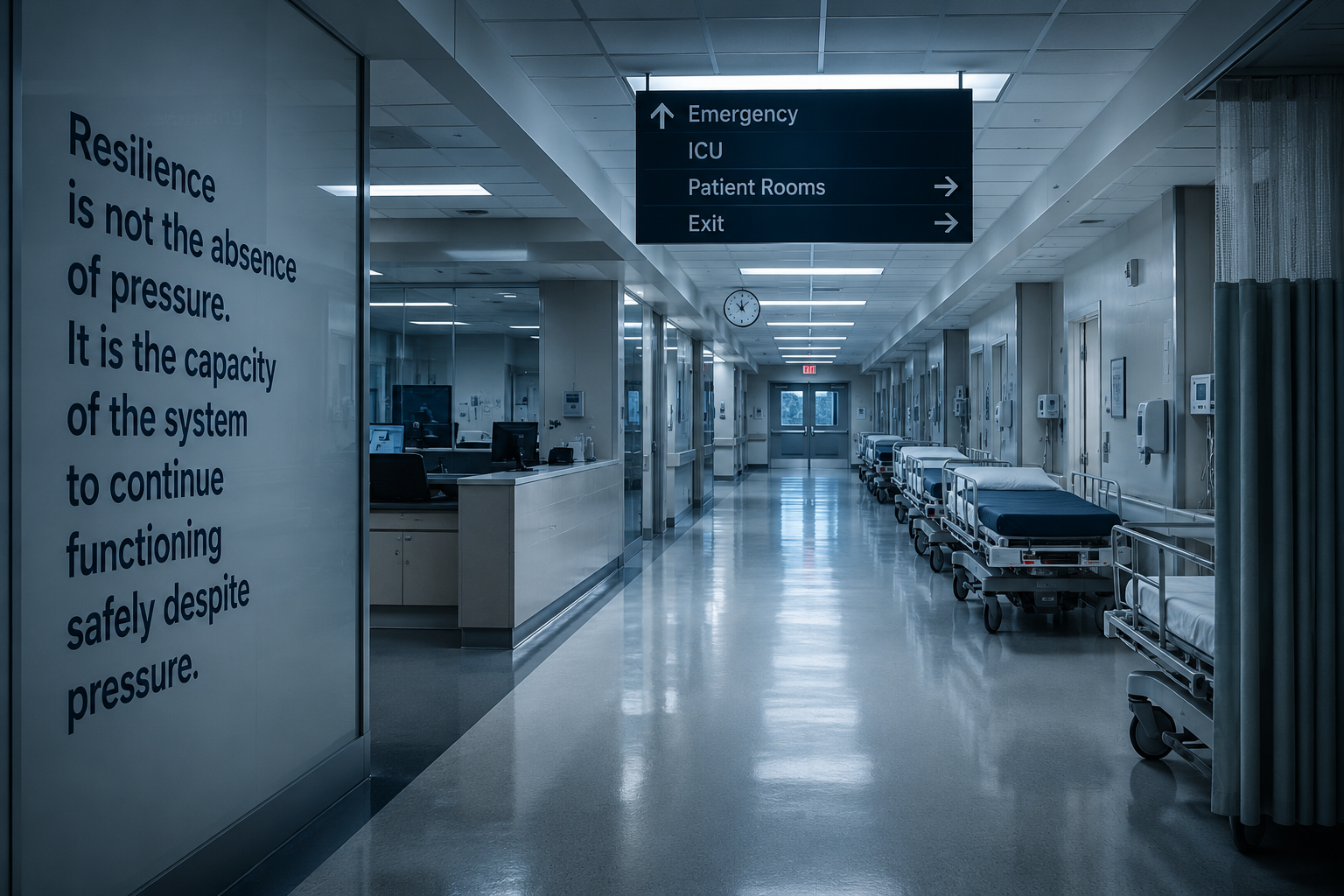
Resilience is not the absence of pressure.
It is the capacity of the system to continue functioning safely, coherently, and predictably despite pressure.
And perhaps that is one of the most important lessons Brazilian hospitals have taught me.
References
- To Err Is Human: Building a Safer Health System
- Resilient Health Care
- The association between emergency department crowding and adverse patient outcomes: a systematic review
- Burnout in healthcare professionals: a call for organizational action
- Goodhart’s Law and healthcare performance measurement
Follow the Topic
-
BMC Global and Public Health
An open access, transparent peer review journal publishing outstanding and influential research and opinion of broad interest to all professional communities involved in global and public health research, policy-making, implementation and delivery worldwide.
Related Collections
With Collections, you can get published faster and increase your visibility.
Food security, nutrition, and dietary trends
BMC Global and Public Health is calling for submissions to our Collection on food security, nutrition, and dietary trends. These are interconnected elements that profoundly impact global health and well-being. As the world grapples with rapid population growth, climate change, and economic disparities, the challenges surrounding food access, quality, and sustainability have intensified. This Collection aims to gather diverse research that examines these complex relationships, focusing on how dietary patterns, food availability, and nutritional status influence overall health outcomes. By exploring the multifaceted nature of food systems, this Collection seeks to showcase pathways to achieve improved food security and nutritional health worldwide.
The goal of this Collection is to build a comprehensive body of knowledge that informs policy and practice. We encourage submissions that investigate:
Impact of dietary patterns on health outcomes
Addressing food insecurity through policy
Role of ultra-processed foods in nutrition
Personalized nutrition and dietary therapy
Nutritional supplements for malnutrition
This Collection supports and amplifies research related to SDG 2: Zero Hunger and SDG 3: Good Health and Well-Being.
We encourage work from local, regional, national, and global partnerships and collaboration among multidisciplinary scientists using multiple methodologies. We ask that authors be careful to use non-stigmatizing/preferred language in their manuscripts as outlined in relevant language guidelines for their respective fields.
All manuscripts submitted to this journal, including those submitted to collections and special issues, are assessed in line with our editorial policies and the journal’s peer-review process. Reviewers and editors are required to declare competing interests and can be excluded from the peer review process if a competing interest exists.
Publishing Model: Open Access
Deadline: Aug 28, 2026
Sexual health education
BMC Global and Public Health is calling for submissions to our Collection on issues critical to advancing health and well-being across diverse populations. The aim of this Collection is to explore the development, implementation, and impact of sexual health education programs and curricula. We welcome contributions that examine knowledge gaps, attitudes toward sexual health education, and innovative strategies to deliver sexual health education. Potential topics include the role of sexual health education in reducing rates of sexually transmitted infections, addressing challenges related to HIV prevention, improving access to contraception, and supporting healthy pregnancy outcomes. Studies on the health workforce’s preparedness to deliver sexual health services and the integration of sexual health topics into student curricula are also encouraged.
Through this Collection, we aim to highlight:
- Advances in sexual health education and its influence on sexual and reproductive health outcomes.
- Barriers to implementing sexual health curricula in different cultural or socioeconomic contexts.
- Effective strategies for reducing the incidence of sexually transmitted infections, including HIV.
- The role of healthcare professionals in shaping sexual health knowledge and attitudes.
- Insights into student engagement and learning about sexual health.
Together, these topics will offer a holistic perspective on how education, prevention, and care intersect to address critical public health challenges related to sexual and reproductive health.
We encourage work from local, regional, national, and global partnerships and collaboration among multidisciplinary scientists using multiple methodologies. We ask that authors be careful to use non-stigmatizing/preferred language in their manuscripts as outlined in relevant language guidelines for their respective fields.
This Collection supports and amplifies research related to SDG 3: Good Health and Well-being, SDG 4: Quality Education, and SDG 10: Reduced Inequalities.
All manuscripts submitted to this journal, including those submitted to collections and special issues, are assessed in line with our editorial policies and the journal’s peer-review process. Reviewers and editors are required to declare competing interests and can be excluded from the peer review process if a competing interest exists.
Publishing Model: Open Access
Deadline: Sep 03, 2026
Please sign in or register for FREE
If you are a registered user on Research Communities by Springer Nature, please sign in