When Extraordinary Effort Becomes the Operating Model
Published in Healthcare & Nursing, Public Health, and Education

Explore the Research
Just a moment...
academic.oup.com
One of the most dangerous moments in healthcare organizations is when extraordinary effort stops being perceived as extraordinary.
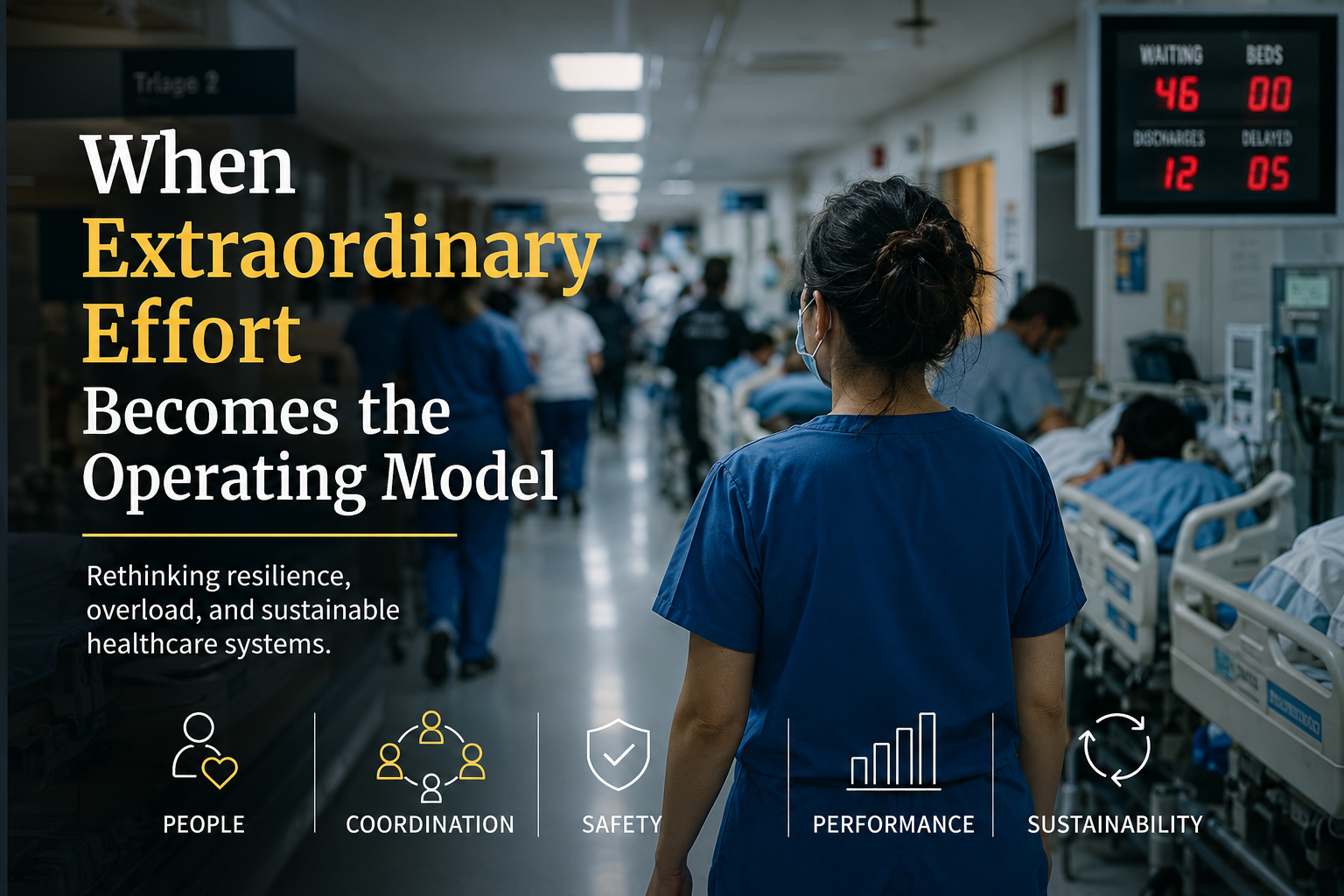
In many hospitals, professionals adapt continuously to overcrowding, operational fragmentation, staffing shortages, delayed discharges, communication failures, and constant pressure.
At first, these adaptations are interpreted as resilience.
Over time, however, something more complex can happen:
extraordinary effort gradually becomes incorporated into the operational model itself.
Teams begin to normalize:
- working permanently under overload;
- managing patients in corridors;
- functioning with reduced operational visibility;
- compensating for fragmented processes through individual effort alone.
The problem is that systems sustained mainly by continuous adaptation eventually become fragile.
Not because professionals lack competence or commitment.
But because chronic overload progressively affects coordination, communication, decision-making, and organizational reliability.
One of the most important lessons I learned working in Brazilian hospitals is that resilience should not be confused with the ability to tolerate unsafe pressure indefinitely.
Sustainable healthcare systems are not the ones that require constant heroism.
They are the ones capable of maintaining safe coordination, governance, operational intelligence, and predictability even during periods of saturation.
Perhaps one of the greatest risks in healthcare management is when exhaustion becomes invisible because it has become routine.
And maybe one of the greatest responsibilities of leadership is recognizing when adaptation is no longer resilience — but a warning sign of systemic fragility.
References
-
Organizational Maturity as a Tool for Quality Governance: A Longitudinal Study in a Brazilian Hospital
https://doi.org/10.1093/ijcoms/lyag022 -
To Err Is Human: Building a Safer Health System
https://nap.nationalacademies.org/catalog/9728/to-err-is-human-building-a-safer-health-system -
The association between emergency department crowding and adverse patient outcomes: a systematic review
https://intjem.biomedcentral.com/articles/10.1186/s12245-018-0198-9 -
Resilient Health Care
https://link.springer.com/book/10.1007/978-1-4094-3051-2

Please sign in or register for FREE
If you are a registered user on Research Communities by Springer Nature, please sign in