When more immunotherapy is not the answer after PD-1 failure
Published in Cancer and Biomedical Research
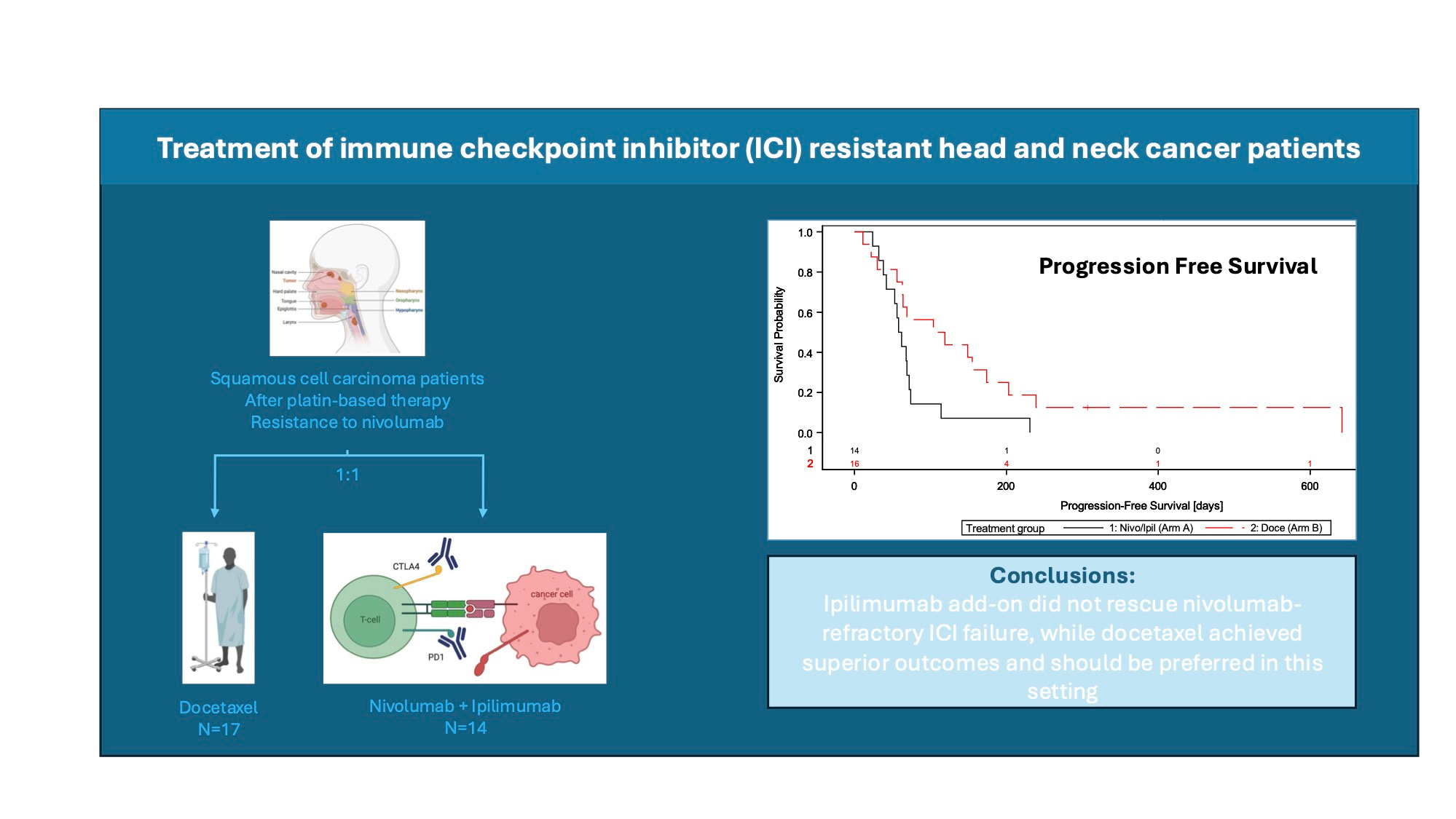


Immune checkpoint inhibitors have become an important treatment option for recurrent or metastatic squamous cell carcinoma of the head and neck. However, many patients do not respond, and treatment options after early progression on PD-1 inhibition remain limited. The OPTIM trial addressed a practical clinical question: can adding CTLA-4 blockade with ipilimumab rescue patients whose disease progresses on nivolumab, or does conventional chemotherapy with docetaxel remain the better option?
Why we asked this question
Dual checkpoint inhibition has shown durable activity in other cancers, including melanoma and renal cell carcinoma, but it also increases toxicity. A sequential strategy seemed attractive: start with nivolumab alone and escalate to nivolumab plus ipilimumab only in patients with early progression. This could, in principle, spare patients unnecessary toxicity while preserving the option of intensified immunotherapy.
How the study was designed
OPTIM was an open-label, randomized, multicenter phase II trial conducted in Germany within the AIO network. Adults with recurrent or metastatic squamous cell carcinoma of the head and neck who had previously received platinum-based chemotherapy first received nivolumab monotherapy.
Patients with progression within 6 months were randomized to:
| Arm | Treatment |
|---|---|
| Experimental arm | Nivolumab plus ipilimumab |
| Control arm | Docetaxel |
The primary endpoint was objective response rate according to RECIST 1.1. Secondary endpoints included progression-free survival, overall survival, and safety.
What we found
The study was planned for 154 patients but was stopped early because the treatment landscape changed. Overall, 49 patients received nivolumab, and 31 patients with early progression were randomized.
Efficacy
The results did not support escalation to dual checkpoint inhibition after early nivolumab failure.
| Outcome | Nivolumab + ipilimumab | Docetaxel |
|---|---|---|
| Objective response rate | 0% | 17.6% |
| Median progression-free survival | 1.97 months | 3.66 months |
| Median overall survival | 3.97 months | 11.9 months |
| 12-month overall survival | 28.6% | 44.6% |
Docetaxel showed numerically better efficacy across endpoints. The difference in progression-free survival favored docetaxel, while overall survival was numerically longer with docetaxel but not statistically significant.
Safety
Toxicity differed between the two approaches.
| Safety outcome | Nivolumab + ipilimumab | Docetaxel |
|---|---|---|
| Treatment-emergent adverse events | 84.6% | 81.3% |
| Grade ≥3 adverse events | 38.5% | 68.8% |
Docetaxel appeared more active but was associated with more high-grade toxicity. This underlines the difficult balance between disease control and treatment burden in this setting.
Biomarkers
PD-L1 expression did not identify a subgroup that clearly benefited from nivolumab plus ipilimumab. Outcomes were similar irrespective of PD-L1 status, suggesting that PD-L1 may have limited value once early resistance to PD-1 blockade has already become clinically apparent.
What the results mean
OPTIM suggests that simply adding ipilimumab after early progression on nivolumab is unlikely to overcome primary resistance in recurrent or metastatic head and neck squamous cell carcinoma. More immunotherapy is not necessarily better, particularly when a tumor has already demonstrated resistance to PD-1 inhibition.
At the same time, docetaxel is not an ideal solution. It retained measurable activity after nivolumab failure, but at the cost of greater toxicity. The findings therefore highlight the continued need for better post-ICI strategies, including rational combinations, improved biomarkers of resistance, and treatment approaches that provide benefit without unnecessary burden.
Why this matters
As immune checkpoint inhibitors move earlier in the treatment pathway, including curative-intent settings, clinicians will increasingly see patients whose cancers recur after prior immunotherapy. OPTIM helps define what should not be assumed: sequential escalation from PD-1 blockade to PD-1 plus CTLA-4 blockade should not be considered an effective default strategy after early PD-1 failure in this disease.
Negative trials are clinically valuable when they answer relevant questions. OPTIM shows that a biologically plausible and patient-sparing escalation strategy did not translate into improved outcomes, redirecting future research toward more precise approaches for immune-resistant disease.

Follow the Topic
-
Cancer Immunology, Immunotherapy
Cancer Immunology, Immunotherapy is providing a timely and open access publication of original discovery and developments in basic and translational research in the field of cancer immunology and immunotherapy.

Related Collections
With Collections, you can get published faster and increase your visibility.
Imaging in Cancer Immunotherapy
It explores imaging modalities such as PET, MRI, and CT to assess immune responses, tumor microenvironment changes, and treatment efficacy in cancer immunotherapy.
Publishing Model: Open Access
Deadline: Feb 16, 2027
CAR Macrophage
This collection highlights advances in macrophage biology and engineering for cancer immunotherapy, with a particular focus on CAR macrophages. It also welcomes studies on macrophage functions in tumors, interactions with CAR-T cells and other immune populations, and strategies to improve antitumor immunity and clinical translation.
Publishing Model: Open Access
Deadline: Apr 09, 2027

