When Protocols Fail: Lessons from Fragmented Healthcare Systems
Published in Healthcare & Nursing, Public Health, and Behavioural Sciences & Psychology

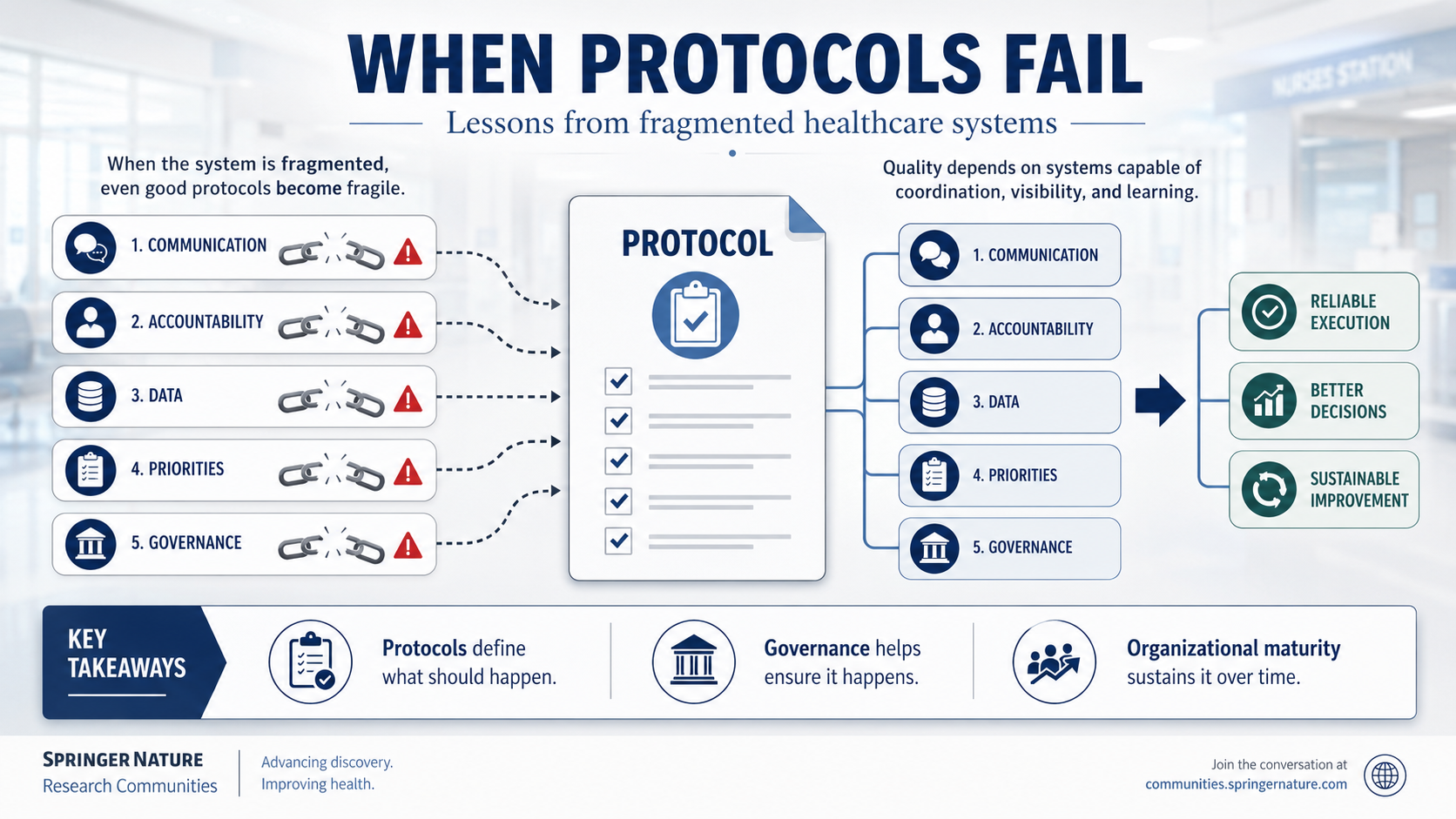



Hospitals invest substantial effort in developing clinical protocols, care pathways, checklists, bundles, training programs, and standard operating procedures.
These tools are essential.
They reduce variation, support safer clinical decisions, and help translate evidence into daily practice.
Yet one question continues to appear across healthcare systems:
Why do well-designed protocols sometimes fail to produce sustained improvement?
The answer may not lie in the protocol itself.
It may lie in the system around it.
In complex healthcare environments, protocols depend on multiple organizational conditions to function effectively: reliable communication, clear accountability, timely data, leadership alignment, operational visibility, and governance structures capable of sustaining implementation over time.
When these conditions are weak, even technically sound protocols may become fragile.
They may exist on paper.
They may be included in training sessions.
They may be audited periodically.
But they may not consistently change daily practice.
This is especially relevant in hospitals experiencing operational pressure, workforce shortages, overcrowding, fragmented information systems, and competing institutional priorities.
In these environments, failure rarely occurs because professionals do not care about quality.
More often, failure emerges because the organizational system does not support consistent execution.
Fragmented communication makes it difficult for teams to coordinate care.
Fragmented accountability makes it unclear who is responsible for sustaining change.
Fragmented data prevents leaders from seeing problems early.
Fragmented priorities cause improvement initiatives to compete with each other.
Fragmented governance limits the organization’s ability to learn from variation and respond consistently.
Under these conditions, protocols may become isolated technical solutions placed inside an immature organizational system.
This perspective is closely related to our recent longitudinal study, Organizational Maturity as a Tool for Quality Governance: A Longitudinal Study in a Brazilian Hospital, published in International Journal for Quality in Health Care Communications.
In that study, we examined how organizational maturity evolved over time in a Brazilian hospital. The findings suggested that quality governance depends not only on formal standards or isolated improvement initiatives, but also on the organization’s capacity to coordinate, monitor, standardize, and sustain change across multiple domains.
This distinction is important.
Protocols define what should happen.
Governance helps ensure that it actually happens.
Organizational maturity determines whether the system can sustain it.
A second example comes from our quality improvement work on visual management of nursing schedules and workforce balancing.
In that preprint, we described an intervention that integrated nursing schedules, absenteeism, hospital occupancy, staff redistribution, overtime coverage events, and associated costs into a visual workforce management process. The intervention was temporally associated with a reduction in mean monthly overtime coverage events from 143 at baseline to 23.4 after implementation, and a reduction in mean monthly overtime-related expenditure from BRL 32,693.00 to BRL 6,071.42.
The key lesson was not simply that a dashboard reduced overtime.
The broader lesson was that visibility changed the quality of operational decision-making.
By making staffing imbalance visible earlier, the organization was able to redistribute existing professionals more effectively before overtime coverage became necessary.
This illustrates a broader principle in healthcare improvement.
Tools do not improve systems by themselves.
Protocols do not improve care by themselves.
Dashboards do not improve decisions by themselves.
They become effective when embedded in governance routines, communication structures, leadership alignment, and organizational learning.
That is why implementation matters as much as design.
A good protocol in a fragmented system may produce limited results.
A good protocol in a mature system may become part of a sustainable quality infrastructure.
For healthcare leaders, this has practical implications.
Before asking whether a protocol is being followed, we should also ask:
Is the governance structure clear?
Are responsibilities defined?
Is information visible in time for action?
Are teams aligned around the same priorities?
Is there a mechanism for learning when the protocol fails?
Can the organization adapt without losing standardization?
These questions move quality improvement from compliance to capability.
They also help explain why similar interventions may produce different outcomes across hospitals.
The variation may not be in the protocol.
It may be in the organizational maturity of the system implementing it.
In the end, healthcare quality depends not only on knowing what should be done.
It depends on building systems capable of doing it reliably, learning from failure, and sustaining improvement over time.
Perhaps protocols fail not because they are weak, but because the systems around them are not mature enough to support them.
Related research
Rodrigues Filho RND, Morais LG. Organizational Maturity as a Tool for Quality Governance: A Longitudinal Study in a Brazilian Hospital. International Journal for Quality in Health Care Communications. 2026. DOI: 10.1093/ijcoms/lyag022.
Rodrigues Filho RND, Barbosa MCP, Miranda GFS, Morais LG. Visual Management of Nursing Schedules for Workforce Balancing and Reduction of Overtime Coverage: A Longitudinal Quality Improvement Study. Research Square Preprint. DOI: 10.21203/rs.3.rs-10121229/v1.
Related literature: healthcare quality governance, organizational maturity, implementation science, Lean Healthcare, patient safety, and sustainability of quality improvement interventions.
Follow the Topic
-
BMC Global and Public Health
An open access, transparent peer review journal publishing outstanding and influential research and opinion of broad interest to all professional communities involved in global and public health research, policy-making, implementation and delivery worldwide.
-
BMC Nursing
This is an open access, peer-reviewed journal that considers articles on all aspects of evidence-based nursing care; nursing research methods; nursing service delivery, utilization, and evaluation; nursing administration and human resources.
-
The Review of International Organizations
-
Educational technology research and development
This is a scholarly journal focusing on research and development in educational technology.




Related Collections
With Collections, you can get published faster and increase your visibility.
Career development for nursing students
BMC Nursing is calling for submissions to its Collection, Career development for nursing students. The transition from nursing education to professional practice is a pivotal phase for nursing students, fraught with challenges and opportunities. As the healthcare landscape continues to evolve, nursing students must navigate a myriad of career pathways, requiring not only clinical competence but also a solid understanding of professional development strategies. This Collection aims to explore the various dimensions of career development for nursing students, including mentorship, networking, and skill acquisition, to better prepare them for successful careers in nursing and healthcare.
Addressing career development in nursing education is essential for fostering a skilled and adaptable workforce. Recent advancements in nursing curricula emphasize the importance of integrating career readiness into educational programs. Initiatives such as simulation training, mentorship programs, and career counseling services have emerged to support nursing students in their professional journeys. By equipping future nurses with the tools and knowledge needed for career success, we can enhance job satisfaction, reduce turnover rates, and ultimately improve patient care outcomes.
Future research in this area holds promise for innovative approaches to career development tailored to the needs of nursing students. As technology continues to reshape healthcare, there may be a rise in virtual mentorship programs and online networking platforms that facilitate connections among nursing professionals. Additionally, ongoing research may lead to the identification of best practices for career development that can be standardized across nursing programs, ensuring that all students have equitable access to the resources they need for successful career trajectories.
We call for studies contributing to the examination of topics relating to career development for nursing students, including but not limited to:
- Mentorship programs in nursing education
- Integration of career readiness in nursing curricula
- The role of simulation in career development
- Effective networking strategies for nursing students
- Peer mentoring and its influence on career maturity and decision-making self-efficacy
- Leadership development and mentoring for emerging nurse leaders
- Digital health and technology skills for modern nursing practice
All manuscripts submitted to this journal, including those submitted to collections and special issues, are assessed in line with our editorial policies and the journal’s peer review process. Reviewers and editors are required to declare competing interests and can be excluded from the peer review process if a competing interest exists.
Publishing Model: Open Access
Deadline: Mar 12, 2027
Person-centered care in nursing 2026
BMC Nursing is calling for submissions to its Collection, Person-centered care in nursing 2026. Person-centered care (PCC), often embraced as part of the culture change movement, describes a shift from staff-centric task-based and disease-centered care to a focus on the individual. This philosophy is characterized by health care professionals’ (such as nurses’) knowledge of the individual with various care needs and a close and trusting relationship between care professionals and recipients. Furthermore, this integrates a clinical perspective with a broader understanding that recognizes the unique experiences of each person with various care needs. Particular attention is required for populations such as older adults in long-term and home-care settings and individuals with complex, multi-morbid conditions, where coordinating person-centered, inter-professional care is critical. In recent years, PCC has gained traction as a “gold standard” in nursing and healthcare, fostering improved communication between individuals with various care needs and healthcare professionals, enhancing the quality of nursing, and promoting better health outcomes. The integration of the perspectives of individuals with various care needs and their loved ones into care planning and decision-making is vital for the successful implementation of PCC.
Advancements in technology (e.g., artificial intelligence) seems to provide promising contributions to the evolution of person-centered care, allowing for greater autonomy and empowerment of individuals with various care needs and involvement in their own care. Research has shown that when people with various care needs are actively engaged in their care, they are more satisfied with it. Moreover, the emphasis on gender and ethnic competence and health equity within PCC frameworks highlights the need for nurses to tailor care interventions to diverse populations, ensuring that all individuals receive equitable treatment that respects their unique backgrounds.
As research in PCC continues to evolve, new methodologies and frameworks are anticipated to further empower individuals with diverse care needs and their loved ones in their care. Future advancements may include innovative digital tools that enhance care communication, more comprehensive approaches to informed consent, and strategies to ensure that care delivery is equitable and gender- and culturally sensitive. Such developments will likely transform how nurses engage with individuals receiving care, ultimately leading to improved health outcomes and a more inclusive healthcare system.
We call for studies contributing to the investigation of topics relating to person-centered care, including but not limited to:
- Empowerment strategies through PCC for individuals with diverse care needs
- Development of innovative PCC interventions and their implementation
- Enhancing health equity through PCC
- Gender and cultural competence in PCC
- PCC approaches in aged-care and long-term residential facilities
- PCC models for dementia, frailty and multimorbidity
- Coordination of complex care across settings (acute, community, home)
- Technology-enabled PCC for older and complex-care populations (e.g., remote monitoring, AI-supported care planning)
- Innovative PCC outcomes
All manuscripts submitted to this journal, including those submitted to collections and special issues, are assessed in line with our editorial policies and the journal’s peer-review process. Reviewers and editors are required to declare competing interests and can be excluded from the peer review process if a competing interest exists.
Publishing Model: Open Access
Deadline: Jan 15, 2027
Please sign in or register for FREE
If you are a registered user on Research Communities by Springer Nature, please sign in
Nice academic information
Thanks