When Sound Holds Its Shape
Published in Behavioural Sciences & Psychology




Why auditory streaming?
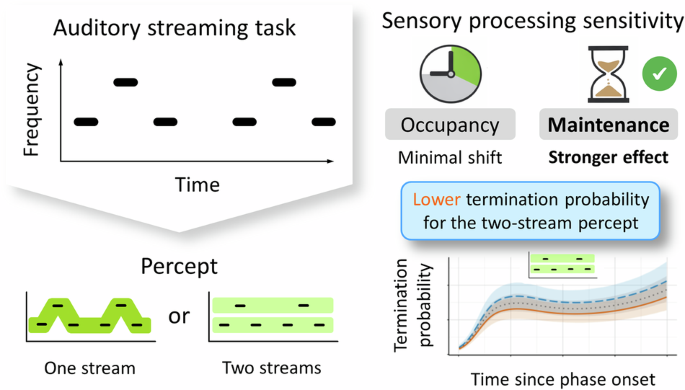
Auditory streaming is useful because it creates a controlled form of ambiguity. The physical stimulus remains constant, but perception alternates between two interpretations.
In our experiment, participants listened to an 8-min sequence of tones arranged in an ABA pattern. They continuously reported whether they heard one integrated stream or two segregated streams. This gave us a detailed record of perceptual switches over time.
The task is simple for participants, but rich for analysis. We can ask not only which percept dominates, but also how long each percept lasts, how often perception switches, and whether one percept becomes especially stable once it appears.
This last point became central to the study.
What we expected
At the beginning, there were several plausible possibilities.
One possibility was that people with higher sensory processing sensitivity would simply hear two streams more often. This would mean a general bias toward segregation, as if subtle acoustic differences were weighted more strongly from the outset.
Another possibility was that their perception would switch more slowly overall, regardless of which percept was currently dominant. This would imply a broad slowing of perceptual dynamics.
A third possibility was more specific: sensory processing sensitivity might not determine which percept wins overall, but rather how long a percept is maintained once it has been established. In other words, the trait might influence the stability of perceptual organization over time.
To distinguish these possibilities, we combined descriptive measures with statistical models that separated state occupancy from state maintenance.
What we found
The descriptive pattern was clear. Participants with higher sensory processing sensitivity showed fewer perceptual switches overall. They also tended to have longer percept durations, especially for the two-stream percept.
However, the deeper story came from the modeling. A model of state occupancy showed little evidence that higher sensory processing sensitivity simply shifted perception toward the two-stream state. In plain language, highly sensitive individuals did not just spend much more total time hearing two streams.
Instead, the strongest pattern appeared in state maintenance. A time-resolved hazard model showed that higher sensory processing sensitivity was associated with a lower probability that the two-stream percept would end once it had been established. The percept was not necessarily entered more often. Rather, once it emerged, it tended to hold its shape.
A further analysis of dominance-duration distributions supported this interpretation. Trait-related differences were expressed mainly in the timescale of percept durations, while changes in regularity were modest. Together, the results suggest that sensory processing sensitivity is linked to how auditory organization unfolds over time, especially through stabilization of the segregated percept.
A possible interpretation
One way to think about this finding is through predictive processing.
In everyday listening, the brain is constantly trying to infer the most plausible causes of incoming sound. When a sequence is ambiguous, different interpretations compete. Predictive-processing accounts suggest that perception depends on the balance between incoming sensory evidence and internally stabilizing expectations.
In auditory streaming, a segregated two-stream percept may be supported by regular temporal structure. Once the brain has identified that structure, it can become easier to maintain. Our results are broadly compatible with the idea that individuals with higher sensory processing sensitivity may place greater weight on subtle but reliable acoustic regularities.
This interpretation remains cautious. We did not directly test predictive processing, nor can our correlational design establish causality. But the framework offers a useful bridge between personality, auditory scene analysis, and perceptual stability.
Why it matters
Sensory processing sensitivity is sometimes discussed in everyday terms as being easily overwhelmed by sensory input. That may be part of the story, but our findings point to a more specific possibility. Greater sensitivity may also involve a different way of stabilizing perceptual organization.
This could be useful in some situations. In complex sound scenes, such as speech in noise or polyphonic music, the ability to maintain separate streams may support source separation. At the same time, emphasizing local detail could have costs when integration is more useful. A listener who strongly separates sound elements may sometimes lose the larger pattern.
This trade-off may be important for understanding both the benefits and challenges associated with sensory processing sensitivity. Sensitivity is not simply “more” perception. It may change the temporal dynamics through which perception becomes organized.
What’s next
The present study used a neutral laboratory task with healthy young adults. Future work should test whether similar patterns appear in older adults, clinical populations, and more natural sound environments. It would also be useful to combine auditory streaming with neural measures, such as markers of auditory cortical processing or excitation–inhibition balance.
For now, the main message is simple. The same repeating sound can be heard in different ways, and those percepts can last for different lengths of time. Sensory processing sensitivity appears to shape this temporal life of perception—not by simply changing what is heard, but by changing how firmly an auditory organization is held once it emerges.
In that sense, the study began with a modest sequence of tones. But it led us to a broader question: how do stable traits shape the fragile, flickering architecture of experience?

Hirohito Kondo is Dean and Professor at the School of Psychology, Chukyo University, Japan. His research explores how the human brain organizes sensory inputs into meaningful perceptual objects and how these processes interact with attention and emotion. His recent work examines temporal dynamics in perceptual organization, with a particular focus on auditory scene analysis. Professor Kondo has served on the Editorial Board of Scientific Reports since 2019.
Follow the Topic
-
Communications Psychology
An open-access journal from Nature Portfolio publishing high-quality research, reviews and commentary. The scope of the journal includes all of the psychological sciences.

Related Collections
With Collections, you can get published faster and increase your visibility.
Replication and generalization
Publishing Model: Open Access
Deadline: Dec 31, 2026
Stress and Health
Publishing Model: Open Access
Deadline: Nov 30, 2026