When the Biggest Problem Wasn't the Algorithm
Published in Computational Sciences and Education

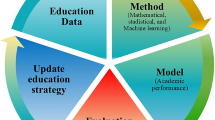

Every research project starts with a question. This one started with a frustration.
Over the past few years, I had read dozens of excellent papers on predicting student performance using machine learning. Almost every study reported promising results, yet nearly all shared one common limitation the data behind the research was unavailable. Student records are rightly protected by privacy regulations, but this also means that researchers cannot reproduce published work, compare algorithms fairly, or build upon previous studies. The field was advancing, but everyone was running in parallel on different datasets.
At first, I considered building another prediction model using existing public educational datasets. The more I explored them, however, the clearer it became that they were either too small, lacked important behavioural or socioeconomic variables, or represented only a narrow educational context. None could serve as a comprehensive benchmark for modern machine learning research. That realization changed the direction of this project entirely.
The question shifted from "Can I build a better predictor?" to "Can I build something that helps the entire research community?"
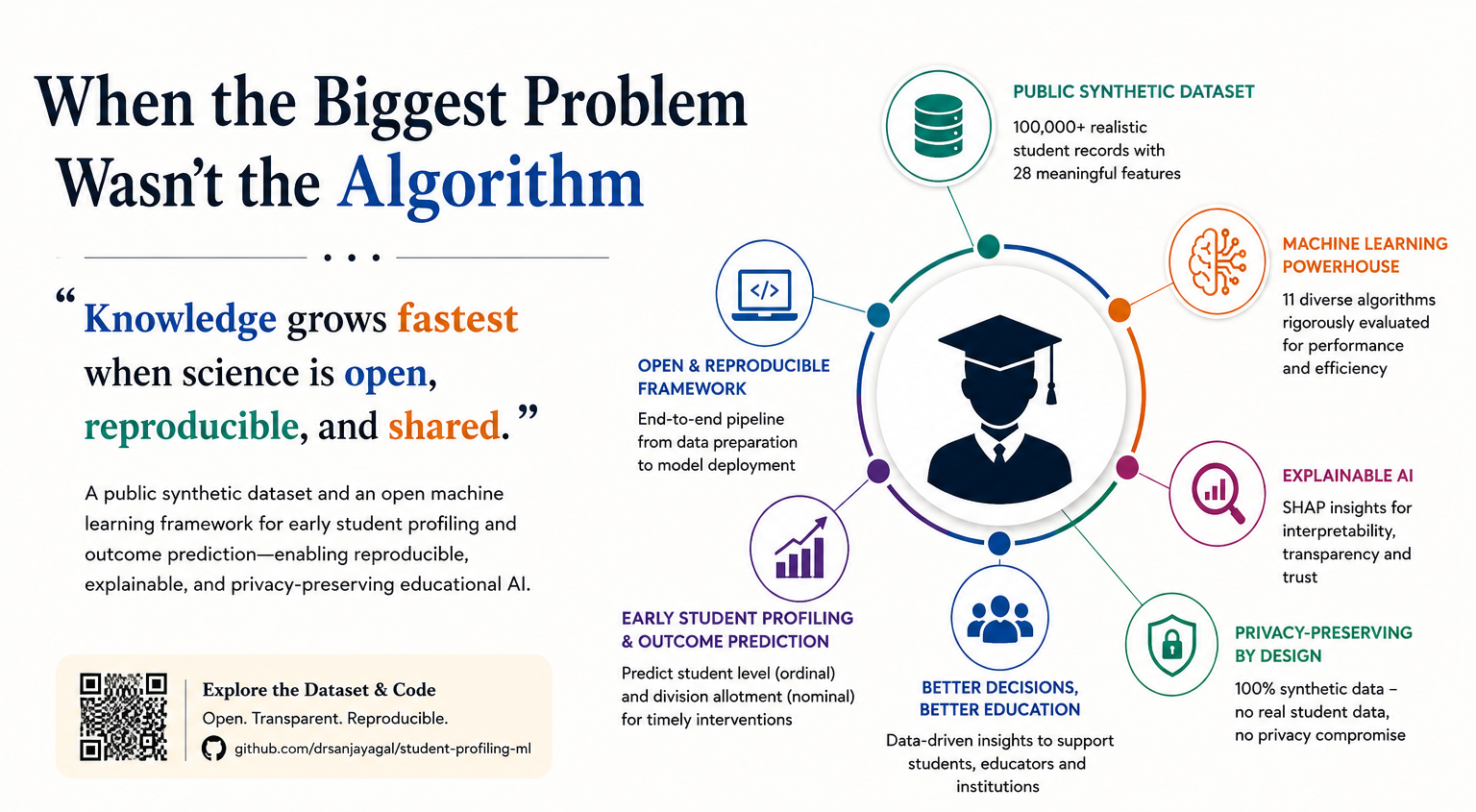
That decision led to what eventually became the University Intake Synthetic Dataset a completely synthetic dataset containing more than 100,000 realistic student profiles. Designing it turned out to be far more challenging than training the machine learning models themselves. A synthetic dataset cannot simply contain random numbers; it has to behave like real educational data. Academic scores needed meaningful relationships with entrance examinations, socioeconomic indicators had to influence educational opportunities, missing values had to appear naturally, and the dataset needed enough complexity to challenge modern algorithms while containing no real student information whatsoever.
Once the dataset existed, the machine learning framework almost became the natural next chapter. Rather than comparing only one or two popular algorithms, I wanted a framework that researchers could reuse, extend and benchmark. The pipeline gradually evolved into a complete ecosystem covering preprocessing, feature engineering, multiple machine learning models, explainability using SHAP, rigorous evaluation protocols and open-source implementation. The goal was never simply to publish another accuracy number it was to make future educational AI research easier to reproduce.
One of the most satisfying moments came during model interpretation. As expected, previous academic achievement emerged as the strongest predictor, but the explainable AI analysis also revealed how behavioural and socioeconomic factors subtly influenced predictions. Those insights reinforced an important lesson: student success cannot be reduced to examination marks alone. Machine learning can identify patterns, but it also reminds us that education is influenced by many interconnected factors.
Looking back, this paper is less about building another machine learning model and more about addressing a long-standing reproducibility challenge in educational data mining. I hope the dataset, code, and framework encourage researchers to test new ideas, compare methods fairly, and develop transparent AI systems without compromising student privacy. If this work makes the next research project a little easier for someone else, then it has achieved its purpose.
Sometimes, the most meaningful contribution isn't a better algorithm it's creating the foundation that allows better algorithms to be built.
Knowledge grows fastest when science is open, reproducible, and shared.
Regards
Dr. Sanjay Agal
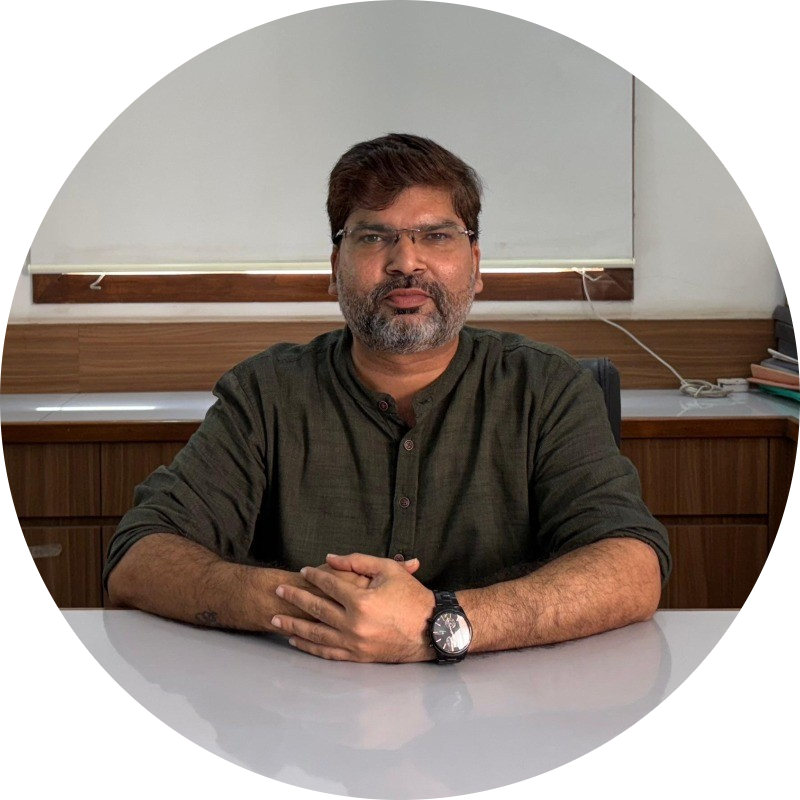
I am Dr. Sanjay Agal, an educator, researcher, and academic leader dedicated to advancing the frontiers of knowledge and shaping the future of engineering education. Currently, I serve as Professor and Head of the Department of Artificial Intelligence and Data Science at Parul University, Vadodara, India. My professional journey also includes serving as the Principal of Dr. V. R. Godhania College of Engineering & Technology, Porbandar an opportunity I was formally endorsed for by Gujarat Technological University (GTU) in 2023.
My career has been guided by a deep commitment to innovation-driven learning and impactful research. Over the years, I have authored sixteen books and published numerous research papers in reputed international journals. I have also secured several patents, reflecting my sustained efforts to bridge theoretical understanding with meaningful real world applications.
With a vision to inspire and empower the next generation of thinkers, innovators, and problem solvers, I strive to foster an environment where curiosity, creativity, and academic excellence thrive. Whether through teaching, research, or academic leadership, my mission remains the same: to contribute to a transformative educational ecosystem that benefits students, faculty, and society at large.
Follow the Topic
-
Scientific Reports
An open access journal publishing original research from across all areas of the natural sciences, psychology, medicine and engineering.

Related Collections
With Collections, you can get published faster and increase your visibility.
Cancer Prevention and Control
Publishing Model: Hybrid
Deadline: Feb 19, 2027
Healthy Aging
Publishing Model: Open Access
Deadline: Dec 31, 2026