Why did Robert Hooke call them “cells”?
Published in Arts & Humanities
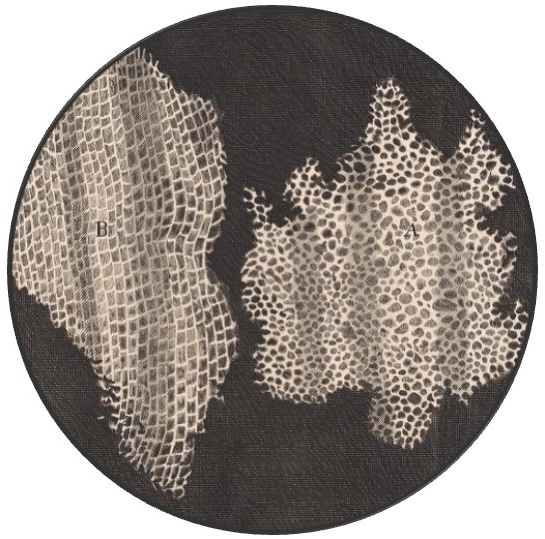
Hooke was not looking at “life” in the modern biological sense. He was looking (among other things) at cork, a tissue composed of dead cells even in living plants, and trying to understand what he was seeing through a microscope. What struck me most when re-reading his words was not only what he observed, but how he observed it.
At first, he could not clearly see the structure he was searching for. So he changed the preparation. He cut thinner sections. He adjusted the illumination. He placed the material against a dark background. And then, suddenly, something appeared that had been invisible before: a network of tiny empty compartments, which reminded him of small rooms, or cellae.
It is a remarkably modern scientific moment. Observation, failure, adjustment, curiosity, and finally recognition.
More than 350 years later, it is still possible to feel some of that excitement by reading Hooke’s own words in Micrographia. You can almost follow the moment in which an apparently ordinary material begins to reveal an unexpected hidden structure.
One of the interesting paradoxes is that the term “cell” did not originally emerge from the observation of living units, but from dead cork tissue. Hooke was not describing living protoplasm, metabolism, or the fundamental units of life as we understand them today. He was describing empty spaces delimited by cell walls in cork.
In our new paper, we went back to Hooke’s original observations to reconstruct what he actually saw, and why the term “cell” emerged from cork anatomy rather than from the later concept of living cellular units.
For me, this story also says something broader about science itself. Scientific concepts do not emerge in isolation. They emerge from specific materials, instruments, techniques, and ways of looking carefully at the world.
Sometimes science advances through grand theories. Sometimes it begins simply with someone looking carefully at a piece of cork and wondering what is inside.
Link:
https://www.researchgate.net/publication/404907352_What_did_Robert_Hooke_actually_see_Cork_and_the_origin_of_the_term_'cell'
I am a wood scientist and professor at the University of Torino (Italy). My research explores wood anatomy, ecology, and conservation, linking plant biology, dendrochronology, and cultural heritage studies. I’m interested in how wood structure reveals growth conditions, species identity, and material history, from living trees to ancient objects.



Please sign in or register for FREE
If you are a registered user on Research Communities by Springer Nature, please sign in