Why I Stopped Asking if African Startups Are “Investor-Ready”
Published in Business & Management


When I began my research journey into African fintech, I thought I knew the question I was trying to answer.
Like many scholars and practitioners, I was interested in performance—why some ventures scale, raise capital, and survive, while others stall or disappear. The dominant language in both academia and industry pointed in one direction: investor readiness.
If founders could become more investor-ready—more structured, more data-driven, more aligned with global expectations—then growth would follow. This logic is reflected in both practitioner frameworks and policy interventions aimed at improving access to finance (e.g., World Bank, 2020).
But as I spent more time with entrepreneurs, cases, and data across the continent, something did not sit right.
The Question That Didn’t Fit
In classroom discussions, consulting engagements, and case analyses, I kept encountering a pattern that the investor-readiness lens could not fully explain.
Some ventures that looked “ready” on paper—polished decks, strong metrics, compelling narratives—still struggled to survive. Others, often less polished and operating in highly constrained environments, found ways to endure and even grow.
This observation echoes a broader critique within entrepreneurship research: that firm success cannot be explained solely by internal capabilities or access to capital, but must also account for institutional context (e.g., Institutional Theory; Douglass North, 1990).
This raised a deeper question:
What if the problem is not whether African ventures are ready for investors, but whether they are ready for change?
From Investor Readiness to Change Readiness
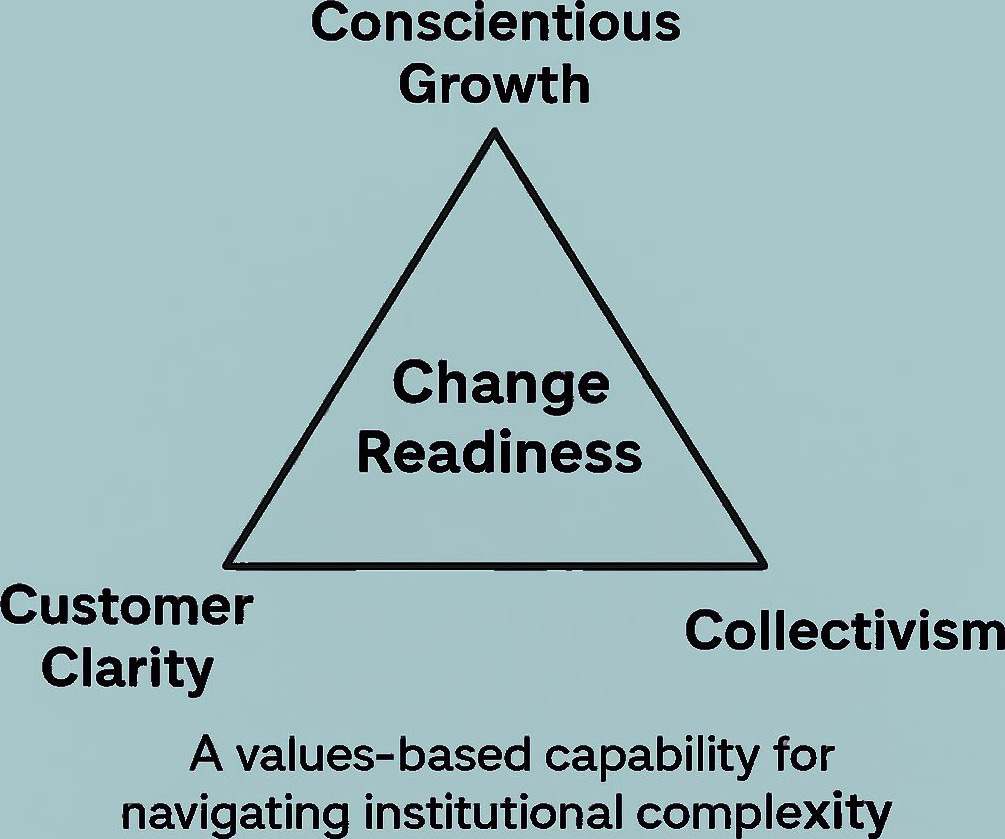
This question became the foundation for what I now describe as Change Readiness—a values-based mechanism for entrepreneurial survival in complex and uncertain environments.
Rather than focusing on external validation, Change Readiness shifts attention inward, toward how firms respond to their environments, stakeholders, and constraints.
Through my research, this construct evolved around three core dimensions:
- Customer Clarity – the ability to deeply understand and respond to real customer needs, particularly in fragmented and informal markets
- Collectivism – the capacity to build trust-based relationships with teams, partners, and communities
- Conscientious Growth – a disciplined and ethical approach to scaling, where growth is aligned with long-term impact rather than short-term gains
These dimensions reflect not just strategies, but organizational postures. In this sense, Change Readiness complements existing perspectives such as the Resource-Based View (Barney, 1991) by emphasizing not only what firms have, but how they behave under constraint.
Writing the Book: Bridging Two Worlds
Writing Institutional Entrepreneurship in African Fintech was an attempt to bridge two worlds that often speak past each other.
On one hand, academic literature offers rich theoretical insights into institutions, legitimacy, and entrepreneurship (e.g., DiMaggio and Powell, 1983). On the other hand, practitioners navigate realities that are far messier than most models assume.
The challenge was not simply to apply theory to practice, but to allow practice to reshape theory.
This meant drawing not only from established frameworks, but also from lived experiences, African proverbs, and case studies across West, East, Southern, and North Africa.
In doing so, I found myself constantly negotiating between rigor and relevance:
- How do you remain theoretically grounded while speaking to real founders?
- How do you write for global scholarship without losing local nuance?
This tension became a creative force rather than a constraint.
What Surprised Me Most
Perhaps the most surprising insight from this journey was the central role of values.
In environments characterized by institutional voids—where formal systems are weak or inconsistent—values are not abstract ideals. They become operational tools.
Trust, fairness, commitment, and responsibility are not “soft” concepts; they are mechanisms through which entrepreneurs build legitimacy and sustain relationships.
This aligns with emerging work in values-based strategy and moral agency in entrepreneurship, which suggests that ethical orientation can shape firm outcomes in meaningful ways.
In this sense, growth is not merely a function of capital or capability, but of character.
Why This Matters
This work is not only about African fintech. It speaks to a broader shift in how we understand entrepreneurship in complex environments.
As global markets become more uncertain, the conditions often associated with emerging economies—volatility, informality, institutional gaps—are becoming more widespread.
In such contexts, the question of readiness becomes more nuanced.
It is no longer sufficient to ask whether firms are ready for investment. We must also ask whether they are equipped—internally and relationally—to navigate change.
Looking Ahead
This book represents one step in an ongoing research agenda. Future work will focus on empirically testing the Change Readiness construct and exploring its implications across sectors and geographies.
At the same time, I remain committed to engaging practitioners—through teaching, consulting, and writing—to ensure that these ideas continue to evolve in dialogue with real-world challenges.
For founders, investors, and policymakers interested in applying these ideas, one practical starting point is to assess where a venture currently stands across the three dimensions of Change Readiness. Even a simple diagnostic can surface hidden constraints and guide more grounded growth strategies.
Ultimately, my hope is that this work contributes to a more context-sensitive understanding of entrepreneurship—one that recognizes that growth is not only built, but becomes.

Dr. Glory Enyinnaya is a management scholar and strategy consultant whose work bridges theory and practice in entrepreneurship, fintech ecosystems, and inclusive economic growth. She is a faculty member at Pan-Atlantic University in Nigeria, where she leads research on change readiness, a theory she introduced in Harvard Business Review to explain how entrepreneurs in complex, low-trust environments gain legitimacy and scale. She is also the founder of Kleos Advisory, which has supported national entrepreneurship initiatives across Africa. Her forthcoming book, Institutional Entrepreneurship in African Fintech, will be published by Palgrave Macmillan in April 2026.
Follow the Topic
-
Small Business Economics
Small Business Economics: An Entrepreneurship Journal (SBEJ) publishes original research addressing all aspects of entrepreneurship and small business economics, with a special emphasis on the economic and societal relevance of research findings for scholars, practitioners and policy makers.

Related Collections
With Collections, you can get published faster and increase your visibility.
Entrepreneurship and the Creation of Decent Work for All
Springer Nature is inviting submissions to our new multi-journal Collection on Entrepreneurship and the Creation of Decent Work for all, reflecting on the U.N. Sustainable Development Goal SDG 8.
Societal changes, environment, political and financial crises inevitably affect labor markets and the quality of employment. Recent pandemic and global political changes have only demonstrated how quickly one´s employment and workplace situation can change. Among other factors, entrepreneurship could play a crucial role in the creation of decent work, especially in a volatile environment.
Understanding the relationship between entrepreneurship and working conditions is crucial for supporting policies and instruments which aim at more productive, decent work, fair wages, better access to the labor market, and improved job opportunities for all.
In order to fully represent this multifaceted topic, we would like to gather a spectrum of current perspectives in a single Collection, facilitating a better understanding of possibilities and ways of striving toward the goal of “achieving full and productive employment and decent work for all” (SDG 8 of the U.N.).
We encourage submissions including, but not limited to, the following topics:
- Equal pay for work of equal value
- Gender discrimination in employment
- Immigration and employment
- Labor shortages after COVID-19
- Modern slavery and child labor
- Labor policy
- Entrepreneurial enterprises, SMEs, and family businesses
- Global entrepreneurial firms: organization design, emerging conceptions in entrepreneurship (i.e. born globals), globalization’s challenges and opportunities, cultural differences
- Remote work
- Opportunity entrepreneurship as a direct way to generate high quality employment
- Measuring and dealing with positive and negative externalities of new businesses
Submissions to this collection may be research or review articles, depending on the individual journal guidelines. Each submission will undergo thorough and rigorous peer review in accordance with each journal’s peer review editorial policy. Accepted articles will be published in the journal they were submitted to, as well as highlighted on this collection page.
Publishing Model: Hybrid
Deadline: Ongoing


Please sign in or register for FREE
If you are a registered user on Research Communities by Springer Nature, please sign in