Why Increasing Forest Disturbances are Good News for Europe’s Large Herbivores
Published in Ecology & Evolution, Agricultural & Food Science, and Zoology & Veterinary Science
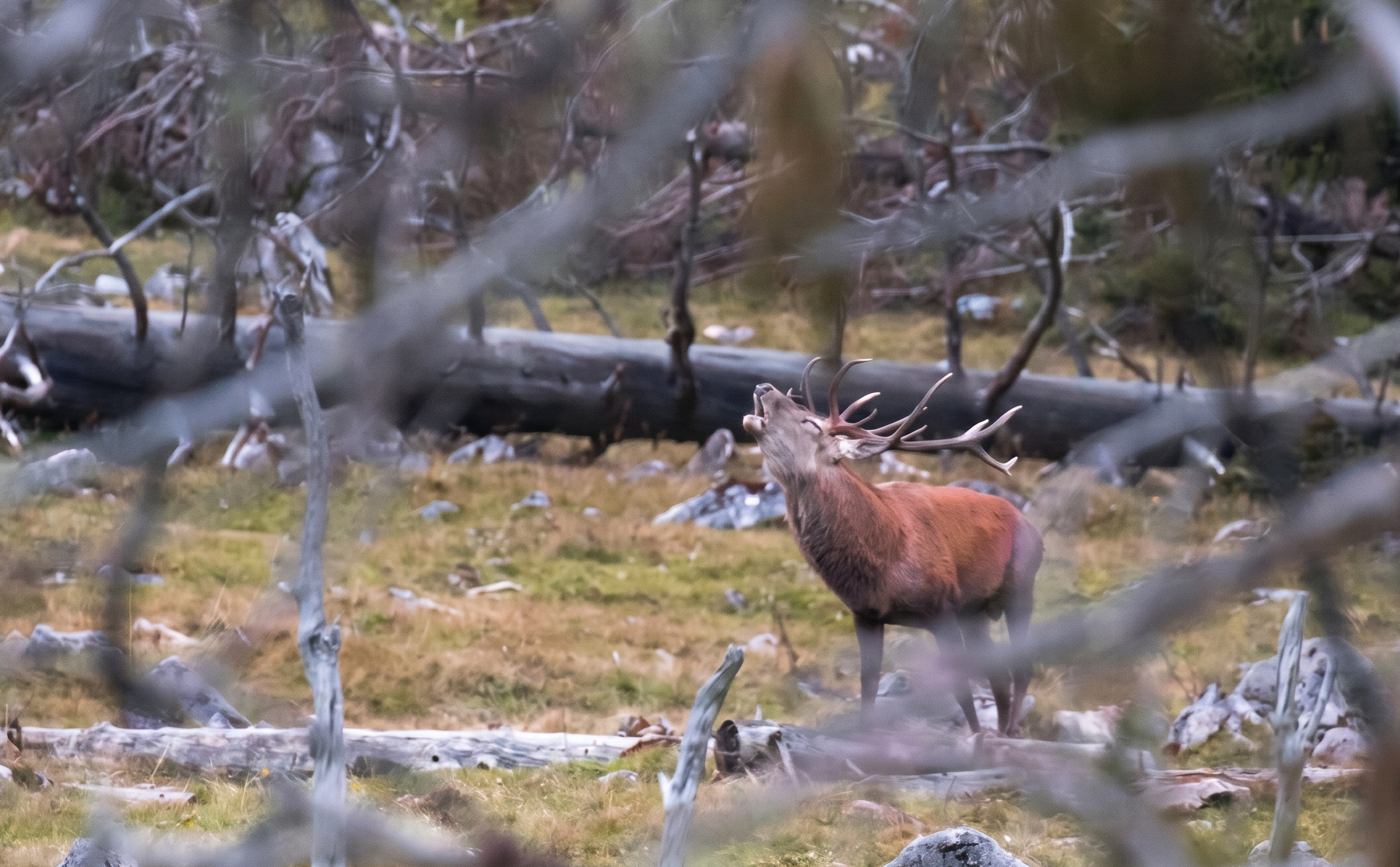

In our recent paper, "Increasing forest disturbance enhances habitat suitability for Europe’s large herbivores," published in Nature Ecology & Evolution, my colleagues and I set out to understand how increasing forest disturbances across Europe have reshaped the habitats of some the continent’s most iconic large mammals. Understanding how forest dynamics have affected these species was particularly interesting because of the important ecological roles they play in forest ecosystems.
Rapid changes with unclear impacts
The motivation for this study came from a simple observation: As in many regions of the world, forests in Europe have been changing rapidly, but the long-term impacts on wildlife, including large herbivores, have remained poorly understood. Over the last few decades, canopy mortality has doubled in Europe’s temperate forests1, driven by both intensified forest use and a strong increase in natural disturbances like bark beetle outbreaks, forest fires, and windstorms, also fueled by climate change2.
At the same time, populations of widespread and abundant large herbivores, including red deer and roe deer, have been growing considerably. Meanwhile, the largest herbivores on the continent, European bison and moose, still absent from large parts of their former ranges, have been expanding their distributions. While previous, local studies already showed that forest disturbances often create good foraging conditions and can attract large herbivores3, we did not know how the impact of disturbances played out across an entire continent and over several decades. How long do benefits last? How do impacts vary across seasons and landscape contexts? And do different species respond in the same way?
Two satellite technologies and a large collaborative effort
To answer these questions, we integrated datasets from two satellite technologies: satellite images and animal tracking data collected via GPS collars. To capture a wide gradient of foraging strategies, we focused on four European herbivore species whose native ranges cover large parts of the continent (European bison, moose, red deer, and roe deer). Because capturing and collaring wild animals is costly and labor-intensive, past studies were often limited to a few individuals in small geographic areas. Through a large collaborative effort involving researchers from across Europe and the EUROMAMMALS network, we were able overcome these limitations, allowing us to compile a massive dataset comprising 3,069 tracked animals and over 19 million individual locations collected over more than 25 years. By matching this tracking data with high-resolution satellite maps that capture forest disturbances year-by-year, we could see exactly how these animals used disturbed forests compared to undisturbed areas.
What the Data Told Us
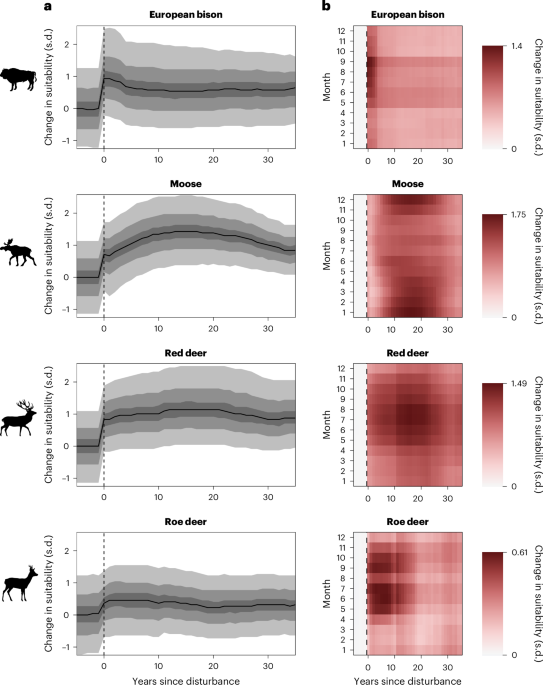
Long-lasting benefits: We found that all four species used disturbed forest areas more intensively than undisturbed forest areas at least 35 years after the event.
Foraging strategies determine the use of disturbed areas over time: The timing of these benefits closely matched species-specific foraging strategies. European bison preferred the early stages of regrowth. In contrast, moose and red deer showed a delayed response, peaking 10 to 20 years later when regrowing trees provided optimal browsing conditions.
Preference for small patches: All species preferred smaller disturbance patches over large, expansive ones. Smaller patches provide easily accessible, high-quality forage while allowing animals to stay near protective tree cover, minimizing the exposure to predators or weather extremes.
Importance of landscape context: We found that the attraction to disturbed forest was even stronger in landscapes where other foraging habitats, like grasslands or croplands, were rare.
Why This Matters for Wildlife and Forest management in Europe
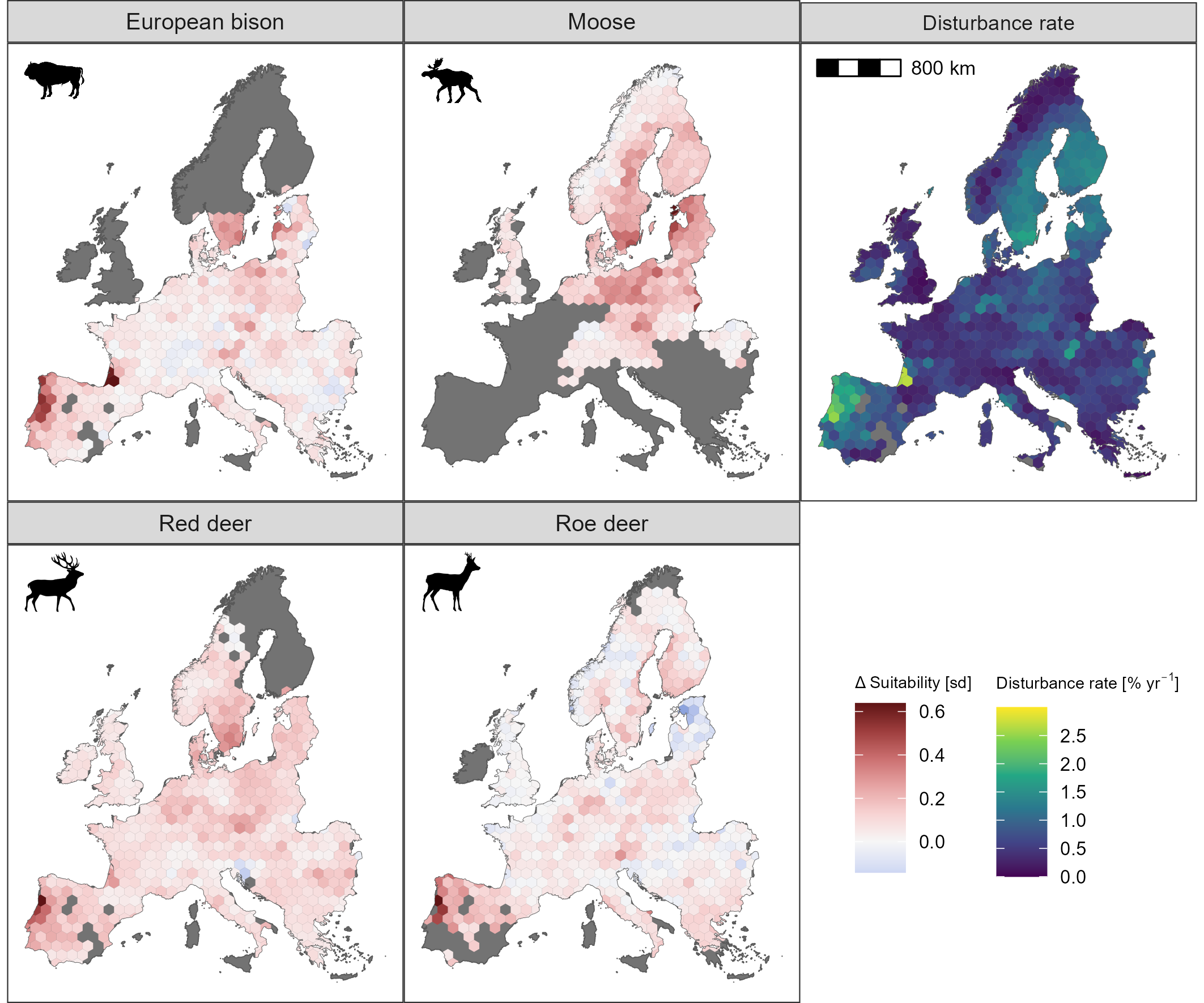
Our results show that recent forest disturbances have significantly improved habitat conditions for large herbivores across Europe. Moose and red deer benefited more strongly than the other species, and habitat improvements were particularly pronounced in highly disturbed regions like Scandinavia, Western Iberia, and parts of Central Europe.
However, these habitat improvements also imply new challenges for wildlife and forest management. The attraction of large herbivores to disturbed areas can lead to higher browsing pressure on young trees. This can intensify already widespread conflicts with forestry in areas where timber production is a priority. Conversely, ecological restoration and rewilding initiatives often view this increased impact on forest vegetation positively, as it can enhance biodiversity and strengthen ecosystem resilience.4.
As climate change continues to increase disturbance rates in Europe5 and elsewhere, understanding the long-term interactions between disturbance dynamics and large herbivores is crucial. Acknowledging forest disturbances as key drivers of habitat dynamics and better considering their impact on wildlife populations will be important to design management strategies that balance timber production, wildlife conservation, biodiversity, and ecosystem resilience.
- Senf, C. et al. Canopy mortality has doubled in Europe’s temperate forests over the last three decades. Nat. Commun. 9, 4978 (2018).
- Seidl, R. et al. Forest disturbances under climate change. Nat. Clim. Change 7, 395–402 (2017).
- Kuijper, D. P. J. et al. Do ungulates preferentially feed in forest gaps in European temperate forest? For. Ecol. Manag. 258, 1528–1535 (2009).
- Svenning, J.-C., Buitenwerf, R. & Roux, E. L. Trophic rewilding as a restoration approach under emerging novel biosphere conditions. Curr. Biol. 34, R435–R451 (2024).
- Grünig, M. et al. Climate change will increase forest disturbances in Europe throughout the 21st century. Science 391, eadx6329 (2026).

Follow the Topic
-
Nature Ecology & Evolution
This journal is interested in the full spectrum of ecological and evolutionary biology, encompassing approaches at the molecular, organismal, population, community and ecosystem levels, as well as relevant parts of the social sciences.

Related Collections
With Collections, you can get published faster and increase your visibility.
Biodiversity and ecosystem functioning of global peatlands
Publishing Model: Hybrid
Deadline: Jul 27, 2026
Understanding species redistributions under global climate change
Publishing Model: Hybrid
Deadline: Dec 31, 2026



Please sign in or register for FREE
If you are a registered user on Research Communities by Springer Nature, please sign in