Why recommender systems need diversity, before the walls of Plato’s cave become unbreakable
Published in Social Sciences, Mathematical & Computational Engineering Applications, and Arts & Humanities


The verdict was historic. It confirmed what many researchers have been warning for years. Algorithmic systems are much more influential than we think. They shape our experiences, emotions, worldviews, and much more.
The morning I read the news, I thought about something I had seen repeatedly in my research. People are consuming information online, but they are also consumed by its structure. What the lawsuit revealed publicly is something I have been studying privately for a long time.
It reminded me of a metaphor that has anchored my thinking for years: Plato’s cave.
In Plato’s story, people sit in darkness, mistaking the shadows on the wall for reality. They do not know that the shadows are curated. They do not know that someone is choosing what they see. They do not know that there is a world beyond the images.
Recommender systems have become the modern torch bearers, casting the shadows we take for reality. Their influence reaches everyone, including the people who create them.
Creators, scientists, artists, and even national leaders live inside these algorithmic environments. The decisions they make can involve matters as serious as conflict or war, something we have witnessed more than once in the recent past. In such a climate, algorithms can amplify anger and tension, even among statesmen making critical choices. The stakes of algorithmic influence are therefore impossible to ignore.
We open our phones in the morning and receive an emotional atmosphere shaped by a mathematical function. We scroll at night and encounter a filtered slice of the world, personalized for what we reacted to yesterday. The walls of the cave are smooth, bright, entertaining, and calibrated to keep us facing forward.
In my earlier paper AI Alignment: Assessing the Global Impact of Recommender Systems, published in Futures in 2024, I argued that these systems already act as global infrastructures of attention. They steer curiosity, polarize groups, compress emotional landscapes, and influence civic life. At the time, this felt urgent. After the Meta and YouTube trial, it now feels late.
Yet my current work began but from observation.
I often talk with students who tell me that their feeds feel strangely uniform. They describe seeing the same emotional tone again and again: outrage, envy, sarcasm, despair, euphoric consumerism, one dominant mood, repeated. Friends have said that their recommendations feel like variations of the same theme, even across different months. And when I ask people whether they ever encounter political views outside their own, the answer is often only when the system seems to want to make them angry.
This narrowing does happens quietly. It happens when familiar content performs better than unfamiliar content. It happens when engagement becomes the central metric. It happens when the system decides that new perspectives are risky because they may reduce scrolling time.
It happens when the cave becomes comfortable.
That was the moment I started asking a different question: if recommender systems shape our informational environment, how do we design them to support well being, not only engagement?
This paper is one attempt at an answer.
The idea is simple. If recommender systems influence what people see, then diversity cannot be an optional feature added afterward. It needs to be part of the core scoring process.
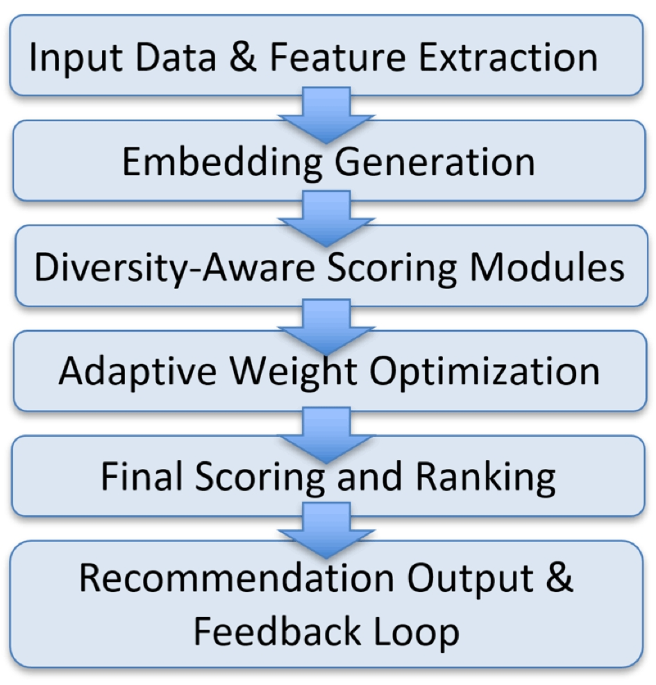
The model we developed integrates three different forms of diversity directly into the recommendation score, each addressing a crucial facet of human experience. It considers emotional diversity to counter the repetitive affective climates that often encourage addictive patterns of use. It incorporates categorical diversity to broaden intellectual exploration and help users step beyond narrow comfort zones. And it includes political diversity to soften echo chambers and reduce the gradual hardening of ideological divides. These dimensions create a more balanced and human centered recommendation process.
We chose these three dimensions because they mirror how people live. We think in feelings, we grow through topics, and we navigate the world through values and viewpoints. These are the building blocks of human experience. A system that recognizes them can better reflect human complexity.
The outcome was encouraging. Diversity increased substantially, sometimes doubling, while accuracy barely changed. This matters because it challenges a powerful myth in algorithmic design that relevance and diversity are mutually exclusive. They are not. The trade off is not as steep as many believe. When diversity is built into the core architecture, the system can balance both.
For me, this was a reminder that the human mind can handle more than algorithms often assume. People can learn, explore, and engage with unfamiliar material if the system gives them the chance.
Behind this work is also personal experience.
I have watched recommender systems influence people close to me. I have seen how someone’s emotional state can become tied to the tone of their feed. I have seen how political perspectives harden when the only alternative views people encounter are extreme caricatures. I have seen how creativity shrinks when recommendations reflect only past behavior. And I have seen how easy it is for a digital environment to become an invisible routine.
I have also seen the opposite. Exposure to varied emotional tones can lift someone’s mood. An unexpected category can awaken curiosity. A balanced set of political viewpoints can reduce hostility. A more diverse feed can remind someone that the world is larger than their scrolling history.
These experiences were the ground truth guiding the design of this model.
The Meta and YouTube ruling marks a historical moment when society begins asking for accountability. Governments, parents, and institutions are not satisfied with the idea that personalization is harmless optimization. The world is waking up to the fact that recommender systems are not neutral. They are behavioral infrastructures.
The question now is what we do with this realization.
Plato believed that leaving the cave required courage and that returning to help others required responsibility. We are at a similar threshold. Regulators, Engineers, researchers, and platform designers have the chance to reshape how recommender systems work before harmful patterns become locked into everyday life.
This paper proposes one path: integrating diversity into the heart of the algorithmic process rather than treating it as decoration.
The influence of algorithmic systems on social media over the past two decades has helped create a global environment marked by polarization, rising anger, growing populism, and weakening democratic culture. This is a complex claim but a large body of research points toward the same direction. The informational climate we live in was shaped, in part, by systems optimized primarily for engagement and profit.
This is why the difference between the current profit oriented recommender systems and those that balance commercial goals with the well being of citizens is so significant. It is a shift in purpose. It is the difference between a system built to widen perspective and a system built to deepen a groove. It is the difference between a cave that narrows over time and a cave with an opening toward daylight.
What I hope readers take away is simple. Recommender systems can serve society better. They can promote exploration, balance, and emotional richness. But they must be designed with these values from the beginning.
The cave is engineered.
And that means it can be re engineered.

Ljubisa Bojic is a communication scientist, futurologist, and author of the papers CERN for AI: A Theoretical Framework for Autonomous Simulation-Based Artificial Intelligence Testing and Alignment, AI alignment: Assessing the global impact of recommender systems and Metaverse through the prism of power and addiction: What will happen when the virtual world becomes more attractive than reality? Bojic received his Ph.D. from the University of Lyon II, France in 2014 and is currently a senior research fellow at the Digital Society Lab, Institute for Philosophy and Social Theory, at the University of Belgrade, senior research fellow at the Institute for Artificial Intelligence of Serbia. He has written more than 50 scientific papers, some of them published in leading journals, such as the European Journal of Futures Research, Scientific Reports and Futures. Bojic was appointed to the United Nations Environment Programme Foresight Expert Panel by UNEP’s Chief Scientist Andrea Hinwood. He was a member of the Serbian government work group dedicated to developing ethical standards for artificial intelligence. Bojic is associate editor of Springer’s journal Humanities & Social Sciences Communications and serves as an executive board member on Horizon’s Project 2022 TWin of Online Social Networks. He is the founder of EMERGE: Forum on the Future of AI Driven Humanity and the initiator of the Belgrade Digital Freedom Pledge intended to stimulate widespread conversations about recognizing recommender systems as a public good and digital identity as a human right. Bojic was featured in the book The Edinburgh Companion to the New European Humanities as one of the founders of a new multidisciplinary approach that uses digital tools to inquire into the humanities. The current focus of Bojic’s research is the development of global AI policies and the alignment of AI with human values and wellbeing. He is frequently invited by the media to comment on the latest developments in AI from the perspective of social sciences and digital humanism. Bojic speaks at universities and events across the world about his latest research.


Please sign in or register for FREE
If you are a registered user on Research Communities by Springer Nature, please sign in