
Bangladesh is urbanizing at a pace few countries have experienced. Cities are expanding faster than the institutions meant to manage water, sanitation, waste, and climate risks. As researchers working closely with urban communities and local governments, we repeatedly encountered a simple but uncomfortable question: How sustainable are our cities really, and how can we compare them in a way that helps policy and planning? Existing assessments often relied on national averages or sector-by-sector indicators, which obscured sharp inequalities within and across cities. This gap motivated our study.
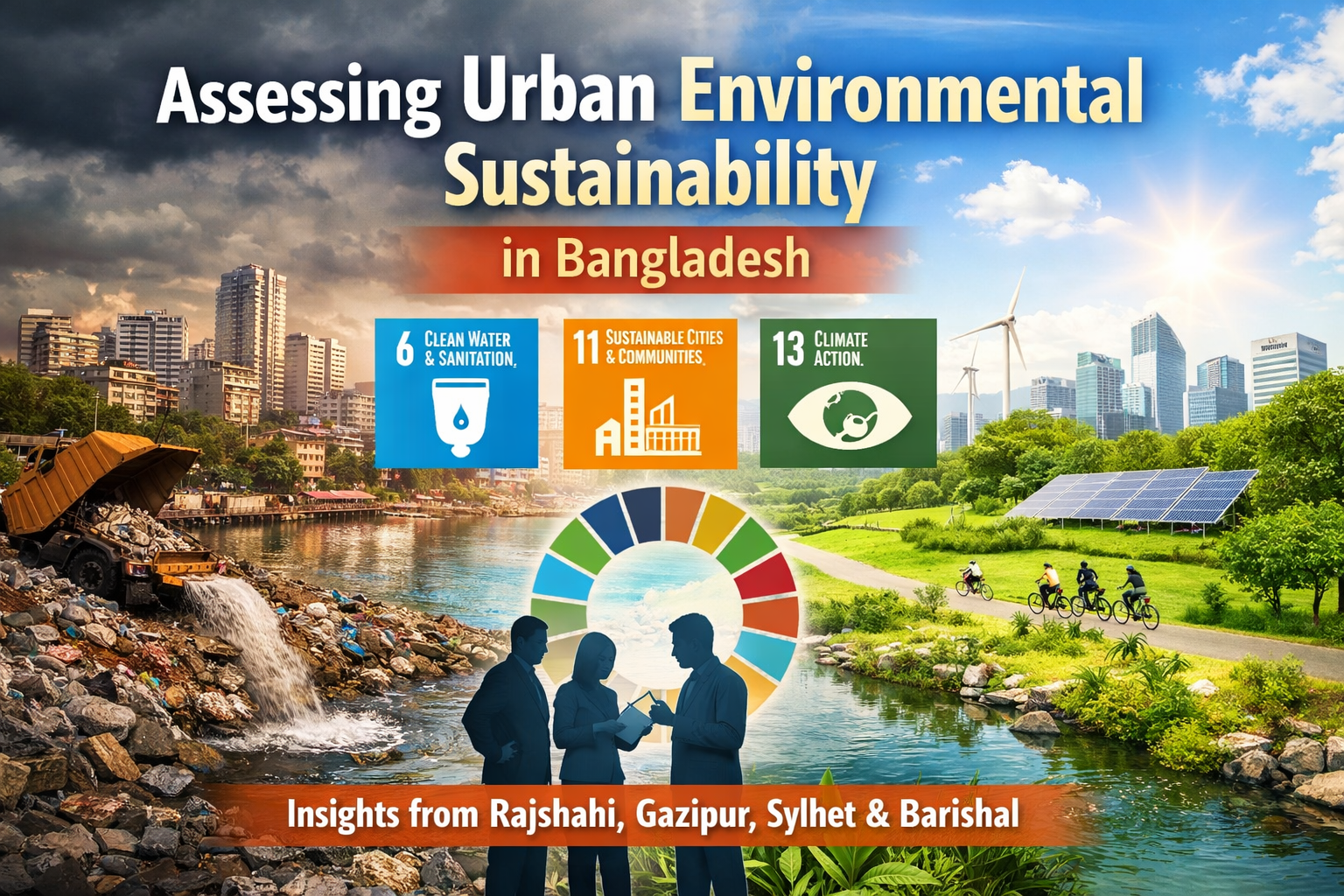
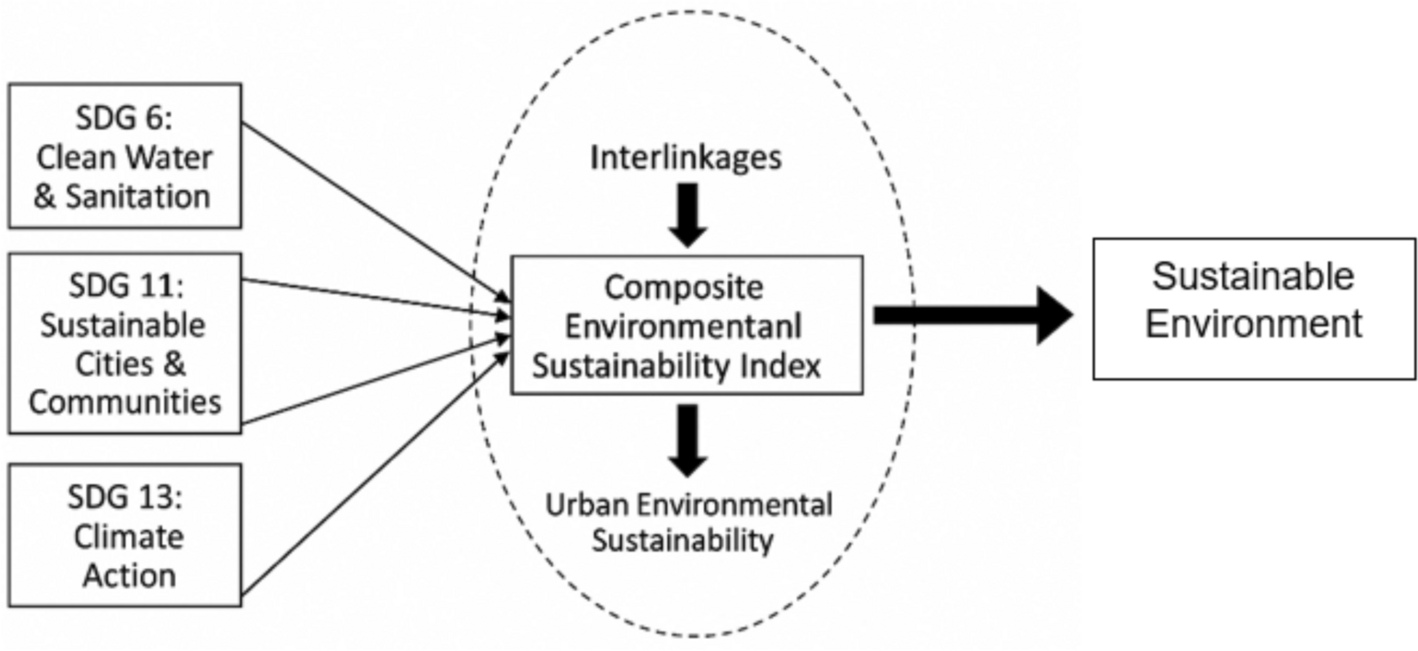
Our paper develops and applies an SDG-aligned composite framework to assess urban environmental sustainability in four major city corporations of Bangladesh, Rajshahi, Gazipur, Sylhet, and Barishal. By focusing on SDG 6 (Clean Water and Sanitation), SDG 11 (Sustainable Cities and Communities), and SDG 13 (Climate Action), we aimed to capture the environmental backbone of urban sustainability while explicitly recognizing the interlinkages among water, infrastructure, and climate resilience.
Building an index that reflects lived urban realities
A core contribution of this study is methodological. Rather than relying solely on secondary statistics, we combined official data with a primary household survey of 1,200 respondents across the four cities. This allowed us to capture not only infrastructure coverage but also service reliability, environmental perceptions, and climate risk experiences at the household level.
Using standardized normalization, principal component analysis, and aggregation techniques, we constructed a Composite Sustainability Index that integrates indicators across the three SDGs. Importantly, this approach does not treat the goals as isolated silos. Instead, it operationalizes the SDG nexus, recognizing that improvements in waste management, for example, can enhance water quality and reduce climate-related vulnerabilities.
What we found: moderate progress, unevenly distributed
Our results show that overall urban environmental sustainability in Bangladesh’s cities remains moderate. Among the four city corporations, Rajshahi emerged as the strongest performer, while Gazipur, despite being one of the country’s fastest-growing industrial hubs, ranked lowest. Sylhet and Barishal occupied intermediate positions, each with distinctive strengths and vulnerabilities.
Across all cities, SDG 6 indicators generally performed better than those related to SDG 11 and SDG 13. Access to water and sanitation has expanded, but service quality, equity, and long-term safety remain uneven. Performance on climate action was the weakest and most variable, revealing significant gaps in adaptation planning, renewable energy adoption, and institutional preparedness.
One of the most striking findings is the strength of interlinkages among the SDGs. Water and sanitation outcomes were strongly correlated with urban infrastructure and service quality, while climate resilience was closely tied to how well cities managed waste, drainage, and public services. These patterns confirm that sustainability gains in cities are rarely achieved through single-sector interventions.
Inequality matters, socially and spatially
Beyond city-level comparisons, our analysis highlights deep social and spatial inequalities. Higher-income and better-educated households consistently scored higher on the composite sustainability index, reflecting better access to services and greater adaptive capacity. Female-headed households showed relatively stronger outcomes in water and sanitation, likely reflecting targeted WASH initiatives, but lagged in climate-related dimensions, pointing to persistent barriers in access to finance, energy technologies, and decision-making spaces.
These findings reinforce a critical message: urban sustainability is not only an environmental or technical challenge; it is also a question of equity, governance, and inclusion.
Why this research matters
This study contributes to urban sustainability research in three key ways. First, it offers a replicable, SDG-aligned framework that can be used by policymakers and researchers to monitor sustainability at the city level in data-constrained contexts. Second, it provides empirical evidence of the SDG nexus in action, demonstrating that fragmented governance undermines sustainability outcomes. Third, it generates city-specific insights that can inform targeted policy responses rather than one-size-fits-all solutions.
For Bangladesh, and other rapidly urbanizing countries, the implication is clear: achieving the 2030 Agenda will depend on strengthening integrated urban governance, investing in climate adaptation alongside basic services, and addressing the social inequalities that shape environmental outcomes. We hope this work supports more evidence-based, locally grounded pathways toward sustainable and resilient cities.
— Imran Hossain and co-authors

Follow the Topic
-
Discover Cities
This is a fully open access, peer-reviewed journal that supports multidisciplinary research and policy developments across the field of urban science.

What are SDG Topics?
An introduction to Sustainable Development Goals (SDGs) Topics and their role in highlighting sustainable development research.
Continue reading announcementRelated Collections
With Collections, you can get published faster and increase your visibility.
Green Spaces and Sustainability in Cities
In recent decades, with the rapid development of urbanization, it has brought about rapid economic development and convenient life, while it has also brought a series of environmental problems, including global warming, air pollution, ecosystem chaos, biodiversity decline and other environmental problems, which will also lead to the physical and mental health of residents in cities. Green spaces in cities plays multiple roles in the city of ecological, social and economic services, is an integral part of the urban ecosystem, and plays an indispensable role in improving environmental problems and promoting sustainable development in cities.
This series aims to discuss the role of green spaces in alleviating environmental problems in cities, as well as research on the use and management of green spaces in sustainable urban development. Through this series of studies, we will explore how to better play the ecological and social service functions of green spaces in cities and promote the sustainable development of cities.
The research collected in this series includes, but is not limited to, the following topics:
• Evaluation of green spaces and ecological services value in cities;
• Evaluation the accessibility and equity of green spaces in cities;
• The impact of green spaces on microclimate in cities;
• Green spaces and health in cities;
• Green spaces and resilient cities;
• Green spaces and social justice;
• Green spaces and the well-being of residents in cities;
• Governing, planning and management of green spaces in cities.
• Green spaces in smart cities;
• Sustainable development in cities.
Keywords: Green space; Environmental sustainability; Climate change; Social justice; Resilient cities; Smart cities; Health; Urban planning; Urban service
Publishing Model: Open Access
Deadline: Jan 31, 2027
Urban Futures: Strategies for Decarbonized, Resilient, and Equitable Cities
Cities stand at the forefront of the global sustainability challenge. This Collection explores how urban areas can become drivers of climate action, social equity, and systemic transformation. Drawing from contributions presented at the Urban Futures Symposium 2025 (hosted by the Urban Energy Systems Laboratory at Empa, Switzerland), this Collection brings together research, practice, and policy insights on how to build decarbonized, resilient, and equitable cities.
The articles cover a wide range of themes, including integrated urban energy systems, low-carbon mobility, participatory governance, just and equitable transitions, sufficiency-based planning, nature-based solutions, circularity, embodied emissions, digital urban innovations, financing and economics, and building and energy technologies. With case studies from cities across the Global North and South, and perspectives from both academic and practitioner communities, the Collection highlights interdisciplinary and cross-scale strategies for navigating urban complexity in a rapidly changing world.
We invite contributions that explore theoretical frameworks, empirical studies, modeling approaches, or co-designed solutions for shaping just, climate-compatible urban futures.
Keywords: Urban transitions; Urban resilience; Participatory urban planning; Justice, equity, and well-being; Urban governance and policy; Integrated energy systems and technologies; Sustainable mobility; Sufficiency strategies; Circular economy and resource flows; Materials and embodied emissions; Nature-based solutions; Urban ecology and environmental systems; Financing mechanisms and urban economics; Innovations in the built environment; Systemic innovation for urban sustainability.
This Collection supports and amplifies research related to SDG 11 (Sustainable Cities and Communities), SDG 7 (Affordable and Clean Energy), SDG 13 (Climate Action), SDG 12 (Responsible Consumption and Production), and SDG 10 (Reduced Inequalities).
Publishing Model: Open Access
Deadline: Dec 31, 2026