Wolbachia Moves in: How Does the Bacteria fare in Mosquitoes in Urban Environments?
Published in Microbiology and Zoology & Veterinary Science


According to the WHO, each year almost 4 billion people are at risk of contracting mosquito-borne diseases, such as dengue fever. Other types of mosquito-borne diseases include malaria, Zika, yellow fever, West Nile virus, and chikungunya.
However, there are some potentially promising ways of containing and reducing the transmission of these diseases, such as by utilizing Wolbachia, a bacterium that can infect many different kinds of invertebrates. In fact, scientists estimate it can be found in 6 out of 10 of all insects.
While they aren’t found in all types of mosquitoes, the bacteria can be introduced in a lab setting into Aedes aegypti, a species that carries dengue, yellow fever, and other mosquito-borne diseases. Scientists then release these mosquitoes into the wild, where they mate and pass it down to future generations.
But why should we care about these tiny microbes?
Because, as this Scientific American article puts it, “For our purposes, the most interesting characteristic of Wolbachia is that it appears to block the dengue virus from replicating in the tissues of mosquitoes.” It has also been shown to limit transmission of other mosquito-borne diseases, such as yellow fever and Zika.
However, in the grand scheme of things, this Wolbachia treatment is still relatively new and further studies are required to analyze some of the intricacies. For example, it’s not so simple as just releasing Wolbachia-infected mosquitoes into the environment and then letting nature take its course. In fact, the environment itself may impact how successful the Wolbachia replacement strategy is successful or not. This is especially noticeable in cities, as “complex urban environments where fine-scale heterogeneity in temperature and built environment may influence mosquito population dynamics.”
In a new Research Article entitled “Climate and landscape features associated with successful Wolbachia replacement in the municipality of Rio de Janeiro, Brazil” in Parasites & Vectors, available now as an Article in Press, Tiley et al. set out to “investigate how climate and landscape features are associated with heterogeneous Wolbachia replacement outcomes using wMel prevalence data from releases in the municipality of Rio de Janeiro, Brazil.”
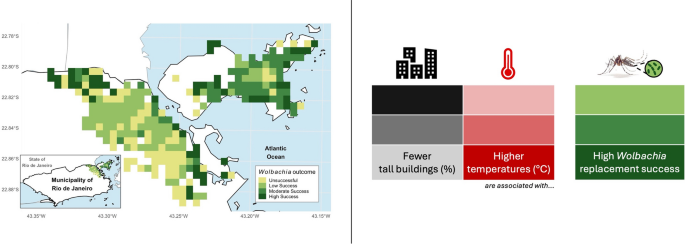
To do this, the team broke the city down into 500-by-500-meter units and, across a 26-month timespan, analyzed how successful Wolbachia deployment was, exploring various associations, such as the temperature, elevation, rainfall, and building structure.
They found that the success of the Wolbachia introduction was related to warmer temperatures and fewer tall buildings, and negatively associated with high elevation and lower rates of rainfall. However, Tiley et al. did state that, “These associations may also reflect unmeasured socioeconomic or infrastructure variation.”
These results show that Wolbachia replacement strategies may struggle in drier urban environments with taller buildings. They speculate that when trying to introduce Wolbachia infected A. aegypti into these sorts of locations, researchers “may require higher release densities, targeted supplemental interventions, and more intensive monitoring,” though they note that these theories require further studies, pointing to potential directions for future research.
For the time being, strategies involving Wolbachia replacement remain works in progress, but they show great promise. Who knows. Maybe one day, as that Scientific American article puts it, we could defeat dengue.
Header image: Photo of Rio de Janeiro by chulhwan from PixaBay

Follow the Topic
-
Parasites & Vectors
This journal publishes articles on the biology of parasites, parasitic diseases, intermediate hosts, vectors and vector-borne pathogens.
-
BugBitten
A blog for the parasitology and vector biology community.

Related Collections
With Collections, you can get published faster and increase your visibility.
Translational leishmaniasis
This collection focuses on leishmaniasis as a central model while also encompassing related parasites that share comparable biological traits, pathogenic mechanisms, and clinical relevance. The aim is to create a translational bridge between basic research and practical applications, highlighting insights that can be extended across the spectrum of kinetoplastids and other closely linked parasites.
Topics of interest include:
• Analytical and omics-based advances for parasite detection, monitoring, and characterization.
• Comparative biology of Leishmania and related parasites, with emphasis on shared mechanisms of infection and survival.
• Host-pathogen interactions and immune responses.
• Epidemiology and transmission dynamics, including drawing parallels between leishmaniasis and other parasitic infections.
• Translational strategies in drug discovery, vaccine development, and therapeutic interventions applicable to leishmaniasis and related parasitic diseases.
By linking leishmaniasis with other parasitic diseases of similar characteristics, this collection seeks to foster integrative approaches, stimulate cross-disciplinary dialogue, and accelerate the translation of knowledge into innovative diagnostic, preventive, and therapeutic solutions.
Publishing Model: Open Access
Deadline: Nov 27, 2026
Credelio Quattro
This collection was created to facilitate access to manuscripts published in Parasites & Vectors focusing on Credelio Quattro™ (lotilaner, moxidectin, praziquantel, and pyrantel chewable tablets).
Articles published in the collection have already gone through the systematic peer review process of the journal.
Publishing Model: Open Access
Deadline: Ongoing