How Tiny Power Sources Could Revolutionize Bioelectronics?

Like

Share this post

Choose a social network to share with, or copy the URL to share elsewhere

This is a representation of how your post may appear on social media. The actual post will vary between social networks

Explore the Research

Springer Nature Singapore
Springer Nature Singapore Springer Nature Singapore

Thin-Film-Engineered Self-Assembly of 3D Coaxial Microfluidics with a Tunable Polyimide Membrane for Bioelectronic Power - Nano-Micro Letters

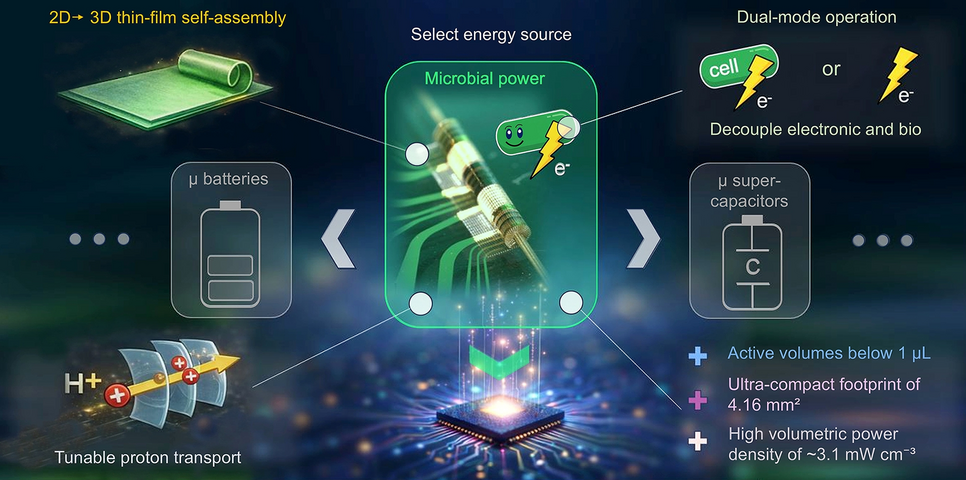
Thin-film self-assembly of three-dimensional (3D) microsystems presents a compelling route to integrate complex functionalities into ultra-compact volumes; yet, strategies for incorporating tunable ion-conducting elements remain limited. Here, we introduce a strain-induced self-assembly platform that transforms lithographically patterned multilayer thin films into functional 3D coaxial Swiss-roll microtubes with total active volumes below 1 µL. A key innovation is the monolithic integration of a chemically tunable polyimide proton exchange membrane, enabling post-fabrication optimization of ionic transport that balances proton transport with mediator blocking. We further implement a dual-mode operational scheme that decouples microbial metabolism from electrochemical power generation, revealing biofouling, not chemical fouling or membrane degradation, as the dominant failure mechanism in conventional architectures. Critically, optimally treated polyimide membranes exhibit excellent recoverability after fouling, while cell-free mode operation maintains stable performance by physically excluding microorganisms from the microelectronic environment. This integrated bio-electronic microsystem achieves a volumetric power density of ~ 3.1 mW cm⁻3 within an ultra-compact footprint of 4.16 mm2. Our work establishes a scalable thin-film engineering approach to create tunable, 3D bioelectronic power sources for autonomous microsystems. Graphical Abstract

Egunov, A.I., Tang, H., Saenz, P.E. et al. Thin-Film-Engineered Self-Assembly of 3D Coaxial Microfluidics with a Tunable Polyimide Membrane for Bioelectronic Power. Nano-Micro Lett. 18, 342 (2026). https://doi.org/10.1007/s40820-026-02188-7

Please sign in or register for FREE

If you are a registered user on Research Communities by Springer Nature, please sign in