Decoding the brain and body in motion
Published in Neuroscience and Behavioural Sciences & Psychology



Inside the brain and body during basketball movement
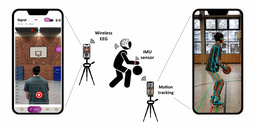
What happens in the brain when a basketball player prepares for a shot? This video presents the portable mobile brain/body imaging framework that we developed to simultaneously record neural and behavioral signals during natural settings, using basketball as an example.
Our setup combines two smartphones, a wireless EEG system, camera-based human pose tracking, and a wrist-worn inertial measurement unit (IMU). Together, these components allow simultaneous acquisition of brain activity and whole-body movement outside the laboratory using low-cost, lightweight, and portable equipment.
In our study, 26 basketball players performed self-paced free throws while all signals were recorded simultaneously. Using these synchronized recordings, we identified the readiness potential—a slow negative EEG potential reflecting movement preparation—during a complex, natural whole-body action. The study demonstrates that meaningful neural activity can be measured reliably in realistic environments rather than only under highly controlled laboratory conditions.
This video provides a concise overview of the acquisition framework and illustrates how brain and body signals were integrated throughout the experiment. The complete methodology, results, code, resources development , project website, open-source apps, and additional YouTube videos are available.
For the full story behind this work—including the motivation, challenges, and broader implications—see our accompanying Behind the Paper article on Springer Nature Research Communities.
Related publication
Contreras-Altamirano, M., Klapprott, M., Jacobsen, N., Maanen, P., Welzel, J., & Debener, S. (2026). A portable solution for simultaneous human movement and mobile EEG acquisition: readiness potential for basketball free-throw shooting. Experimental Brain Research, 244, Article 153. DOI: https://doi.org/10.1007/s00221-026-07342-6
Related links
- Project website: https://juliuswelzel.github.io/eeg_basketball_website/
- YouTube playlist: https://youtube.com/playlist?list=PLXzC1LH6jMuk
- GiHub: https://github.com/micufx/Pupillometry-EEG
- Related literature: https://doi.org/10.1016/j.isci.2026.116647
- Open-source apps: https://neuropsyol.github.io/
References
- Contreras-Altamirano et al. (2026). Experimental Brain Research.
- Debener et al. (2012). Psychophysiology.
- Gramann et al. (2011). Reviews in the Neurosciences.
- Haupt et al. (2026). iScience.
- Jacobsen et al. (2022). Frontiers in Sports and Active Living.
- Klapprott & Debener (2024). Frontiers in Human Neuroscience.
- Schurger et al. (2021). Trends in Cognitive Sciences.
Follow the Topic
-
Experimental Brain Research
This journal publishes original contributions on many aspects of experimental research of the central and peripheral nervous system.

Related Collections
With Collections, you can get published faster and increase your visibility.
Contributions of the reticulospinal system to sensorimotor control
The prominent role the reticulospinal system and descending reticulospinal pathway play in shaping spinal motoneuron excitability and the production of motor responses is being increasingly appreciated. One of the challenges of studying reticulospinal pathways in higher-order vertebrates (e.g. humans and non-human primates) is the difficulty in accessing these systems at the level of the brainstem.
This call of papers invites submissions with novel data showing the contributions of the reticulospinal system, or putative reticulospinal system, to the control of spinal motoneuron excitability, voluntary/involuntary movements, gait or postural control. These studies can include in investigations of the reticulospinal system in animal preparations or humans with or without neurological disorders. Submissions with innovative protocols for examining the contributions of reticulospinal systems to sensorimotor control are highly encouraged.
Publishing Model: Hybrid
Deadline: Ongoing
The contribution of muscle synergies to normal and abnormal motor control
The idea that the CNS may control complex interactions by modular decomposition has received considerable attention. Muscle synergies, computationally identified intermuscular coordination patterns, have been used to characterize neuromuscular control in humans. One important reason for the interest in understanding modularity in motor control is the impaired regularities in muscle activities in various pathologies. Investigations of muscle synergies, motor primitives, compositionality, basic action concepts, and related theoretical and experimental studies may contribute, at different levels, to advance our understanding of the modular architecture underlying motor behaviors. The goal of this Topical Collection is to present and discuss available evidence, conceptual frameworks, and basic issues related to intermuscular coordination patterns in motor control and learning. These cover a range of issues such as the effective dimensionality, neural underpinnings, movement invariants and biomechanical correlates, spinal maps of motoneuron activation, comparative physiology, development, and movement disorders. By bringing together researchers who are interested in understanding the building blocks of coordinating many muscles, we aim at promoting interactions between various research areas and techniques and providing a broad perspective on the notion of modularity in neuromuscular control.
Publishing Model: Hybrid
Deadline: Dec 31, 2026