The hidden symmetry of time : how PT-symmetric wormholes obey Einstein’s laws


This short video summarizes the main contributions of my article published in General Relativity and Gravitation and offers a behind the scene look at the physical intuition and mathematical journey that led to these results.
The starting point : a geometry with 2 faces
The model I explore is a PT-symmetric wormhole meaning a geometry that connects two time-reversed copies of the Schwarzschild exterior. Unlike the classical Einstein-Rosen bridge which is non-traversable, this construction exploits a discrete symmetry combining parity (P) and time reversal (T) to link 2 spacetime regions that are, in a precise sense, mirror images of each other in time. The throat itself is a null hypersurface, a lightlike surface, where the 2 patches are joined.
Exotic matter at the throat : a necessary ingredient
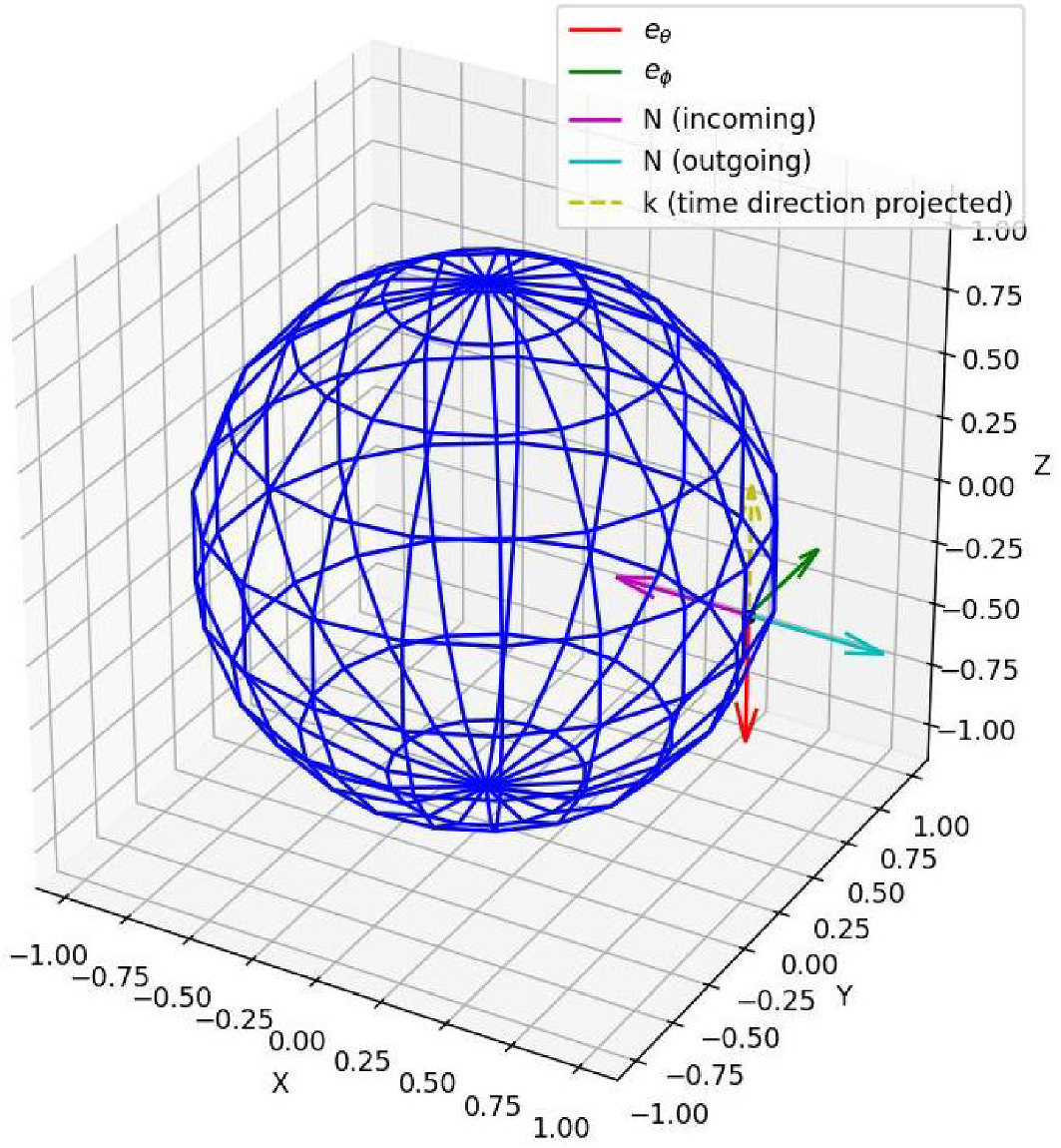
A central question in wormhole physics is always : what holds the throat open ? Using the Barrabès–Israel thin-shell formalism in Poisson's reformulation, I evaluate the surface stress-energy tensor of the null shell located at the throat. The analysis relies on a carefully constructed vector basis on the null hypersurface Σ, illustrated in Figure 1 which shows the null generator k, the two transverse vectors N⁺ and N⁻ associated respectively with the incoming and outgoing sides of the junction and the two spacelike angular directions spanning the sphere S² at r = α.
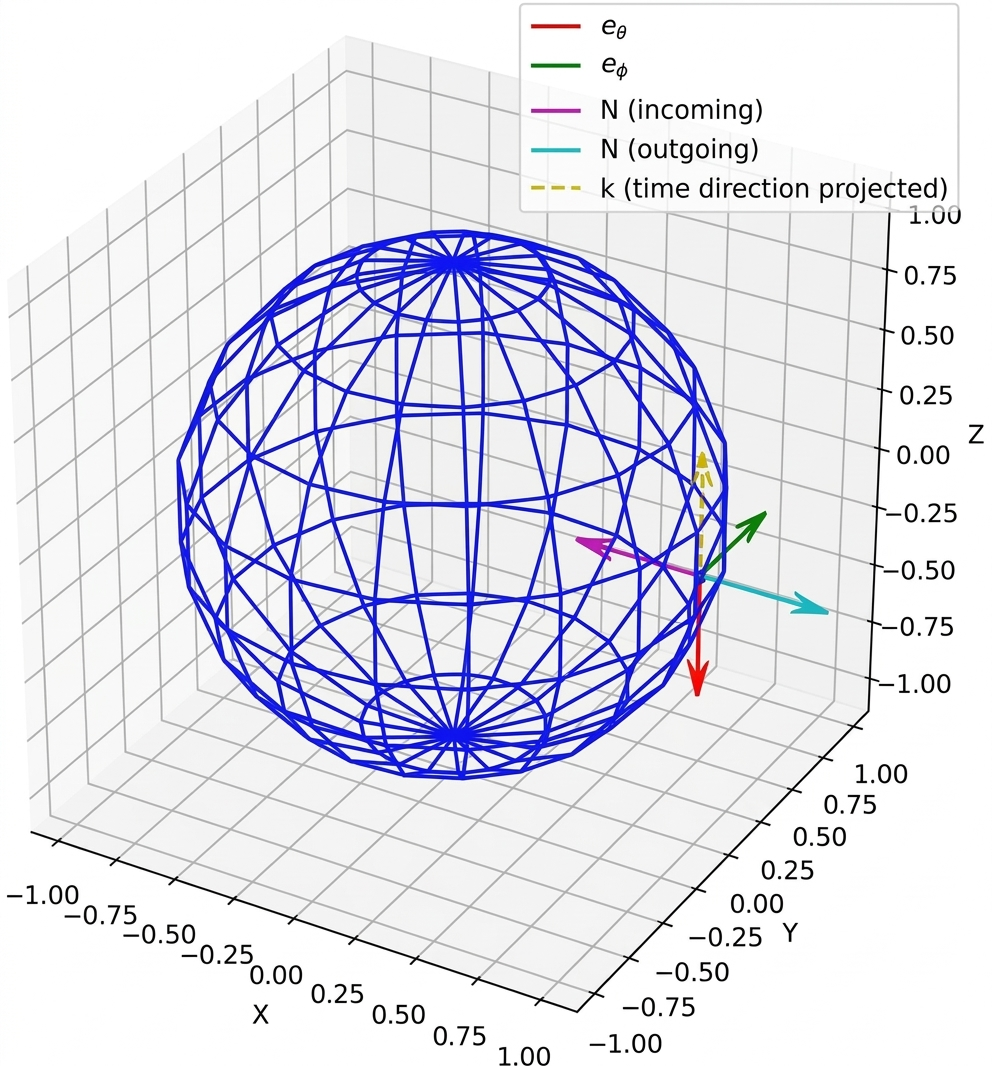
Figure 1
The result is unambiguous : the junction requires exotic matter, specifically a lightlike membrane with negative surface energy density and positive tangential pressure. This is a violation of the null energy condition which is a well-known feature of traversable wormhole geometries, but here derived in a precise and self-consistent framework tied to the PT-symmetric structure.
Conservation laws and the Bianchi identities
One of the key checks in any thin-shell construction is whether the energy-momentum is properly conserved across the junction. I verify this explicitly through the Bianchi identities, confirming that the exotic fluid at the throat acts as a repulsive source that stabilizes the geometry while remaining fully consistent with the Einstein field equations on both sides of the shell. This consistency is not automatic. It is a non-trivial result that validates the physical coherence of the model.
Semi-classical implications
Beyond the classical picture, PT symmetry has interesting quantum consequences. I discuss a PT-induced suppression of vacuum flux at the throat, which can be understood as a partial cancellation between contributions from the two time-reversed regions. This effect has potential implications for the thermodynamics of such objects and for how they interact with quantum fields.
Observational signatures
The most exciting part of the paper is the discussion of potential observational signatures that could, in principle, distinguish a PT-symmetric wormhole from a black hole or other compact objects. Because the throat at r₀ = α and the photon sphere at r = 3M define a wave cavity in tortoise coordinates, illustrated by the effective potential in Figure 3 and the spatial layout in Figure 4, incoming gravitational waves undergo repeated partial reflections, giving rise to the following predictions:
- Gravitational-wave echoes arising from the photon-sphere/throat cavity. The delay between successive echoes scales logarithmically as Δt ~ −(2M/c) ln(ℓ/M) in the near-horizon limit, as shown in Figure 2, with partial reflections between the two potential barriers illustrated in Figure 3.
- Duplicated or through-throat photon rings, leading to non-Kerr asymmetries in horizon-scale images
- PT-paired quasi-normal-mode frequencies, appearing as doublets due to the time-reversal structure
- A relic cosmological population of mini wormholes, which could contribute an effective cosmological constant Λeff or seed large-scale cosmic voids
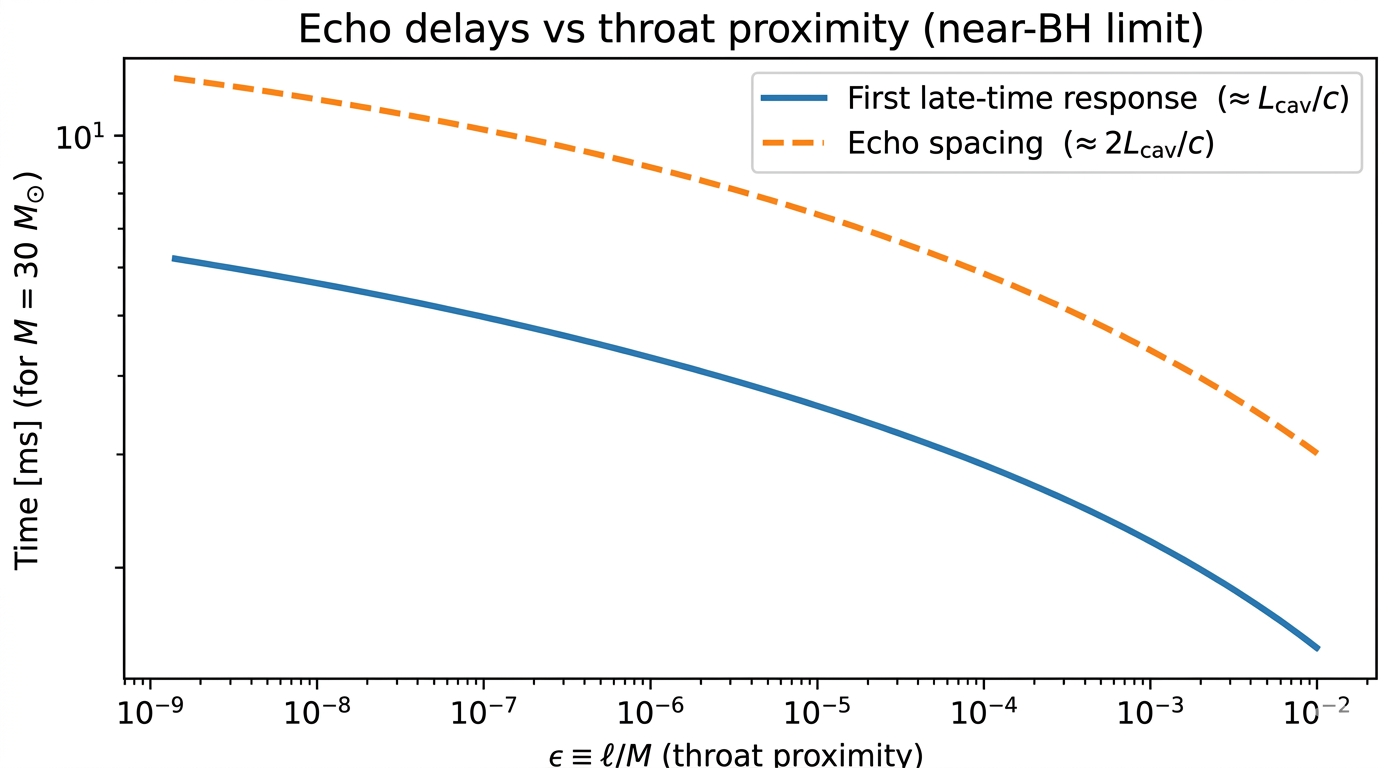
Figure 2
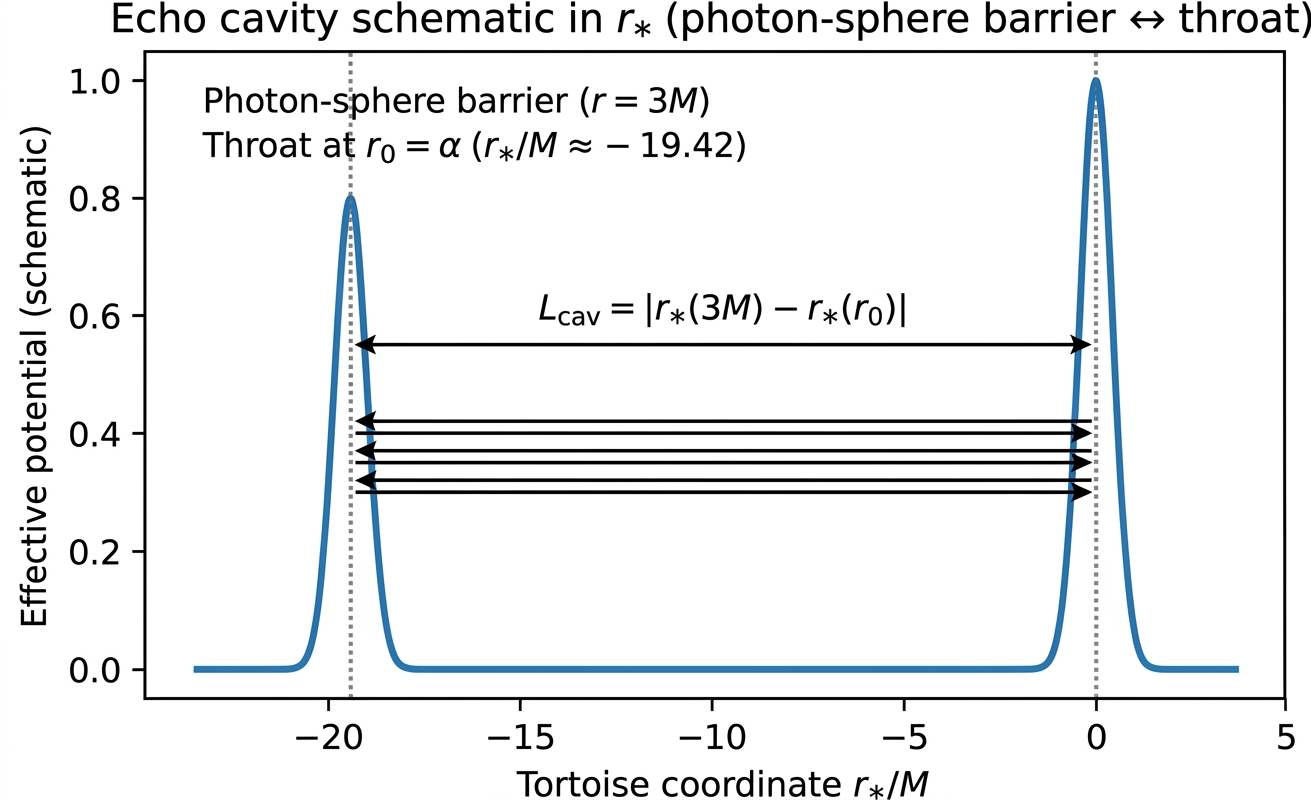
Figure 3
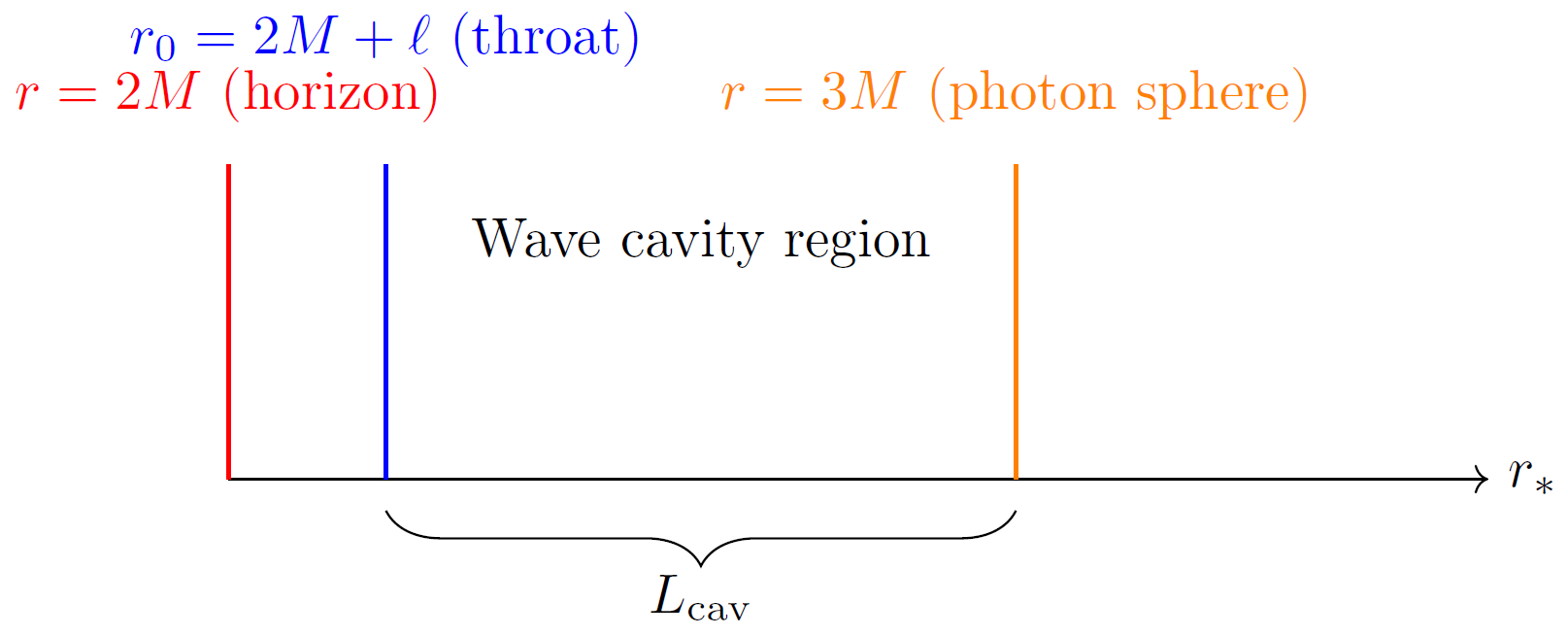
Figure 4
Why this matters ?
PT-symmetric wormholes offer a distinct and mathematically rigorous route to traversability, one that does not rely on ad hoc matter fields, but instead emerges from the symmetry structure of spacetime itself. My work clarifies the conditions under which closed timelike curves can arise in such a framework and lays the groundwork for the 2 follow-up papers recently accepted for publication on Alcubierre-type geometries and quantum entanglement in bimetric spacetimes.

Follow the Topic
-
General Relativity and Gravitation
General Relativity and Gravitation is a journal devoted to all theoretical and experimental aspects of modern gravitational physics.

Related Collections
With Collections, you can get published faster and increase your visibility.
Machine Learning in Gravitational-Wave Science
A collection of articles on applications of machine learning techniques in gravitational-wave research.
While the Living Review "Applications of machine learning in gravitational-wave research with current interferometric detectors" (27 February 2025) serves as a general introduction to the topic, we encourage authors to submit their work on specific applications of machine learning methods, neural networks, and deep learning techniques in GW data analysis, including noise reduction and mitigation, signal detection, parameter estimation, classification and interpretation of astrophysical sources to the journal General Relativity and Gravitation.
Publishing Model: Hybrid
Deadline: Aug 01, 2026
Geometry of Classical and Quantum Space-Times (Jerzy Lewandowski Memorial Conference)
Based on contributions from the Jerzy Lewandowski Memorial Conference, held from September 15–19, 2025, at the Banach Center in Warsaw, this collection of peer-reviewed articles intends to include review papers as well as original research honoring his memory and continue scientific discussions in the areas that were central to his research passion.
All speakers, as well as selected poster presenters, are invited to submit their papers for peer review to the journal General Relativity and Gravitation. Publication under the subscription model is free of charge, open-access is offered for a fee or under the terms of Springer's institutional agreements.
Publishing Model: Hybrid
Deadline: Jun 30, 2026
Please sign in or register for FREE
If you are a registered user on Research Communities by Springer Nature, please sign in