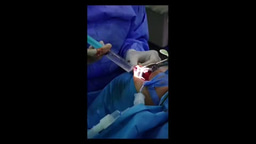
Bofares speculum
This tool was proposed and designed to retract the middle turbinate medially at its different three part (M1, M2, and M3) with accommodated heights and self-retained controlled with wide range adjustor to provide a sufficient access to the middle meatus during endoscopic sinus surgery.
Published in Biomedical Research
- The name of the designed instrument: BOFARES middle meatal speculum.
- Structural description for this instrument: This presenting instrument was designed mainly as tube-like skeleton, which provided by two openings. External one that facilitate the passage of the telescope with the other instruments during the endoscopic sinus surgery, and the internal opening, which continues inside the nasal cavity with two wings, one is fixed wing that is applied on the lateral nasal wall, and other one is mobile, which is applied on the middle turbinate. The mobility of the mobile wing is adjusted by provided adjustor screw according to the required distance for the middle turbinate retraction. The both wings have pyramid shape that is suitable for the shape of the nasal cavity and ended by blunt and smooth ends.
- Aim behind the idea of this proposed instrument: as it is well known that the most significant, interested and target area for surgeons during functional endoscopic sinus surgery (FESS) is the middle meatus. The most highlighted problem that may facing the surgeon who are approaching the endoscopic middle meatal surgery is the inability to get a sufficient surgical access into the middle meatus. This is most probably due to oversized middle turbinate or floppiness of middle turbinate that resulting in the obscuring of the field and frequent fogging of the lens due to recurrent touching of coming in route middle turbinate. Therefore, it become necessary to resolve this problem, which I am sure that interrupt the interest of most of the surgeons. For this reason, this tool was proposed and designed to retract the middle turbinate medially at its different three part (M1, M2, and M3) with accommodated heights and self-retained controlled with wide range adjustor to provide a sufficient access to this very important area.
- Function: to provide a very good and sufficient access through the middle meatus, starting from the maxillary line and the area of the lacrimal sac up to the sphenoid sinus very posteriorly and frontal sinus very superiorly.
- How much it will be beneficial?!.. As the middle meatus is the most important area for the endoscopic sinus as well as sinus related surgical procedures as DCR, orbital decompression…etc. and because of previously mentioned difficulties in regard, thus this tool will be very helpful for most of surgeons and will get a very high rate of impaction.
- Important points must be taken serious regarding the design and manufacturing of this tool:
- We must restrict tightly to the measurements, which are given, because these measurements are based on well-established anatomical based data.
- The submitted measurements are belong to adult sino-nasal anatomy, and not suitable for pediatric age groups.
- The metallic materials that will be used for manufacture of this designed instrument should be so strong and resistant to the rusting.
- The surfaces must be as anti-refraction as much as possible that able to absorb the directed light from the telescopes.
- There were two sizes designed for this instrument, one is children and adolescent size, and the other one is adult size. This was according to the well-established anatomical measurements at this area for each age group.
With best regards
Khaled Mohamed bofares (MD)
Professor of otorhinolaryngology
Omar AL-Mukhtar university
Libya

Professor , professor of otorhinolaryngology
Follow the Topic
Biomedical Research
Life Sciences > Health Sciences > Biomedical Research