
A life in science is a series of overlapping start and end dates that bookend various events. Some epochs are long—the years between graduate school orientation and your thesis defense; the assistant professorship; an HHMI Investigator term. Others are short: the two-week deadline an editor gives you to review a paper (which no one ever pays attention to) and the last-minute requests for letters of support from colleagues. And there are the in-between timeframes, like the span from clicking the submission button to receiving final acceptance of a manuscript. All these dates are recorded in our CVs, in our email, and in the papers we publish.
But I started this post with the phrase "life in science" because against this backdrop, life is happening. Sometimes the human condition bleeds into these dates. For our paper A series of spontaneously blinking dyes for super-resolution microscopy, that was particularly true: the submission date is February 28, 2024, and the acceptance is March 5, 2026. Over two years; 736 days to be exact. This is much longer than the average paper from my lab, and one might chalk it up to a tough set of reviewers or the challenges of a multilab collaboration. We did have a rigorous review—Nature Methods has never disappointed me in forcing our papers to be better—and we added a substantial amount of data to the revision. And yes, managing a group of scientists spread across the country is always a fun challenge (emphasis on fun). But that is not the reason the paper took so long. It was me.
In early 2024, doctors had just diagnosed my mother-in-law with lymphoma. They caught it late. I had known her for half my life—longer still if you count that her daughter, Kristina, and I were friends through jr. high and high school in Oregon long before I worked up the courage to ask for a date in our final year of college. She sewed up the holes in my pants in graduate school, holes from the sulfuric acid I used to make rhodamine dyes. An immigrant far from her birthplace in Switzerland, she barely blinked when I dragged her daughter to progressively distant places and eventually the opposite coast. This is another reality of a life in science: you move for training and opportunity, often ending up in random places like northern Virginia.
In response, Kristina began spending a third of her time on the west coast helping her parents. We burned through the frequent flyer miles I had accrued from too many conferences. I was responsible for our two school-aged kids, and, although it was a stressful time (with reheated pasta for dinner many nights), we humans tend to remember the bright spots. Those were small but vivid: giggling through California stops on late mornings; the chilly evening we taste-tested every french fry we could find; our standing Friday Costco trip to buy something their mom would never go for; and putting the same container of the same six carrots in my daughter's lunch—then back in the fridge—every day.
I am fortunate to work at HHMI's Janelia Research Campus, among the most family-friendly research institutions in the US. The culture here is hard to describe, but it somehow melds scientific excellence with the appreciation that life is messy and sometimes hard. No one balked at my calendar being blocked every afternoon for school pickup, or at moving meetings I couldn't attend. Colleagues and friends helped in ways I can't fully account for. Kristina spent time with her mom mostly at the hospital and then, at the end, back at the house she grew up in along with her dad and two siblings for those last days. That was June, after many months of this routine. Kristina made a quick trip back to Virginia for the last week of school and then we all returned to Oregon for the memorial service and a chance to breathe.
Meanwhile, the paper was still there. Our team was making strides responding to reviewers; experiments were running and the revision coming together. But I found it almost impossible to engage. Grief is a powerful thing. The paper had been taking shape and was submitted through all of this; the dysphoria that followed seemed bound up with it. Making figures or reordering the methods section was the last thing I wanted to do, even as the people around me carried work that deserved my attention. I don't say this to excuse the timeline. I say it because it was true, and because I suspect I am not the only scientist who has quietly lost months because they just can't.
But time passes. Grief doesn't disappear, but you get stronger. I found the ability to move through the thick mental mud that I had sunk into. Slowly, the manuscript started to feel like a manuscript again rather than an obligation I couldn't face. The last experiments ran. The figures got made. The revision got written. The science, as it always does, eventually got done.
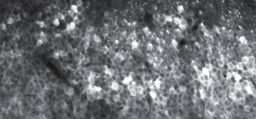
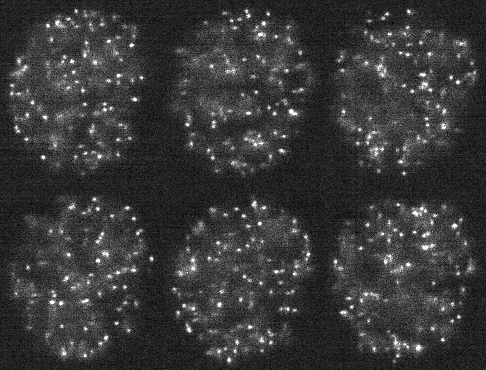
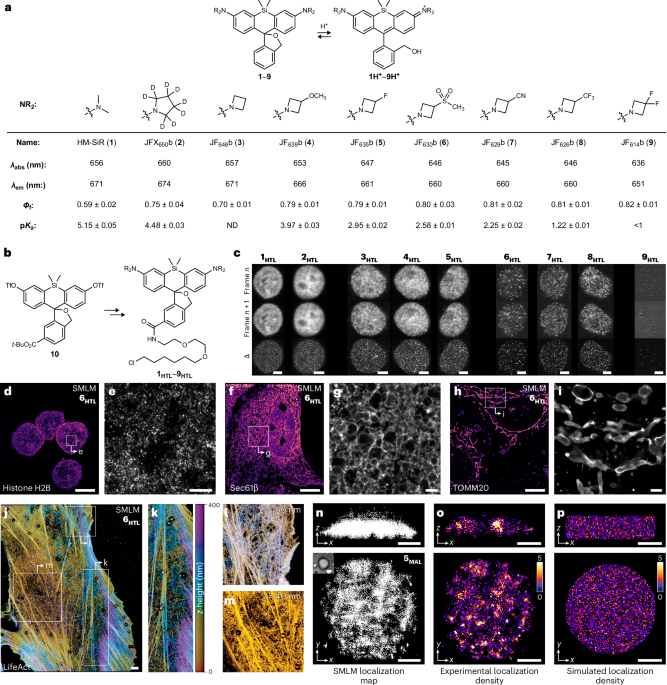
The work itself was worth the wait—or at least I believe it was. I have been involved in super-resolution microscopy from the beginning of my career, and spontaneously blinking fluorophores were always attractive since they circumvented the need for greasy caging groups or weird buffers to function. But there is no one-size-fits-all dye in this game, and the blinking parameters of these types of fluorophores are hardwired into the molecular structure. So, we did what we do best: developed new chemistry and used our dye-tuning strategies to build a panel of fluorophores with different on/off ratios. We then put them through their paces in both single-molecule localization microscopy (SMLM) and super-resolution optical fluctuation imaging (SOFI), two complementary techniques covering a wide range of biological imaging needs. The result is a toolkit of dyes that biologists can pick from based on their experimental conditions.
None of this would have been possible without the patience of my coauthors—especially Brian, Jon, Sig, Wes, and Cathy—who kept the science moving when I could not, and the editors at Nature Methods: Rita, Allison, and Nina, who gave us the time I needed without question. I want to say something about those editors because they deserve it. The people who run our journals don’t always get their due as collaborators. My experience shows why they should. The editors I have worked with at Nature Methods are scientists. They read the papers. They understand the work. They are, it turns out, human—capable of patience, judgment, and grace under circumstances they had no obligation to accommodate. Science is a collective enterprise, and this paper is proof of that, hidden in those 736 days between submission and acceptance.
This is an atypical Behind the Paper post. Most are about clever experimental design, unexpected results, or the eureka moment in the lab. This one is about something else. But sometimes there is more behind a paper than the science; occasionally it feels worth saying so.
Follow the Topic
-
Nature Methods
This journal is a forum for the publication of novel methods and significant improvements to tried-and-tested basic research techniques in the life sciences.