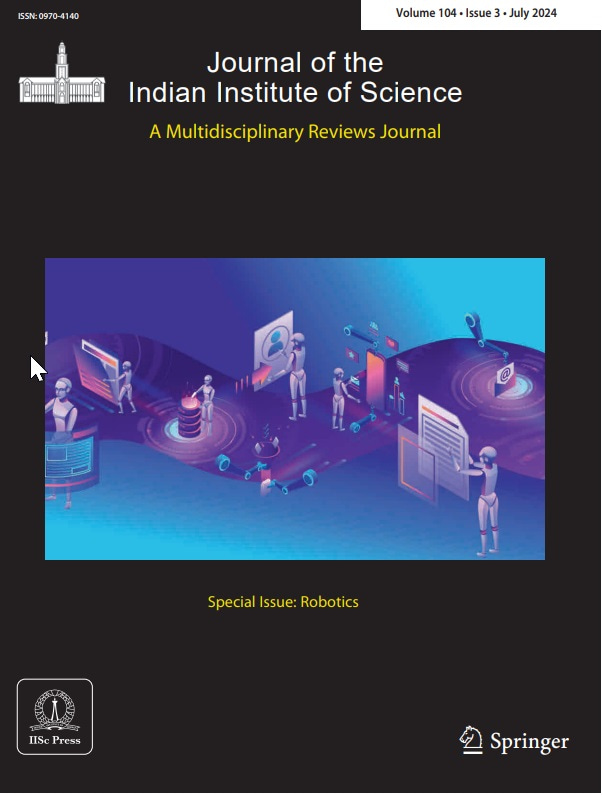
A collection of comprehensive review articles on the state-of-the-art research from manipulators to walking, flying, micro, soft, and data-driven robotics
Published in Computational Sciences




Explore the Research
 Google Docs
IISC PODCAST ROBOTICS MASTER WAVE.wav
This Special Issue on Robotics was guest edited by Prof. G. K. Ananthasuresh, Professor in the Department of Mechanical Engineering and Dean of the Division of Mechanical Sciences at the Indian Institute of Science, Bengaluru.
Here’s a glimpse into the issue, in the words of Prof. Ananthasuresh:
Robots are on the rise, once again. Having shown their impact a few decades ago with industrial automation, and after a lull for some time, robotics today is an active area of research with autonomy as the key feature. Many new application domains from agriculture to zoo-keeping are being pursued. Novel materials, designs, sensors, actuators, fabrication methods, control algorithms, and data-driven approaches are changing the landscape of robotics. Biohybrid robots are the new entrants to the field. Just as computers have become pervasive, robots too are moving in that direction. It is not just humanoid or animal-mimicking robots that we see; the principles of automation and autonomy are becoming a part of many devices around us. In the special issue of the Multidisciplinary Reviews journal of the Journal of Indian Institute of Science, we see the changing landscape of robotics from the conventional kinematics of the workspace of rigid-body manipulators to trendy data-driven approaches to continuum manipulators and soft robots; from legged robots to flying robots.
Click here to access podcast