A Contact-Free Route to Twist Control in van der Waals Heterostructures




The isolation of two-dimensional materials has transformed the way we think about condensed matter systems and nanoscale device engineering. When atomically thin crystals such as graphene, boron nitride, or transition metal dichalcogenides are vertically assembled, they form van der Waals heterostructures with properties that can be very different from those of the individual layers. Because these materials are held together without conventional covalent bonding at the interface, they can be combined even when their lattice parameters are mismatched. This makes them an exceptionally flexible platform for designing new electronic and optical functionalities.
One of the most important parameters in these heterostructures is the in-plane twist angle between adjacent layers. This geometric degree of freedom controls the formation of moiré superlattices and can profoundly modify interlayer hybridization, band structure, and correlated physical phenomena. Twist engineering has therefore become a central theme in the physics of low-dimensional materials. At the same time, controlling the twist angle after assembly remains a major challenge.
Most available strategies rely on direct mechanical interaction, for example through atomic force microscopy tips, or on optothermal and piezoelectric actuation schemes. Although effective in some cases, these approaches can introduce mechanical stress, contamination, or thermal conditions that may irreversibly affect the integrity of the crystals. This has motivated the search for alternative methods that are non-contact and minimally invasive.
In our recent work, we developed a fully electrostatic strategy to induce planar rotation in a van der Waals heterostructure without any direct mechanical contact. The idea is simple in concept but powerful in practice. A localized injection of charge, delivered through the electron beam of a scanning electron microscope, creates an electrostatic torque strong enough to rotate an atomically thin crystal toward a new angular configuration. As shown in Figure 1, the process can be viewed as a transition from an initial state to an actuation stage driven by electron-beam-induced charging, followed by a post-rotation state in which the moiré pattern has been reoriented.
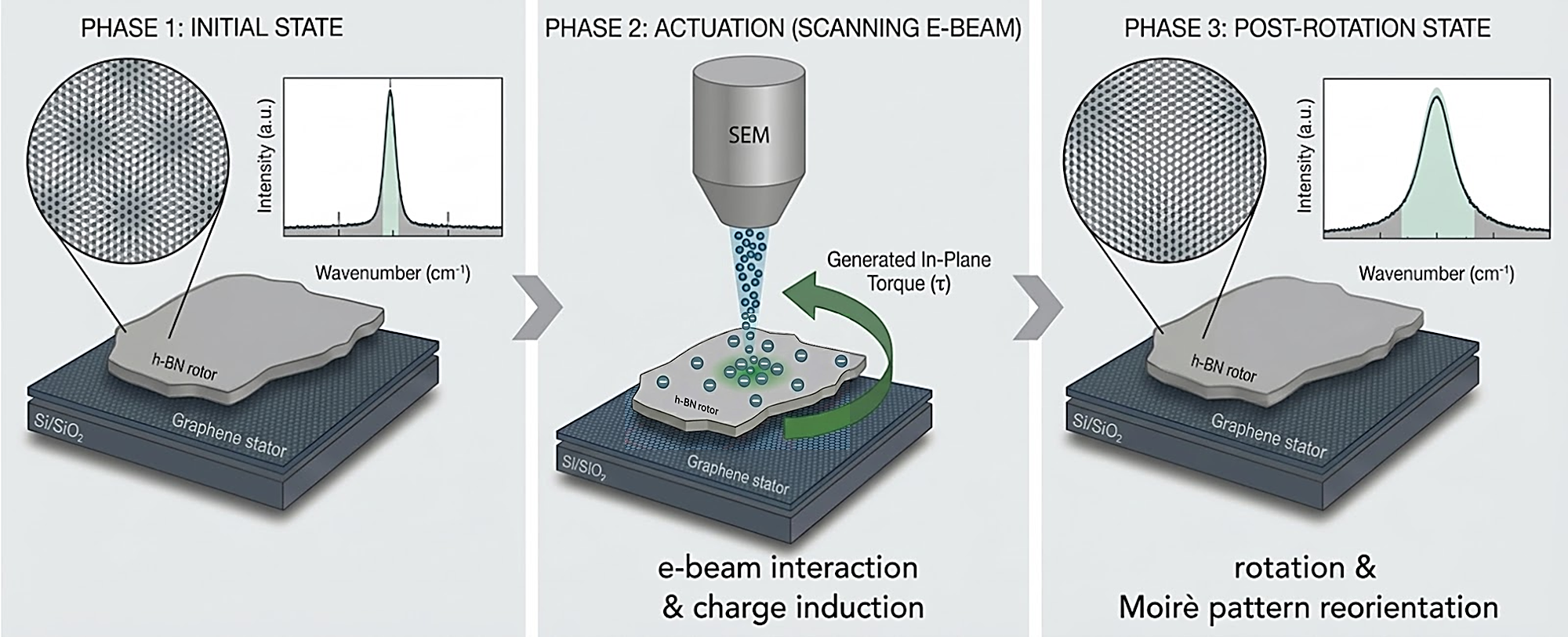
Our platform behaves conceptually as an asymmetric nanoscale capacitor. The fixed element, or stator, is a patterned monolayer graphene electrode transferred onto a Si and SiO2 substrate. The mobile element, or rotor, is a mechanically exfoliated hexagonal boron nitride flake with a thickness of about 30 nm placed on top of the graphene. Because the interaction between graphene and h-BN is governed by van der Waals forces and the two lattices are incommensurate, the interfacial shear resistance is extremely small. This makes the h-BN crystal mechanically decoupled enough to respond to lateral electrostatic forces.
The key mechanism is the controlled accumulation of negative charge on the h-BN surface during scanning electron beam exposure. Under optimized conditions, we inject charge while keeping the deposited energy low enough to avoid detectable structural damage. The resulting potential difference between the charged insulating rotor and the grounded graphene stator generates an electric field with both perpendicular and in-plane components. The perpendicular component modifies adhesion, while the in-plane components generate the lateral torque responsible for rotation. Once this torque exceeds the threshold associated with static interfacial friction, the rotor undergoes rigid-body planar motion.
To quantify this process, we combined in situ electron microscopy with Raman spectroscopy. Raman spectroscopy provides an independent structural probe of the moiré reconfiguration. In graphene and h-BN heterostructures, the moiré potential affects the Raman response of graphene, particularly the 2D band. In the small-angle regime, the broadening of the 2D peak is known to correlate with the moiré wavelength, offering a spectroscopic fingerprint of the twist state.
We observed clear and reproducible actuation in representative devices, with Raman measurements confirming that the induced rotations were accompanied by a substantial reconfiguration of the moiré superlattice. In uncovered graphene regions, the 2D peak remained essentially unchanged, indicating that the electron beam did not produce measurable lattice damage. In the interfacial regions, by contrast, the Raman response evolved strongly after actuation, consistent with a marked increase in moiré wavelength and a reduction in twist angle.
These results establish a proof of concept for contact-free twist manipulation in van der Waals heterostructures. A natural next step is to replace the electron beam with an integrated top contact capable to generate equivalent in-plane electrostatic fields directly on chip. More advanced stator geometries could also enable finer control of the torque distribution and therefore of the final twist angle. Extending this approach to other material families, especially transition metal dichalcogenides, could open new opportunities for actively tuning excitonic, electronic, and topological phenomena in reconfigurable low-dimensional systems.
More broadly, this work suggests a shift in perspective. Twist does not need to remain a static parameter fixed during fabrication. Instead, it can be treated as a dynamic degree of freedom that can be tuned directly within a device, without relying on external mechanical actuation or complex instrumentation. This capability could prove important for the future development of adaptive nanodevices based on two-dimensional materials.

Follow the Topic
-
npj 2D Materials and Applications

This journal publishes papers on the fundamental behavior, synthesis, properties and applications of existing and emerging 2D materials.
Related Collections
With Collections, you can get published faster and increase your visibility.
Functionalization and Reactivity of 2D Materials
Publishing Model: Open Access
Deadline: Oct 06, 2026
2D Materials for Integrated Electronics
Publishing Model: Open Access
Deadline: Apr 18, 2026
Please sign in or register for FREE
If you are a registered user on Research Communities by Springer Nature, please sign in