A deep dive into herbal extraction: Techniques, trends, and technological advancements
Published in Research Data, Biomedical Research, and Agricultural & Food Science
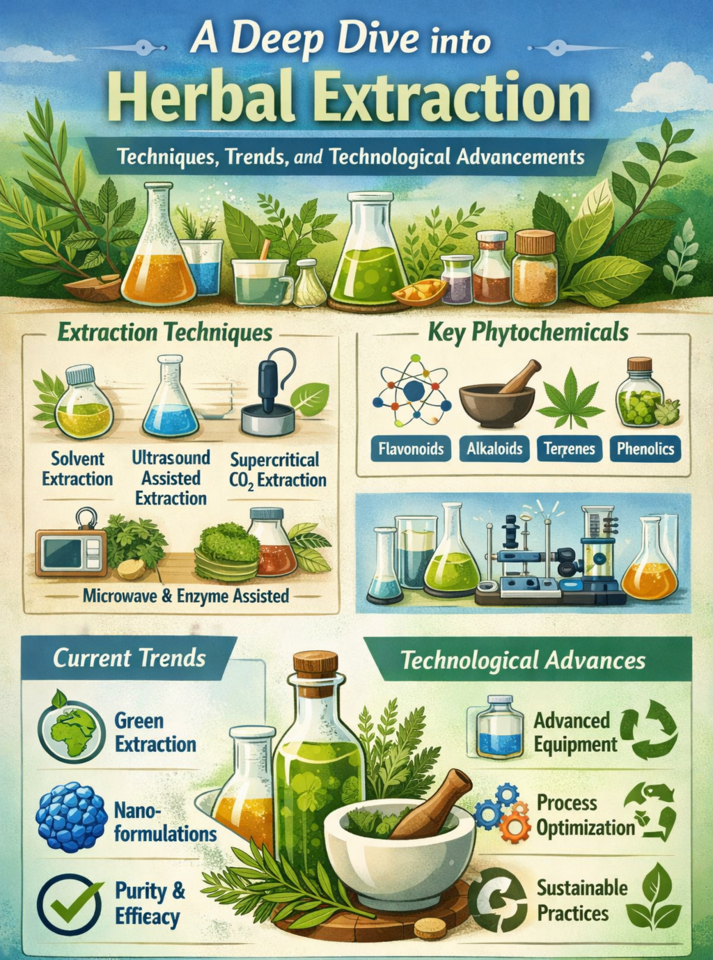
When I first stepped into the world of herbal drug research, I believed extraction was a straightforward step—grind the plant, add a solvent, and collect the extract. Years of research, failed experiments, unstable extracts, and unexpected results quickly taught me otherwise. Extraction is not just a technical step; it is the heart of herbal medicine, shaping efficacy, safety, and reproducibility.
This blog post reflects my journey through herbal extraction research and why I believe this field urgently needs a more unified, strategic approach.
Why Extraction Matters More Than We Think
Extraction determines what actually reaches the patient or consumer. A medicinal plant may be rich in bioactive compounds, but without the right extraction strategy, those compounds may never make it into the final formulation—or worse, may degrade during processing.
In both pharmaceutical and nutraceutical industries, extraction is increasingly viewed as a precision process, rather than a routine laboratory step. Yet, research in this area remains surprisingly fragmented.
From Leaves to Liquids: The Often-Ignored Early Steps
One of the biggest gaps I noticed in the literature is how casually early processing steps are treated.
Drying, particle size reduction, filtration, and concentration are often mentioned briefly—if at all. In practice, these steps can dramatically affect:
- Extraction yield
- Chemical stability
- Oxidation and enzymatic degradation
- Batch-to-batch reproducibility
I have personally seen thermolabile compounds vanish simply because drying temperatures were too high or grinding generated excess heat. These “minor” steps deserve far more attention than they currently receive.
Solvent Choice: More Than Just Polarity
Traditionally, solvents like water, methanol, ethanol, and hydroalcoholic mixtures dominate herbal extraction. While effective, solvent choice is rarely guided by a holistic framework that considers:
- Compound polarity and matrix compatibility
- Toxicological safety and GRAS status
- Environmental impact and sustainability
- Cost and industrial scalability
Emerging alternatives, such as natural deep eutectic solvents (NADES), have been a turning point in my thinking. These solvents, often derived from natural metabolites, offer exciting possibilities for green extraction—yet they remain underexplored, especially in standardized, comparative studies.
Traditional vs. Modern Techniques: A False Dichotomy?
One of the most rewarding realizations in my research journey is that traditional and modern extraction methods are not competitors—they are collaborators.
- Infusion and decoction continue to offer simplicity, cultural relevance, and low energy input.
- Modern techniques like pressurized liquid extraction (PLE), microwave-assisted extraction (MAE), and ultrasound-assisted extraction (UAE) provide speed, precision, and improved reproducibility.
Rather than replacing traditional approaches, modern technologies allow us to refine and validate them, ensuring better control over temperature, pressure, and solvent penetration.
The Power of Combination: Methods and Extracts
Some of the most promising results I’ve encountered came from combining approaches:
- Sequential extraction using solvents of increasing polarity
- Hybrid techniques (e.g., ultrasound followed by solvent extraction)
- Blended extracts from multiple plants to enhance synergistic effects
Yet, synergy is often assumed rather than systematically evaluated. Protecting oxidation-sensitive or thermolabile compounds while preserving multi-component interactions remains a major challenge—and opportunity.
The Missing Links in Current Research
Despite the growing volume of publications, several critical gaps persist:
- No standardized criteria linking plant matrix properties to extraction method selection
- Limited side-by-side comparisons for specific phytochemical classes
- Minimal optimization for compound stability during extraction
- Little integration of scalability, energy efficiency, and waste minimization
- Sparse discussion of regulatory and commercialization constraints
These gaps make it difficult for researchers and industry professionals to translate laboratory findings into real-world applications.
What Patents Are Telling Us
Interestingly, patent databases paint a different picture from academic literature. They reveal rapid growth in:
- Novel solvent systems
- Assisted extraction technologies
- Process intensification and hybrid methods
However, these innovations are rarely synthesized into broader trend analyses. By studying patents more systematically, we can better identify where the field is heading—and where opportunities lie.
Looking Ahead: Smarter, Greener Extraction
The future of herbal extraction lies in integration.
Emerging tools such as:
- AI-driven process optimization
- Microfluidic extraction platforms
- Carbon-neutral and waste-minimized processes
are still in their infancy within herbal research. Yet, they hold immense promise for creating extraction systems that are not only effective but also sustainable and regulatory-ready.
Final Reflections
For me, herbal extraction has evolved from a laboratory technique into a strategic science—one that connects chemistry, biology, engineering, sustainability, and traditional knowledge.
By bridging fragmented research, embracing both old and new technologies, and focusing on process optimization from leaf to final extract, we can unlock the true potential of medicinal plants.
I hope this perspective resonates with fellow researchers, early-career scientists, and practitioners navigating the complex—but deeply rewarding—world of herbal medicine.

Salman Ahmed (ORCID: 0000-0003-2033-0181) holds a B.Pharm. degree from the University of Karachi, Pakistan, and a PhD and M.Phil. in Pharmacognosy from the same institution. He has gained valuable experience in the pharmaceutical industry, having worked at Helix Pharma, Pharm Evo (Pvt.) Ltd., and Searle Pakistan Ltd. Currently, he holds the position of Assistant Professor in the Department of Pharmacognosy at the Faculty of Pharmacy, University of Karachi, Pakistan.
Salman Ahmed has made significant contributions to the field with a decade-long career dedicated to teaching Pharmacognosy, also known as Natural Products Sciences. He has authored 125 research papers with an impact factor of 100 with 2297 citations, a h-index of 24, and an i10-index of 59. He has secured multiple research grants in Pharmacognosy (2021, 2018, 2016, and 2014) to study plants traditionally used for analgesic, anti-inflammatory, diuretic, and antidiarrheal purposes and their effects on digestive enzymes. Additionally, he has authored seven books and presented 16 posters at national and international conferences. Salman Ahmed's expertise is acknowledged by various esteemed journals published by Elsevier, Springer Nature, Wiley, MDPI, Hindawi, and Dove Medical Press Limited, as he serves as an invited reviewer for these publishers.
Scientific Achievements (2011–2015): He pioneered a cost-effective copper sulfate-induced chick emesis model for evaluating natural antiemetics. His research explores antiemetic, analgesic, and anti-inflammatory properties in Pakistani plants, herbs, and spices, reporting fixed oil's analgesic effects and discovering Bergenin as an antiemetic. He authored two state-of-the-art reviews on natural antiemetics, "Antiemetic effects of bioactive natural products" and "Natural antiemetics- an overview". He was awarded Nishan-e-Zafar by the University of Karachi in 2014.
Scientific Achievements (2016–2024): Dr Salman Ahmed pioneered glass slide models to grow Whewellite, Brushite, and Urate crystals for the evaluation of antiurolithiatic and anti-gout drugs, presenting key findings at international conferences such as MMDR-7, STEP-5, ISNPC-14, and ISNPF-2. His book “How to Grow Urinary Stone and Gouty Crystals on Glass Slide” provides detailed methodologies for replicating crystal growth in vitro and discusses the implications for understanding crystal morphologies, disease mechanisms and developing herbal treatment strategies.
Dr Ahmed's research highlights the antiurolithiatic potential of pentacyclic triterpenes and polyphenols. These compounds inhibit calcium oxalate crystallization, reduce oxidative stress, and modulate inflammation. They also promote nephroprotection, diuresis, and ACE inhibition, advancing natural therapeutics for kidney stone prevention.
His contributions include “Glossary of Globally Used Herbs and Animals for Urolithiasis” (2024), a comprehensive book exploring medicinal plants covering botanical families from A to Z and animal-based remedies covering their historical use, mechanism of action, and therapeutic spectrum against Whewellite, Brushite, and Urate crystals separately. His research on antiurolithiatic formulations compiles mono- and polyherbal remedies from diverse regions, including Appalachia, Canada, India, and the Middle East. His work provides critical data for future phytochemical, pharmacological, and toxicological studies, aiding in the discovery of safer, more effective treatments for kidney stones.
Additionally, he explores the anticancer potential of marine peptides against breast, ovarian, cervical, malignant melanoma, prostate, neuroblastoma, glioblastoma, leukemia and lymphoma, advancing natural therapeutics for cancer treatment.
Please sign in or register for FREE
If you are a registered user on Research Communities by Springer Nature, please sign in