A tiny robot riding the ion wind: from lift to controlled flight
Published in Electrical & Electronic Engineering


Imagine sending a tiny flying robot into a narrow gap to look around or touch a surface that is difficult to reach. Before it can report anything useful, it must solve three problems: lift itself, keep its balance and carry something that can sense its surroundings. At this scale, those requirements compete for every milligram.
In our recent paper in Nature Communications, we explored how to bring these capabilities together using ion wind. Our robot has no rotating propellers or flapping wings. Instead, electric fields set the surrounding air in motion. The question behind the work was how to turn that unusual source of lift into controlled flight with useful payloads.
Making the air do the work
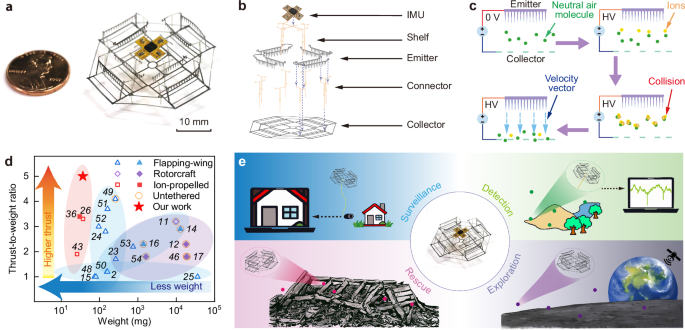
Ion wind begins at a sharp electrode. A strong electric field creates charged particles in the nearby air. As these particles accelerate towards another electrode, they collide with neutral air molecules and transfer momentum to them. Together, those countless collisions produce airflow and thrust.
This removes the need for motors and mechanical transmissions in the propulsion system. It does not remove the engineering challenge. A robot that barely lifts its own structure has little capacity left for sensors. A robot that produces plenty of thrust but tips over cannot take reliable measurements. We therefore had to consider materials, electrode geometry and control together.
Our platform spans 37.7 millimetres and uses four ion thrusters. In the payload experiment, the 36.7-milligram robot lifted an additional 146.8 milligrams, four times its own mass. Expressed as a thrust-to-weight ratio, that is 5:1. The spare lifting capacity creates room for functions beyond take-off.
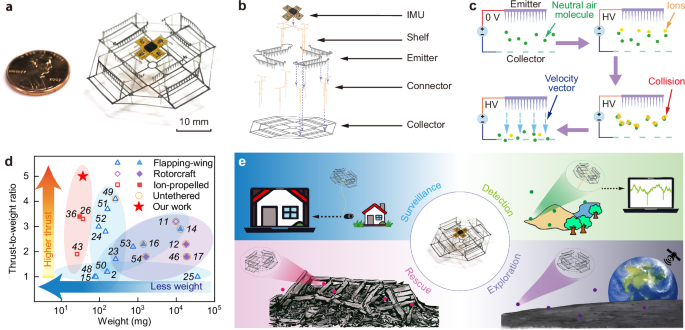
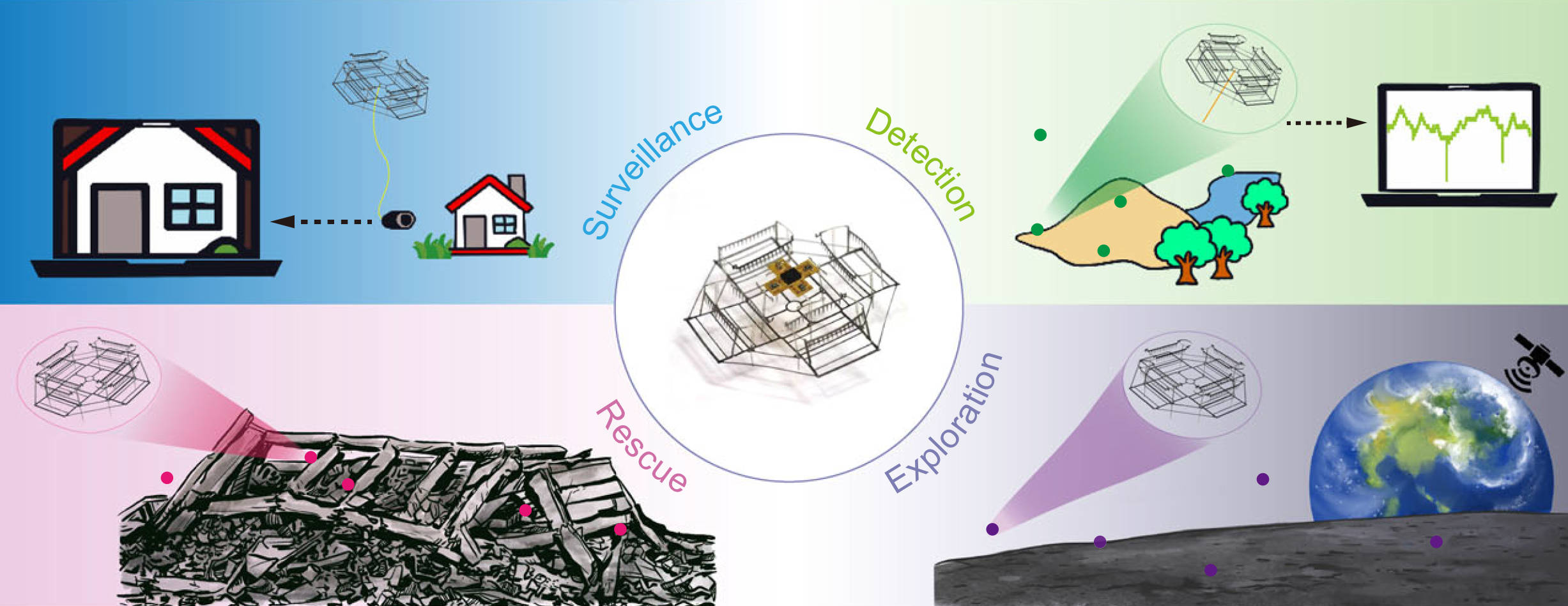
Figure 1 | Flight without propellers. The prototype, its components and the ion-wind principle are shown alongside performance comparisons and possible future applications. Application scenes are concepts, not field demonstrations. Reproduced unchanged from Fig. 1 of Tao et al., Nature Communications (2026). © The Author(s), CC BY-NC-ND 4.0. Source.
Why the material became part of the control problem
One revealing part of the study was that choosing a lightweight material was only the beginning. The structure also had to survive handling, hold its shape and keep working under electrical discharge.
We used a thin film of polyethylene terephthalate, or PET, coated with metal. The polymer provides a lightweight, resilient structure; the coating makes the electrodes conductive. In mechanical tests, silicon emitters fractured and titanium emitters retained substantial deformation, whereas the metallized PET recovered after bending.
The choice of coating mattered too. After 600 seconds of operation under the tested conditions, the current from an aluminium-coated emitter had fallen by 58%, compared with 8% for a tungsten-coated emitter. Images also showed much greater damage to the aluminium coating. An electrode whose performance changes during flight makes the controller's job harder. Materials durability and flight stability were therefore closely connected.
Manufacturing offered another opportunity. Laser-cut parts could be assembled through interlocking features, and an origami-inspired design brought components into a foldable structure. This approach helps align the electrodes while reducing the number of separate pieces to handle. For a device whose geometry shapes its airflow, assembly precision matters as much as convenience.
Giving ion-powered flight a sense of balance
The next challenge was keeping the robot level. With so little mass, small differences in thrust can quickly become large changes in orientation.
We mounted an inertial measurement unit, or IMU, on the robot to measure its motion. Those measurements feed a controller that adjusts the voltages applied to the thrusters. If the robot starts tilting, the system changes the balance of forces to correct it. This continuous cycle of measuring and responding is closed-loop control.
In the experiments, uncontrolled attitude deviations exceeded 30 degrees. With feedback, oscillations were restricted to within about five degrees. The root mean square errors in pitch and roll, measures of deviation in the two tilting directions, fell by approximately 83% and 89%, respectively. We also demonstrated square and triangular flight paths, with an external binocular camera recording position.
These results connect the ability to generate thrust with the ability to direct motion. The robot also hovered continuously for one hour in a separate tethered experiment without an additional payload. That duration reflects operation with an external power supply, rather than endurance from an onboard battery.
From staying aloft to gathering information
Once we had lifting capacity and controllability, we could ask whether sensors would work on a platform surrounded by strong electric fields.
We tested a miniature camera and a fibre Bragg grating sensor as payloads in separate demonstrations. The camera recorded images during flight. The fibre sensor uses changes in the wavelength of reflected light to register its interaction with a target. By bringing it into controlled contact with different solids and liquids, we obtained distinguishable optical responses.
These experiments tested whether the platform could carry functioning sensors during tethered flight. The camera and fibre sensor were passive payloads; they did not guide autonomous navigation. That distinction defines both what the demonstrations establish and the next integration challenge.
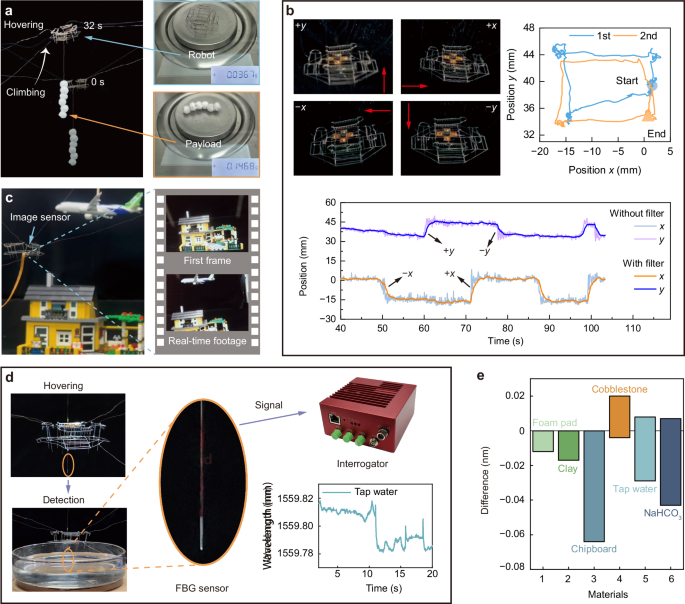
Figure 2 | Adding useful tasks to flight. Separate experiments demonstrate payload lifting, square-path flight, aerial imaging and contact sensing with a fibre Bragg grating sensor. Reproduced unchanged from Fig. 5 of Tao et al., Nature Communications (2026). © The Author(s), CC BY-NC-ND 4.0. Source.
The tether points to the next question
The largest remaining constraint is supplying power and control electronics at this scale. Our demonstrations rely on external equipment. Carrying a sufficiently lightweight power source and high-voltage electronics remains a substantial obstacle to untethered operation.
One route discussed in the paper is a larger carrier that supplies power and houses heavier electronics while deploying small tethered robots into confined spaces. This is a proposed direction, rather than a deployment demonstrated here. Autonomous swarms and rescue missions remain longer-term possibilities.
For us, the broader lesson is that useful miniature flight depends on getting several things right together. A lighter structure makes room for sensing; durable electrodes support steadier thrust; feedback turns thrust into controlled motion. Bringing those pieces together moves ion-powered microrobots towards becoming instruments that can explore and measure their surroundings.
Read the paper: Tao, Q., Gu, Y., Wang, X. et al. Controlled flight of high-thrust ultralight ion-propelled microrobot with integrated sensing. Nature Communications 17, 9530 (2026).
Follow the Topic
-
Nature Communications
An open access, multidisciplinary journal dedicated to publishing high-quality research in all areas of the biological, health, physical, chemical and Earth sciences.

Related Collections
With Collections, you can get published faster and increase your visibility.
Women's Health
Publishing Model: Hybrid
Deadline: Ongoing
Tumor Microenvironment Crosstalk and Therapeutic Implications
Publishing Model: Hybrid
Deadline: Nov 02, 2026