A volcanic cloud of water and fire
Published in Earth & Environment





Inspiring meetings
Our team did not start as a formal collaboration. We are physicists, atmospheric scientists, and volcanologists. Many of us first met at the Kavli Institute for Theoretical Physics in Santa Barbara, where conversations over tea and coffee drifted between turbulence, moist convection, particle dynamics, and volcanic plumes. We came from different disciplines, but we shared a fascination with how complex flows organize themselves in nature. Later, our meetings continued in Tokyo, funded by the Volcano Practical Human Resource Development Support Program in Japan. We even visited Izu Ōshima island and hiked Mount Mihara, so the physicists could learn firsthand from the volcanologists in the team.
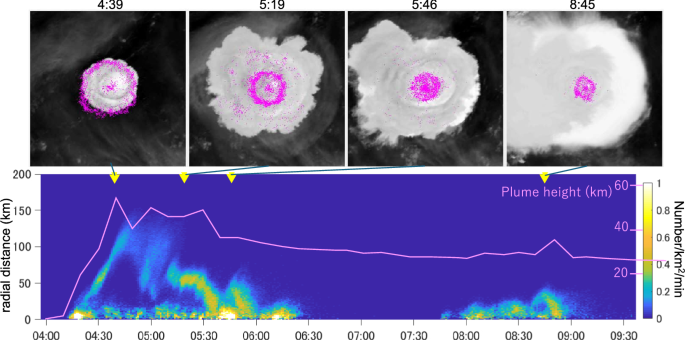
In this way, we all learned about Hunga Tonga eruption. The eruption produced concentric rings of lightning that persisted for hours. During the first explosive phase, the lightning ring formed roughly 40 kilometers from the vent. Later, during a second phase, the ring reappeared—but at about half that radius. The question became unavoidable: what role did turbulence and moisture play in shaping the Tonga umbrella cloud? After all, this eruption was not just powerful. It was wet.
A volcano that moistened the stratosphere
The Tonga eruption injected an unprecedented amount of water vapor into the stratosphere—normally one of the driest parts of the atmosphere. This raised a fundamental question: if the first explosive pulse injected huge amounts of moisture into the upper atmosphere, did that altered environment affect the behavior of turbulence in the next pulse?
Traditional one-dimensional plume models can estimate how high an eruption column will rise. But they cannot fully capture three-dimensional turbulence in the umbrella cloud—the mushroom-shaped region that spreads out at the top of the plume. Nor can they easily describe how moisture affects small-scale turbulent motions and particle collisions. Yet, lightning is generated by particle collisions. And particle collisions are enhanced by turbulence. So, to understand the lightning rings, we needed to understand the turbulence inside a moist volcanic cloud.
Simulating a volcanic thundercloud
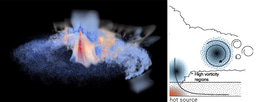
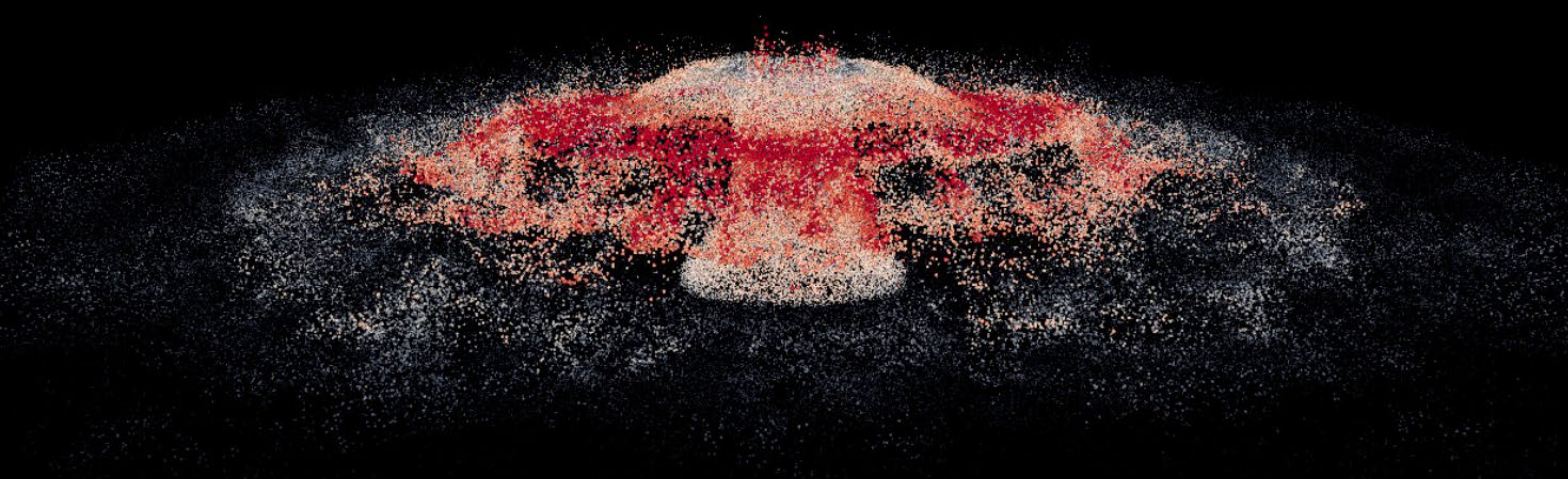
Instead of building the most complex volcanic model possible, we took a different approach. We constructed a simplified but high-resolution three-dimensional model of a moist, stratified atmosphere. Into it, we injected heat and water vapor to mimic an eruption in the simplest possible way. Then, we released millions of tiny “virtual ash and water particles,” and tracked how turbulence transported and clustered them.
We found that in drier conditions, turbulence in the umbrella cloud organized into a vortex ring about 40 kilometers from the vent—remarkably similar to the lightning ring observed during the first phase of the Tonga eruption. But when we increased atmospheric humidity, the turbulent ring moved inward. It formed closer to the central column—around 20 kilometers from the vent. At the same time, turbulence intensified, particles clustered more strongly, and estimated collision rates increased. This behavior mirrors what was observed during the second phase of the eruption.
Moisture reorganizes turbulence
Why does moisture matter so much? When air rises in a plume and cools, water vapor can condense into liquid. That phase change releases latent heat—extra energy that modifies buoyancy and stability. In a moist atmosphere, this can change how and where turbulence develops. In our simulations, higher humidity caused stronger turbulence in the umbrella cloud, increased clustering of particles inside this ring, and enhanced upward transport, leading to taller clouds. The turbulent ring acts like a conveyor belt of collisions. Where turbulence is strongest, particles of different sizes accumulate and collide more frequently. Those collisions can generate electric charge—eventually producing lightning.
Looking ahead
Our model is intentionally simplified. It does not resolve the complex processes near the volcanic vent. It does not include detailed microphysics of ice formation, or explicit electrical charging. But by resolving turbulence directly and tracking millions of particles, it provides new insights into how moisture, turbulence, and particle dynamics interact at small scales. We are now working on other aspects of this problem, putting together laboratory experiments and new simulations that aim at exploiting the interdisciplinary capabilities or our team.

Follow the Topic
-
Scientific Reports
An open access journal publishing original research from across all areas of the natural sciences, psychology, medicine and engineering.

Related Collections
With Collections, you can get published faster and increase your visibility.
Cancer Prevention and Control
Publishing Model: Hybrid
Deadline: Feb 19, 2027
Healthy Aging
Publishing Model: Open Access
Deadline: Dec 31, 2026