Advances in microbial enzyme technology for food processing strategies and applications
Published in Chemistry and Cell & Molecular Biology
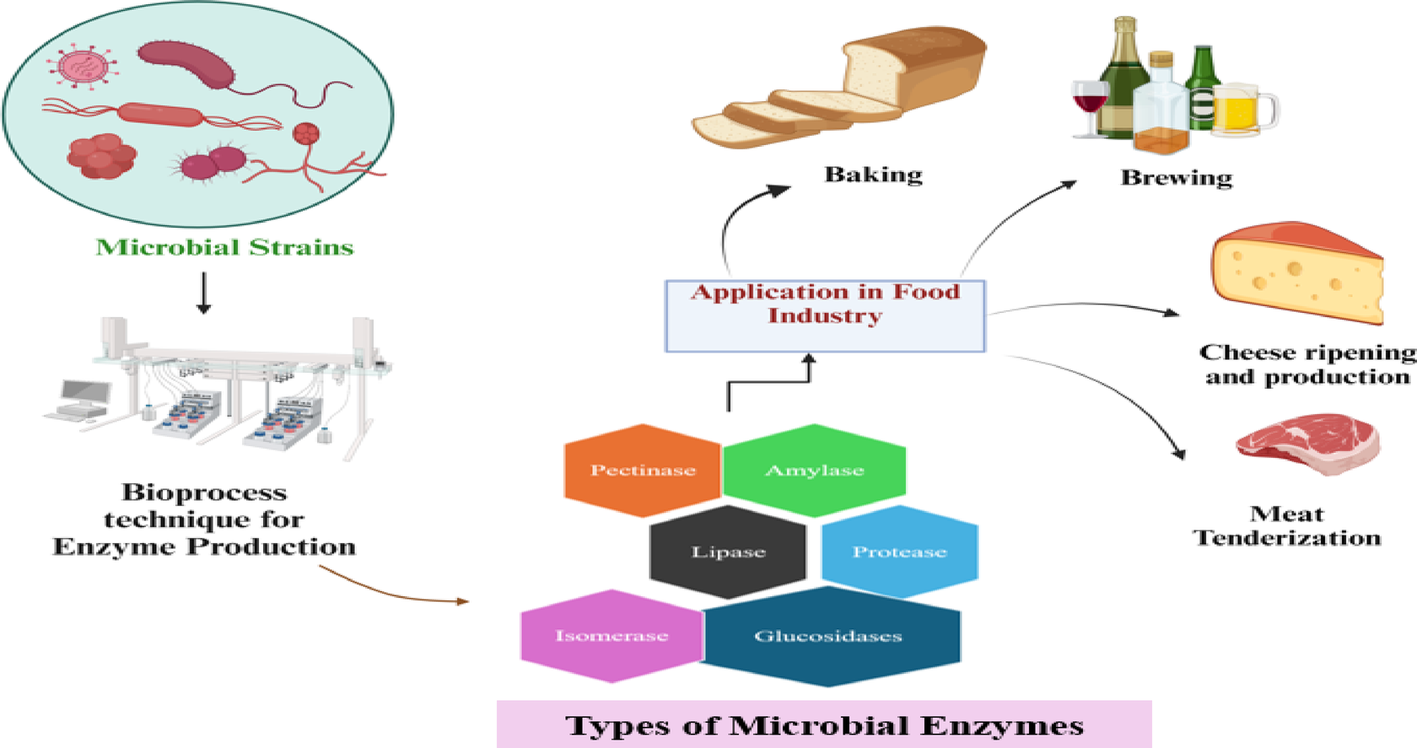

Why Microbial Enzymes?
Enzymes are nature’s catalysts—they speed up chemical reactions without being consumed. In the context of food processing, enzymes help break down complex molecules into simpler forms that are easier to digest, taste better, and have longer shelf lives. While enzymes can be extracted from plants or animals, microbial enzymes—produced by bacteria, yeast, and fungi—have rapidly become the preferred choice for industrial applications.
Microbial enzymes offer several advantages:
-
Cost-effective production using fermentation
-
High stability under industrial conditions
-
Scalability for mass production
-
Customizability via genetic and metabolic engineering
These attributes make microbial enzymes invaluable tools for the food industry as it grapples with rising demand and sustainability challenges.
The Big Picture: Research Goals
Our goal was to synthesize the latest technological advances in microbial enzyme research and examine how these innovations are shaping food processing strategies and applications. Rather than narrow laboratory experiments, our article provides a broad, integrative review—highlighting trends in enzyme production, technological breakthroughs, industrial successes, and emerging opportunities for future research and commercialization.
Key areas covered include:
-
Different microbial sources of food enzymes
-
Advances in enzyme production and strain improvement
-
Integration of biotechnology and genetic engineering
-
Applications in food texture enhancement, flavor improvement, and nutritional optimization
By weaving these threads together, we aimed to present a comprehensive picture of the field’s rapid evolution.
Challenges We Encountered
Like most research projects that involve a broad review of an entire field, this work presented several challenges:
1. Scope and Focus
Microbial enzyme technology spans many industries—food, pharmaceuticals, biofuels, textiles, and more. To do justice to the food processing sector, we had to carefully refine our scope without oversimplifying or overlooking key technological aspects.
We balanced this by emphasizing enzymes most relevant to food processing—such as amylases, proteases, lipases, and cellulases—and highlighting their impact across different types of food products.
2. Rapidly Evolving Literature
This field is advancing quickly thanks to breakthroughs in systems biology, fermentation engineering, and computational design. Staying current with the latest enzyme engineering strategies and industrial case studies required careful curation and synthesis of recent publications, patents, and industry reports.
3. Bridging Science and Accessibility
Our audience at Discover Food includes researchers, industry professionals, students, and food enthusiasts. Writing in a way that is technically accurate yet accessible to non-experts was an intentional and rewarding challenge.
What We Found
Here are some of the most exciting insights from our work:
Microorganisms: Nature’s tiny factories
Microbes such as Bacillus, Aspergillus, Saccharomyces, and Trichoderma species remain cornerstone enzyme producers due to their rapid growth, robustness, and adaptability. These microbes are harnessed to produce enzymes like:
-
Amylases for breaking down starches
-
Proteases for protein modification
-
Lipases for fat transformation
These enzymes improve food texture, flavor, digestibility, and shelf life.
Enhanced Production through Biotechnology
Recent advances in genetic engineering allow scientists to modify microbial strains to:
-
produce higher enzyme yields
-
express enzymes under controlled conditions
-
tailor enzyme activity to specific food applications
Tools like CRISPR, metabolic pathway editing, and systems biology approaches are now central to enzyme strain development—opening new frontiers for custom-designed biocatalysts.
Sustainability and Circularity
Enzymatic processing reduces energy demands and chemical waste compared to traditional methods. For example:
-
enzymatic hydrolysis of starches uses less heat and water
-
enzyme-based clarification replaces harsh filtration chemicals
This aligns with global efforts to make food production more sustainable and resource-efficient.
Implications for the Future
The ripple effects of microbial enzyme innovation extend far beyond improving current food processes. We anticipate:
-
New food product categories with enhanced nutritional profiles
-
Improved plant-based food textures through targeted enzyme use
-
Waste valorization using enzymes to upcycle food byproducts
-
Precision fermentation platforms producing bespoke enzymes for personalized nutrition
There’s also enormous potential for integrating machine learning and bioinformatics to discover novel enzymes and predict their function before lab testing—dramatically accelerating innovation timelines.
Personal Reflections
Working on this review was a deeply enriching experience. It reminded me of how tiny organisms can have a gigantic impact on global food systems. Microbial enzymes might be invisible to consumers, but they are behind many of the foods that define modern diets, from tender bread to dairy alternatives and beyond.
I’m also grateful for the collaborative nature of this field—where microbiologists, food scientists, engineers, and industry partners work together toward shared goals of quality, sustainability, and innovation.
Final Thoughts
The future of food processing is intertwined with microbial enzyme technology. As global food demand rises and environmental pressures mount, these natural catalysts offer powerful solutions that are efficient, adaptable, and aligned with sustainable development goals.
We hope this paper and this Behind the Paper post inspire others—students, researchers, and industry innovators—to explore the potential of enzymes in transforming the way we make, enjoy, and think about food.
here is the link of the paper-https://link.springer.com/article/10.1007/s44187-025-00779-8

Follow the Topic
-
Discover Food
This is a transdisciplinary, open access journal that provides a leading platform for the rapid dissemination of knowledge and advances covering the research and innovation that is taking place across the food sector.

Related Collections
With Collections, you can get published faster and increase your visibility.
Innovations in Food Microbiology, Ingredients, Preservation, and Safety: Advancing Quality Assurance
The global food industry faces increasingly complex challenges in ensuring food safety, preserving quality, and enhancing nutritional value—all while meeting rising consumer expectations for sustainability, transparency, and minimal processing. What sets this topic collection apart is its interdisciplinary focus, bridging food microbiology, ingredient functionality, preservation technologies, and regulatory frameworks to offer a holistic perspective on food quality and safety.
Current international concerns—such as transnational food fraud incidents, the harmonization of food safety regulations across regions, and the implementation of Codex Alimentarius standards—underscore the global urgency of coordinated, science-based solutions. These issues highlight the need for integrated research that not only advances scientific understanding but also informs policy and industry practices worldwide.
This Collection of Discover Food invites contributions that explore cutting-edge scientific advancements and technological innovations that collectively address the full spectrum of food system challenges—from microbial ecology and ingredient interactions to preservation strategies and regulatory compliance. By integrating microbiological, technological, and policy-oriented research, this collection aims to foster a systems-level understanding of how to produce safer, higher-quality, and more trustworthy food.
We welcome original research, reviews, and case studies addressing the following themes:
• Food Microbiology: Investigations into the role of microorganisms in food safety and quality, including microbial contamination, spoilage, fermentation, and probiotics. Studies on microbial community dynamics, detection of foodborne pathogens, and the influence of microbes on shelf life and sensory characteristics are especially encouraged.
• Food Ingredients and Additives: Research on the function, safety, and health impact of food additives and ingredients, both natural and synthetic. Topics may include clean-label alternatives, bioactive compounds, and ingredient innovations that support both product quality and consumer acceptance.
• Food Preservation Technologies: Advances in preservation methods such as high-pressure processing, cold plasma, biopreservation, and antimicrobial packaging. We are particularly interested in studies that evaluate the effects of these technologies on microbial safety, nutrient stability, and environmental sustainability.
• Food Safety and Quality Control: Development and implementation of innovative tools and frameworks for ensuring food safety across the supply chain. This includes rapid pathogen detection, risk assessment models, traceability systems, and the integration of international regulatory standards.
By showcasing interdisciplinary research that connects microbial science with technological innovation and regulatory insight, this Collection seeks to inform and inspire the development of more resilient, sustainable, and consumer-focused food systems on a global scale.
Keywords:
Food Microbiology; Functional Food Ingredients; Food Safety; Sustainable Food Systems; Food Preservation Technologies; Probiotics; Foodborne Pathogens; Shelf-life Extension; Natural Additives; Quality Control
This Collection supports and amplifies research related to SDG 2, SDG 3, SDG 9, SDG 12, SDG 13 and SDG 17.
Publishing Model: Open Access
Deadline: Jan 31, 2027
Advancing the Understanding of Food Structure and Processing in Sensory Perception, Eating Behaviour, and Nutrient Retention
The structure and processing of food are critical in shaping sensory perception, influencing satiety, guiding eating behaviour, and determining nutrient retention. As global food systems evolve, understanding these complex interactions is crucial for developing products that are not only appealing to consumers but also promote health and well-being. This area of study is increasingly significant in the context of personalised nutrition, where tailoring food structures and processing techniques can optimise health outcomes.
This topical collection invites researchers, scholars, and industry professionals to contribute their latest findings on the interplay between food structure, oral processing, and their effects on sensory perception, eating behavior, and nutrient retention. To differentiate this collection and ensure it provides fresh and valuable insights, we encourage submissions that focus on specific emerging trends, innovative approaches, and cutting-edge methodologies. Topics of interest include, but are not limited to:
• The potential use of artificial intelligence and machine learning to optimise food structure and processing for enhanced sensory experiences, satiety, and nutrient retention.
• Application of state-of-the-art imaging (e.g., MRI, CT, and electron microscopy) and analytical methods to study food microstructures and their transformations during food processing as well as oral processing.
• Novel approaches to creating food matrices that modulate sensory properties, digestion, and nutrient release.
• Exploration of the role of texture and rheology in oral processing and its impact on sensory perception and satiety.
• Investigations into how emerging processing methods (e.g., pulsed electric field, high-pressure processing) influence nutrient retention, bioaccessibility, and functional properties of foods.
• Research focused on food structures and formulations tailored for demographic groups with unique nutritional needs, such as elderly populations or individuals with specific metabolic conditions.
Through highlighting novel approaches and innovative technologies in the study of food structure and processing, this collection aims to provide a platform for groundbreaking research that pushes the boundaries of current knowledge. We encourage contributions that explore these cutting-edge areas and offer new perspectives that are not widely covered in existing literature.
Keywords:
• Food structure
• Sensory perception
• Oral processing
• Nutrient bioavailability
• Satiety
• Eating behaviour
• Food matrix design
• Texture and rheology
Publishing Model: Open Access
Deadline: Dec 31, 2026