Advances in TMDs-Based Electromagnetic Wave Absorbers: From Structural Engineering to Multicomponent Synergy
Published in Chemistry and Electrical & Electronic Engineering
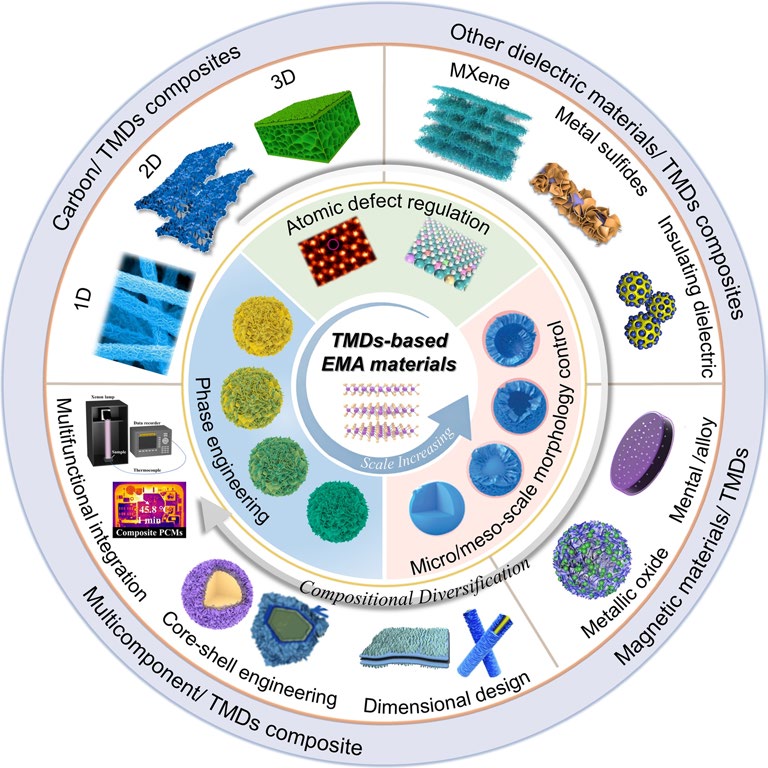
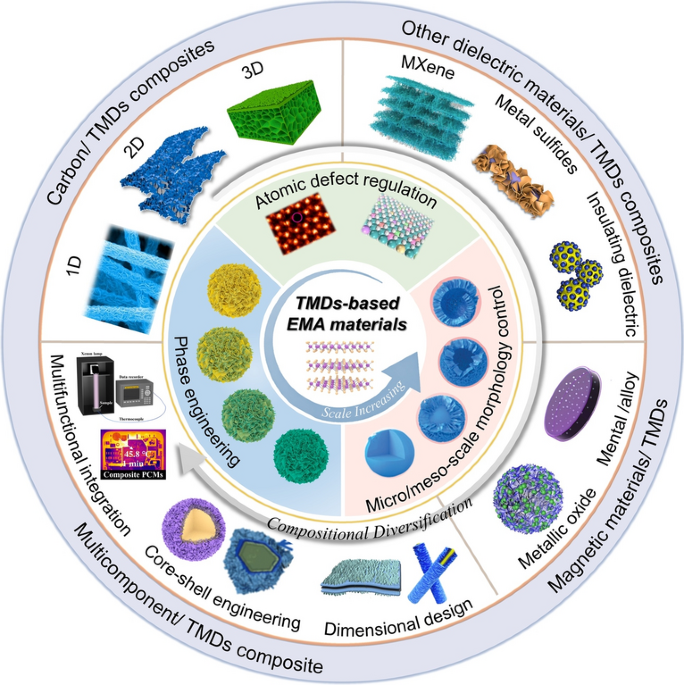

As wireless communication, aerospace systems, electronic devices, and defense technologies continue to generate increasingly complex electromagnetic environments, conventional shielding materials face a fundamental dilemma: strong reflection can create secondary electromagnetic pollution, while achieving thin, lightweight, broadband, and highly efficient absorption remains challenging. Researchers from Harbin Institute of Technology and the Civil Aviation University of China have provided a comprehensive perspective on how transition metal dichalcogenides (TMDs) can address these limitations through multiscale structural engineering and multicomponent synergy, offering new principles for next-generation electromagnetic wave absorbing materials.
Why This Electromagnetic Absorber Matters
TMDs possess layered structures, tunable compositions, diverse electronic states, abundant defect sites, and excellent compatibility with hybrid materials, making them attractive dielectric absorbers. Unlike conventional shielding materials that primarily reflect electromagnetic waves, TMD-based absorbers can dissipate electromagnetic energy through conductive loss, dipolar polarization, interfacial polarization, and, when magnetic phases are introduced, magnetic dissipation. The review highlights two major development routes: regulating pure TMDs from the atomic to submillimeter scale, and constructing multicomponent architectures that couple complementary loss mechanisms.
Innovative Design and Mechanism
At the atomic level, vacancy engineering and heteroatom doping generate localized dipoles and enhance dielectric relaxation. Phase engineering, particularly the controlled coexistence of semiconducting 2H and metallic 1T phases, further regulates conductivity and creates additional phase-boundary polarization. At larger length scales, nanosheets, porous structures, core–shell architectures, and hierarchical networks extend electromagnetic propagation pathways and improve impedance matching. Multicomponent systems introduce another level of control: carbon or metallic networks enhance conductive loss, magnetic components provide magnetic dissipation, and heterogeneous interfaces strengthen interfacial polarization. The key principle is therefore not maximizing one loss mechanism, but balancing multiple pathways to achieve efficient impedance matching and energy attenuation.
Outstanding Performance
The review summarizes numerous representative TMD-based systems with strong and broadband absorption. For example, Fe-doped MoS2 achieves an effective absorption bandwidth (EAB) of 5.36 GHz with a minimum reflection loss (RLmin) of −72.18 dB at only 1.65 mm thickness. Multicomponent systems can push performance further: Fe3O4@C@MoS2 reaches −68.9 dB with a 5.25 GHz EAB, while MXene/CNT@MoS2 delivers −64.1 dB with a 4.28 GHz EAB. Multifunctional architectures can simultaneously provide thermal and mechanical functions; a MoS2/N-doped carbon foam, for instance, achieves a 9.62 GHz EAB while offering thermal insulation.
Applications and Future Outlook
Beyond electromagnetic protection, TMD-based composites are emerging as multifunctional platforms for thermal management, flexible electronics, infrared stealth, environmental durability, and mechanically adaptive devices. However, the review emphasizes that the field must move beyond empirical material screening toward structural programming and predictive design. Future priorities include atomic-level interface engineering, advanced characterization, AI-assisted inverse design, sustainable large-scale synthesis, standardized benchmarking, and multifunctional smart-response systems. By linking atomic defects, phase structures, hierarchical architectures, and multicomponent interfaces with electromagnetic energy dissipation, TMDs could provide a versatile foundation for thinner, lighter, broader-band, and multifunctional electromagnetic protection technologies.

Editor of Nano-Micro Letters, which is an Open-Access, peer-reviewed journal reported papers that have at least one dimension ranging from a few sub-nanometers to a few hundreds of micrometers. The journal is published by Springer Nature and indexed by SCI, EI, SCOPUS, Pubmed, etc. The 2025 JCR Impact Factor is 38.5. The 2025 CiteScore is 58.9.
Follow the Topic
-
Nano-Micro Letters
Nano-Micro Letters is a peer-reviewed, international, interdisciplinary and open-access journal that focus on science, experiments, engineering, technologies and applications of nano- or microscale structure and system in physics, chemistry, biology, material science, and pharmacy.