What can observations of active faults tell us about future earthquakes? A case study of the predictability of slip, rupture geometry, and rupture speed in the 2025 magnitude 7.8 Mandalay (Myanmar) earthquake
Published in Earth & Environment
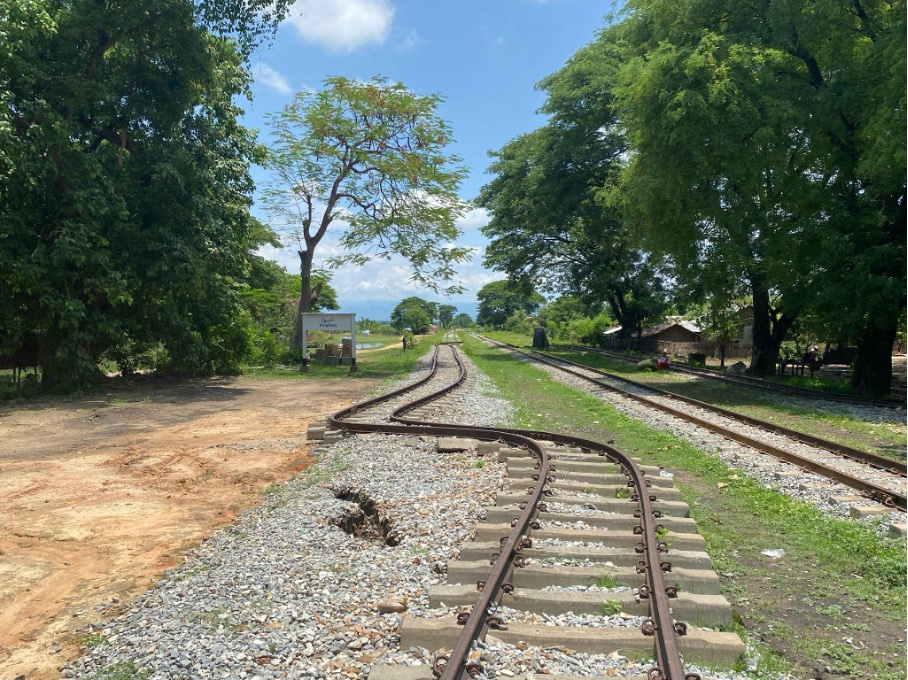
Credit: Dr. Tha Zin Htet Tin. The field survey was supported by the Myanmar Earthquake Committee.
In the months following the devastating 2025 Mandalay earthquake in Myanmar, Southeast Asia, local scientists went out to document surface rupture and damage along the Sagaing Fault that produced the earthquake. Dr. Tha Zin Htet Tin and her colleagues photographed roads broken and displaced by the rupture, damaged infrastructure, and bent railway tracks (see Figure). The magnitude 7.8 temblor struck on March 28, 2025, and broke about 480 kilometers of the Sagaing Fault, making it one of the longest strike-slip ruptures on record. The earthquake caused a high number of fatalities and damaged buildings as far as Bangkok, about 1,000 kilometers away.
The Sagaing Fault has long been recognized as a major seismic hazard in Myanmar. It produced a number of major (magnitude 7 or greater) earthquakes in the last two centuries. A large section of the fault between the cities of Mandalay and Nay Pyi Taw, the country’s capital, had remained quiescent since 1839, presenting a so-called “seismic gap”. The risk posed by the Sagaing Fault stimulated studies of its seismic potential. A long and smooth surface trace of the Sagaing Fault prompted a suggestion that it may host supershear ruptures, a peculiar condition when the earthquake rupture front outpaces the shear wave speed. This results in the formation of shock waves similar to those around aircraft flying at supersonic speed. Another clue came from measurements of slow accumulation of tectonic strain using the Global Positioning System (GPS). These measurements showed that the peak deformation rate is not necessarily centered on the fault trace. One possible explanation was that the fault geometry at depth might differ from that at the surface. The 2025 Mandalay earthquake came as the final reckoning. A research group including scientists from the US, Europe and Myanmar used a rich set of data to investigate the Mandalay earthquake and showed that some of its important characteristics such as the average amount of slip, rupture geometry, and propagation speed could have been anticipated from observations made prior to the earthquake.
Earthquakes are highly complex phenomena due to dependence on multiple factors that are not easily monitored, such as the distribution of stress, frictional properties, fluids, and rock composition at depth. Such complexity motivates the view that earthquakes may be largely chaotic. This seems to be the case for small earthquakes that are dominated by local heterogeneities. Whether the same is true for large ones remains an open question.
Geodetic observations acquired before the Mandalay earthquake recorded slow deformation across the Sagaing Fault and showed where it was locked and accumulating strain. After the earthquake, satellite radar and optical images mapped ground deformation and surface offsets exceeding five meters. The authors of a new study published in Nature Communications used these observations to derive the three-dimensional fault geometry and a model of slip on different fault patches. They then compared average slip on four fault sections to the slip deficit accumulated since the most recent major earthquake on each section. On sections with the longest interseismic intervals, including the “seismic gap”, average coseismic slip agreed with the accumulated slip deficit. Sections with shorter intervals produced more slip than they had accumulated since their previous major earthquakes. The slip deficit therefore provided a minimal estimate, or a lower bound on the amount of fault slip produced by the earthquake. The study calls this behavior minimal slip predictability. A similar pattern was found in earlier work for the 2023 magnitude 7.8 and 7.7 earthquakes in Turkey.
The fault geometry suggested by pre-earthquake measurements was also largely confirmed by data collected during and after the earthquake. Large strike-slip faults are often represented in textbooks and hazard models as vertical, planar surfaces. The Sagaing Fault has a smooth and simple surface trace, but appears to have a more complex shape at depth. The study finds that the northern section of the rupture dips eastward, the central section is nearly vertical, and the southern section dips westward, forming a helix-like geometry that resembles a strand of DNA. These changes in fault orientation can influence rupture speed, where seismic energy becomes concentrated, and where the strongest ground shaking occurs.
The authors combined several independent types of observations to reconstruct the earthquake. Satellite radar measurements captured permanent ground deformation. Global seismic networks recorded waves that traveled through the Earth, while one local station provided a closer view of the shaking. A chance CCTV recording offered another near-fault constraint, which has already been analyzed in several previous studies. In this study, it formed one part of a broader synthesis. Each dataset resolved a different part of the rupture and had different uncertainties. An acceptable physical model had to be consistent with all of them.
The team performed hundreds of three-dimensional dynamic rupture earthquake simulations on supercomputers to connect these observations. The rupture speed, slip history and ground shaking were not prescribed in such simulations. They emerged from physics and accounted for the interactions between fault geometry, stress, friction, rock properties and wave propagation. The authors tested models based on the pre-earthquake state against observations made during and after the event. Agreement across independent datasets allowed the authors to identify features that were robust beyond a single method or observation.
The observations and simulations show that the southward rupture became supershear at depth, while the shallow rupture remained subshear along an approximately 150-kilometer section. Supershear means that the rupture front propagated faster than the local shear-wave speed. This depth dependence reconciles the locally subshear rupture inferred from the CCTV record with the rapid arrival at the near-fault seismic station and the fast southward propagation imaged by teleseismic arrays. In the preferred model, these dynamics arose from heterogeneous stress, low fracture energy, and the three-dimensional fault geometry. The inferred conditions are not unique. Only a limited subset of the models reproduced both available near-fault records, from the seismic station and the CCTV camera, demonstrating the value of observations close to faults.
The evidence on slip predictability so far appears strongest for large, mature faults with measurable strain accumulation. The slip deficit may provide a lower bound on slip in a future maximum-size earthquake, but it does not determine when such an earthquake will occur. The extent to which these relationships apply across other tectonic environments remains to be tested. The Mandalay earthquake provides an independent case in which a major rupture retains a measurable connection to the prior state of the fault.
The results have implications for physics-based hazard assessment, even though the timing and location of the next large earthquake remain unknown. Satellite monitoring can identify where a fault is locked and accumulating strain. Better knowledge of fault geometry at depth can show where rupture and shaking may be amplified. Dynamic rupture simulations can combine these constraints to develop more realistic earthquake scenarios before an event occurs. This approach could improve maps showing which communities would face the strongest shaking from a future large rupture. Lessons from the Mandalay earthquake may be applicable to other mature strike-slip faults around the world. One close cousin is the San Andreas Fault in California that shares many similarities with the Sagaing Fault: both are long, relatively smooth faults with total offsets of hundreds of kilometres, present-day slip rates of a few tens of millimeters per year, and suggested variations in dip angle at depth (the helix-shaped geometry). Both faults cross populous regions and have produced major earthquakes in the past. While the Sagaing Fault has just filled its long-standing seismic gap, the San Andreas Fault is waiting for the Big One, especially at its southern part that did not have a major earthquake in the last 300 years. If the minimally slip-predictable hypothesis holds, the continued quiescence of the Southern San Andreas Fault suggests that a future major earthquake could be larger than its predecessors. Another similar candidate is the Marmara Sea section of the North Anatolian Fault in Turkey that runs next to Istanbul, a major metropolitan area with a population of 15 million.
Earthquake science, using state-of-the-art data and models, is fast and precise after a disaster, when researchers can reconstruct a rupture from the evidence it leaves behind. The results show that some important aspects of a large earthquake may also be constrained beforehand. Interseismic deformation revealed the subsurface fault geometry, the accumulated slip deficit provided a lower bound on average coseismic slip, and the dynamic models identified conditions capable of sustaining a deep supershear rupture. Combining long-term observations with physics-based models can narrow the range of plausible earthquake behavior and improve preparedness for the next major earthquakes.
Ulrich, X. Zou, M. Marchandon, N. Schliwa, F. Tan, A.-A. Gabriel, W. Fan, P. Shearer, M. Thant, T. Zin Htet Tin, E.O. Lindsey, Y. Fialko (2026), "On predictability of slip, rupture geometry, and speed of the 2025 M7.8 Mandalay, Myanmar, Earthquake", in press, Nature Communications, doi:10.1038/s41467-026-77203-x. https://www.nature.com/articles/s41467-026-77203-x
Follow the Topic
-
Nature Communications
An open access, multidisciplinary journal dedicated to publishing high-quality research in all areas of the biological, health, physical, chemical and Earth sciences.

Related Collections
With Collections, you can get published faster and increase your visibility.
Women's Health
Publishing Model: Hybrid
Deadline: Ongoing
Tumor Microenvironment Crosstalk and Therapeutic Implications
Publishing Model: Hybrid
Deadline: Nov 02, 2026