Advancing the detection of hidden awareness following severe brain injury Introduction
Published in Neuroscience



When communication fails
Severe brain injury can leave a person unable to speak or move, making it extremely hard to know how aware they still are. When a person remains in this state for more than 4-weeks, the condition is broadly diagnosed as a prolonged disorder of consciousness (PDoC), where awareness may be absent, minimal or fluctuating. When awareness is though to be absent, it is referred to as unresponsive wakefulness syndrome (UWS), while minimal or fluctuating conscious awareness is referred to as minimally conscious state (MCS). Another group affected by brain injury are those who experience a stroke in the brainstem, at the base of the brain, which results in locked-in syndrome (LIS), where awareness is intact but paralysis prevents almost all movement. In each case, the person may be unable to show what they understand through behaviour alone.
Currently, clinicians rely on standardised behavioural assessment tools, such as the Coma Recovery Scale-Revised (CRS-R), and the Wessex Head Injury Matrix (WHIM), that use observable behaviour to assess where a patient lies on this spectrum of wakefulness and awareness. These tests evaluate behaviours ranging from the reflexive visual and auditory startle responses to more complex tasks such as recalling an object or event from earlier in the day. This creates a major challenge when the patient cannot respond through speech or movement, or cannot do so reliably. Research estimates that roughly 40% of MCS patients are misdiagnosed as UWS, and astonishingly, a diagnosis of LIS can take months, or even years in rare cases.
Therefore, there is a critical need to find ways to help clinicians detect awareness and preserved mental capacity when behaviour alone is not enough.
Where this study began
To tackle this problem, we evaluated a neurotechnology that does not rely on movement: an EEG-based brain-computer interface (BCI), which records tiny electrical signals from the scalp while a person imagines moving. The study grew from earlier work published in 2015, when our team showed that some patients in MCS could produce detectable, task-related brain responses during an EEG-based motor-imagery assessment and could, in some cases, learn to modulate those signals with feedback. Importantly, this earlier work was already taking place at the bedside; in hospital, care-home and home settings – providing the first real indication that this kind of neurotechnology might one day contribute to clinical assessment outside the lab.
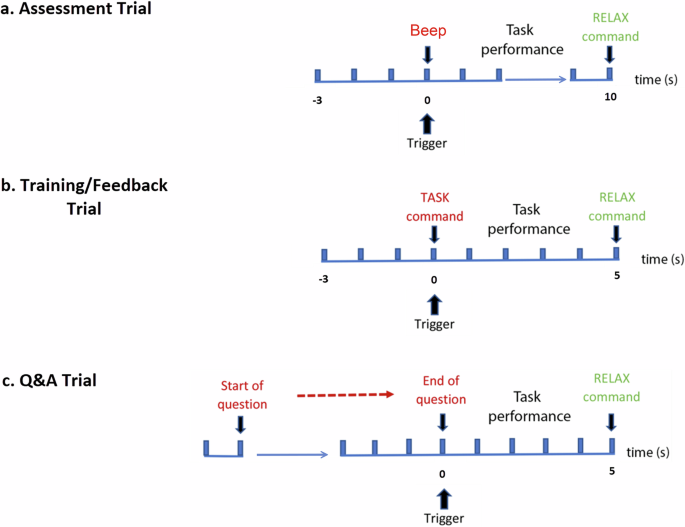
That earlier study was small and preliminary, but it asked a big question: if a person cannot move or speak, might their brain still show us that they are following a command? This new study grew directly from that question, by moving beyond proof-of-principle and testing whether a more structured, multi-phase motor-imagery BCI framework could add useful diagnostic value alongside standard behavioural assessment in patients with PDoC and LIS. This BCI framework progressed from assessing whether the person can perform a simple two-movement motor-imagery task, such as imagining moving the right or left arm; to training those responses with feedback; and finally to attempt to use those imagined movements to answer yes-or-no questions. This final phase was exploratory, but it offered an early glimpse of future communication potential.
Long road to completion
One of the least visible parts of this study was how long and difficult it was to carry through to completion. Bringing together multiple partner sites, each with its own governance processes, clinical pressures and timelines, took substantial coordination.
The study also had to absorb multiple pauses along the way to allow time to complete amendments and other procedural steps needed to run a complex clinical project safely and properly, slowing progress even before COVID-19 disrupted recruitment and bedside visits. Restarting required extensions, renewed approvals and re-engagement across sites.
In 2022, the study faced another major transition when the Chief Investigator relocated from Ulster University in Northern Ireland to the University of Bath in the UK, to become the Director of the Institute for the Augmented Human (IAH). The move brought exciting new momentum, but it also added complexity to an already demanding project. Looking back, finishing the trial required not just scientific persistence, but institutional support, flexibility, and a great deal of determination from everyone involved.
Behind the data
Because participants required around-the-clock care and were not mobile, this was a bedside trial rather than a conventional lab-based study. While this provided important insights for the real-world deployment of this technology, it also added layers of complexity largely unseen in the final paper. Research sessions had to be built around care and medication schedules, participant fatigue and family availability – all while being mindful of the hopes and anxieties of families. Ensuring consistency in the delivery of the protocol in real-world environments that were unpredictable, busy and deeply personal, posed logistic difficulties. These challenges were overcome through the extraordinary cooperation of clinicians, carers and relatives. By far the greatest hidden challenge was entering the lives of people living with palpable uncertainty, exhaustion, hope and grief. Behind every data point was a web of coordination and goodwill that made the research possible – but more than that there was person who had once lived a rich life – a professional mountaineer, a university lecturer, an army pilot, a physicist, a journalist, a teacher, a builder, a student and many more. Our participants were fathers, mothers, sons, daughters, sisters, brothers, and friends – from adolescents to grandparents, these people and their families had their lives devastated and changed utterly in an instant.
What we found
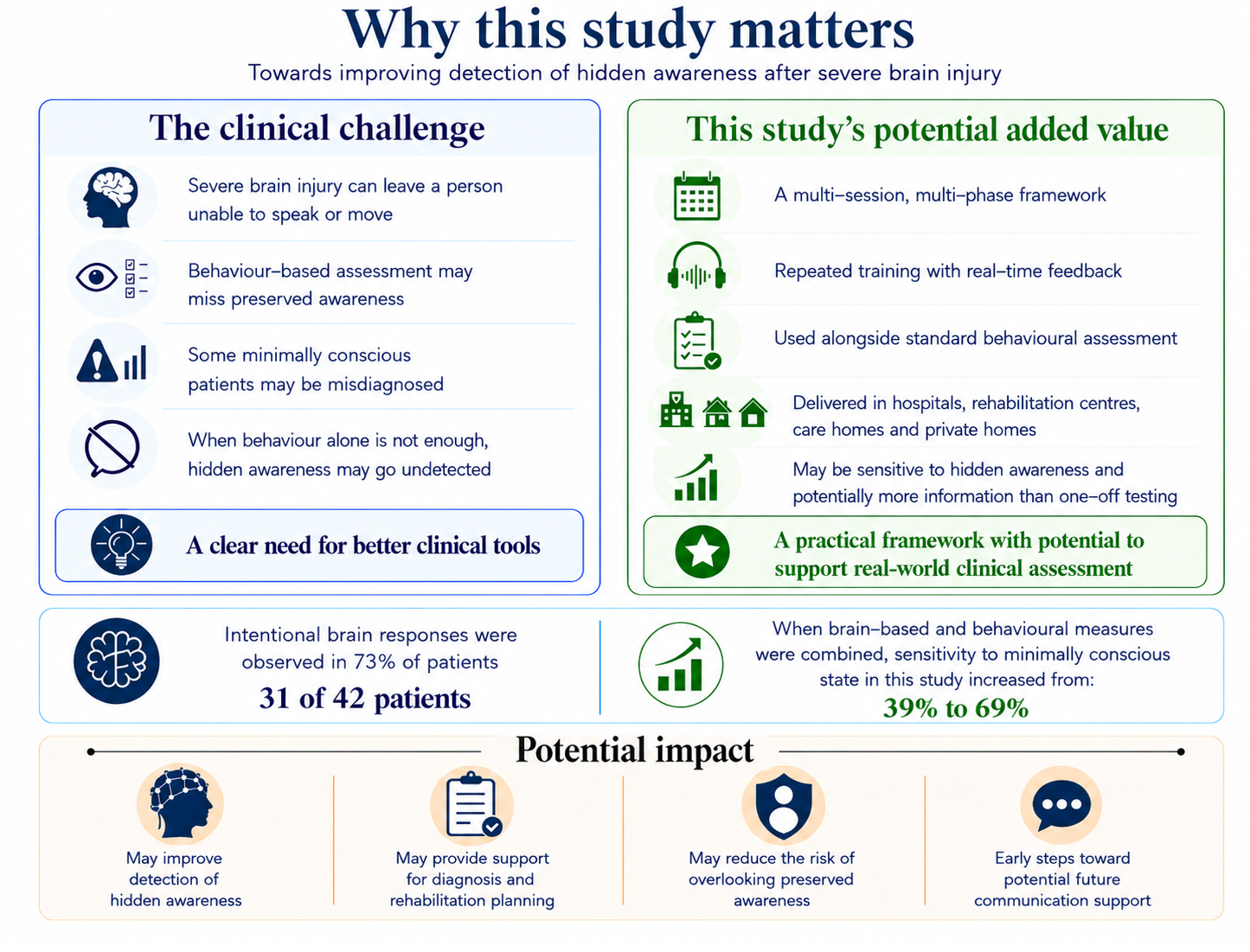
Although people varied greatly in how well they could carry out the motor-imagery task, the overall picture was encouraging: nearly three-quarters of the patients were able to intentionally modulate their brain activity in a way that the system could detect, and most of those progressed to the question-and-answer stage. Overall, the multi-phase motor-imagery BCI distinguished people with LIS from those with PDoC, and, when used alongside standard behavioural assessments, increased sensitivity to MCS to almost 70%. Exploratory analyses of the question-and-answer data, indicates above-baseline accuracies across diagnostic groups, suggesting early potential for future communication-focused research. Beyond this, we found early evidence that other EEG-based markers may also prove useful, capturing differences between groups in both the brain activity patterns involved in decoding imagined movements and the wider brain networks engaged during the tasks. Our published findings indicate that this MI-BCI framework could add meaningful diagnostic value to existing clinical assessment methods by providing a complementary, non-behavioural measure of preserved awareness and cognition.
Why this matters
Ultimately, the real impact of this study lies in reducing the risk that preserved awareness is missed simply because a person cannot show it through movement or speech. Early diagnosis can shape care, rehabilitation, family understanding and future opportunities for communication. Our results do not claim that this problem is solved, but they do show that neurotechnology can be brought to the bedside, into care homes and into family homes, and used in ways that are both scientifically informative and clinically meaningful. For a group of patients whose voices are often hidden, that matters enormously.

Follow the Topic
-
Communications Medicine
A selective open access journal from Nature Portfolio publishing high-quality research, reviews and commentary across all clinical, translational, and public health research fields.

Related Collections
With Collections, you can get published faster and increase your visibility.
Tumor Microenvironment Crosstalk and Therapeutic Implications
Publishing Model: Hybrid
Deadline: Nov 02, 2026
Life Course Epidemiology
Publishing Model: Open Access
Deadline: Sep 30, 2026