After the Paper: A Woman’s Health Decision Often Begins with a Conversation at Home
Published in Social Sciences, Education, and Arts & Humanities

Health information is everywhere today. We see it on television, mobile phones, and social media. But during my research, I realized that access to information does not always mean understanding or trust.
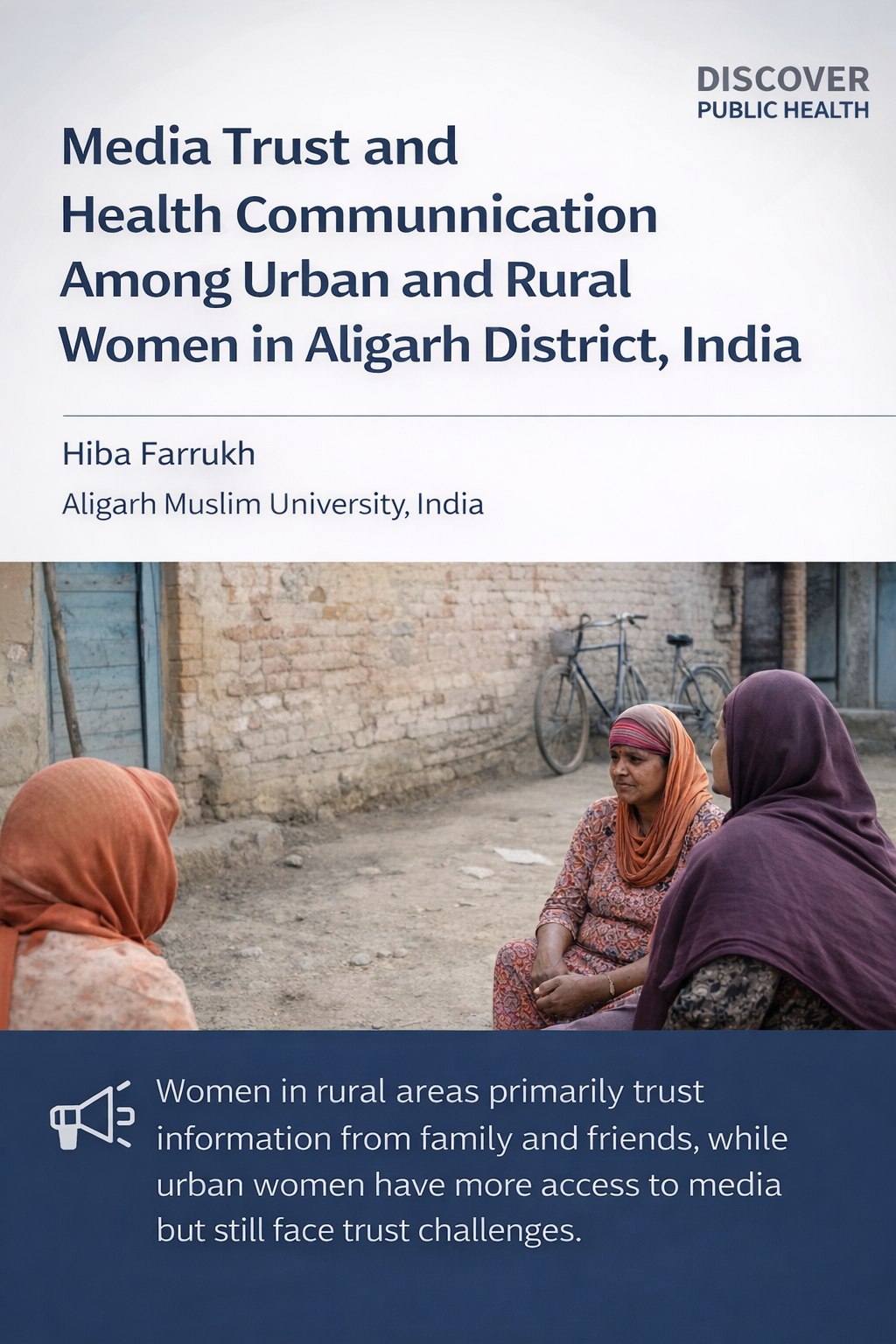
This study, published in Discover Public Health, focuses on media trust and health communication among urban and rural women in Aligarh district, India. The aim was to understand how women receive health information and which sources they trust the most.
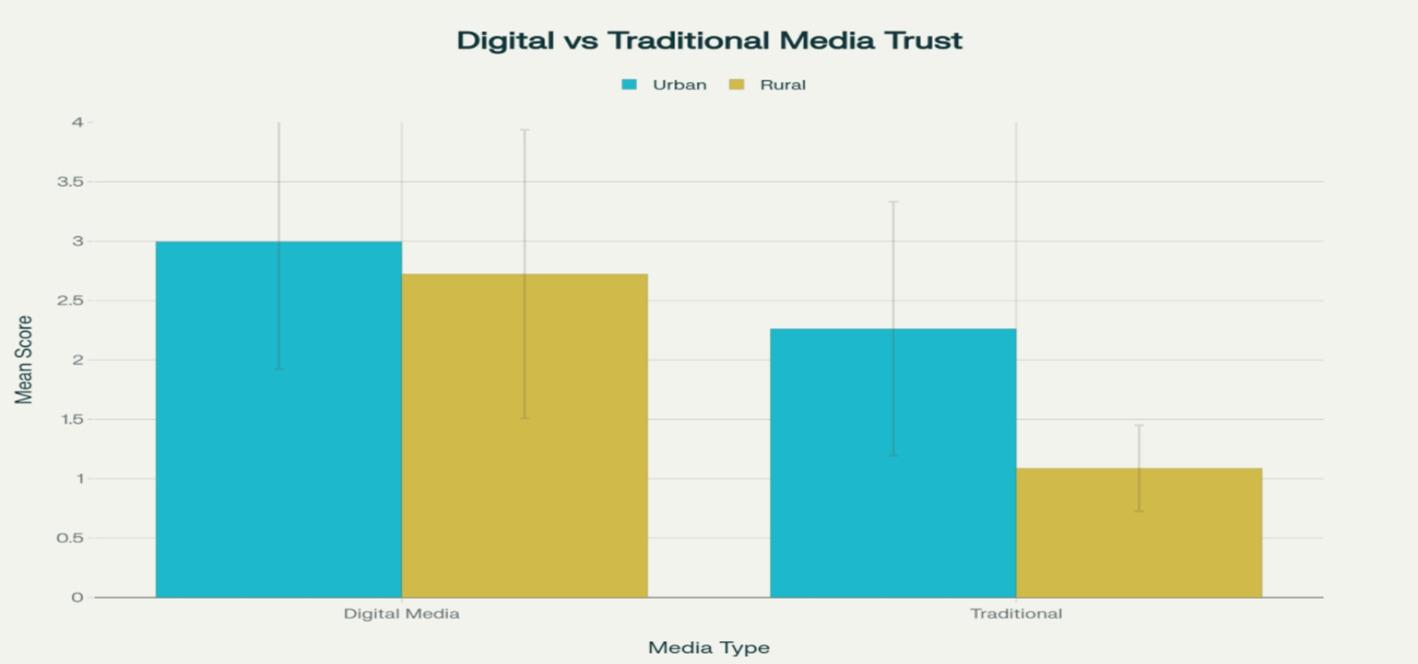
One of the most important findings of this research was the clear difference between rural and urban women. In rural areas, women mostly depend on interpersonal communication. They trust information from family members, neighbors, and friends. These sources are easily available and feel reliable to them. However, this also creates a challenge. Sometimes the information shared is not correct, and it spreads quickly within the community.
In urban areas, women have more access to media such as television, mobile phones, and other digital platforms. But even with this access, trust is not always strong. Some women are unsure whether the information they receive from media is accurate. This shows that simply providing information is not enough. Trust plays a key role in how information is accepted and used.
The impact of this research goes beyond academic understanding. It highlights an important issue in public health communication. If we want to improve health literacy, we cannot depend only on mass media. We must also consider local communication systems and the role of trusted people in the community.
This study suggests that health communication strategies should be more community-focused. Local health workers, community leaders, and trusted individuals can play an important role in spreading correct information. Combining media efforts with interpersonal communication can be more effective, especially in rural areas.
On a personal level, this research changed how I understand communication. I learned that communication is not just about sharing facts. It is about trust, relationships, and everyday conversations. Listening to women during my fieldwork helped me understand their realities beyond numbers and data.
This research also opens the way for future studies. There is a need to explore how misinformation spreads through interpersonal networks and how it can be reduced. Future research can also examine how digital media can become more trustworthy and accessible for women in both rural and urban areas.
In today’s time, when misinformation spreads quickly, understanding how people trust and use information is more important than ever. I hope this study encourages more research and practical efforts to improve health communication, especially for women who play such an important role in family and community health.

PhD scholar in Health Communication
Follow the Topic
-
Discover Public Health
This is an open access journal publishing research from all fields relevant to public health.

Related Collections
With Collections, you can get published faster and increase your visibility.
The Economics of Longevity: Health Expenditure and Societal Implications for Public Health Systems
The relationship between health investment and life expectancy has long been a focal point in public health research and policy. As nations grapple with rising healthcare costs and varying health outcomes, understanding how financial allocations influence population health becomes increasingly critical. Numerous studies have illustrated that increased spending on health services often correlates with improvements in life expectancy; however, the complexities of this relationship are not fully understood. Factors such as socioeconomic status, healthcare accessibility, and the efficiency of health systems play significant roles in determining how investments translate into health outcomes.
At the national level, health investments primarily encompass government expenditure on healthcare systems, public health initiatives, and health infrastructure. Nations that allocate substantial resources toward healthcare often experience better health outcomes and increased life expectancy among their populations. For instance, countries with robust healthcare funding tend to provide more comprehensive services, including preventive care, chronic disease management, and health promotion programs, all of which contribute to enhanced population health. However, it is crucial to consider how these investments are distributed across different segments of the population. Inequities in health spending can exacerbate existing disparities, leading to significant differences in life expectancy among various demographic groups. Effective health investment strategies must address these disparities to ensure that improvements in life expectancy are equitable and inclusive.
The motivation for this Collection arises from the urgent need to bridge the gap between health expenditures and tangible improvements in life expectancy. Recent global health crises and ongoing disparities in health outcomes across different populations have underscored the necessity for a deeper exploration of how resource allocation affects health dynamics. This Collection seeks to provide a platform for researchers and practitioners to discuss empirical evidence, theoretical frameworks, and innovative approaches to understanding these critical interactions. By fostering dialogue around effective health investment strategies, we aim to contribute to the development of more equitable and efficient health systems worldwide.
The purpose of this Collection is to gather comprehensive research that elucidates the dynamics between health investment and life expectancy across diverse contexts. We welcome contributions that analyze historical trends, comparative studies, and policy evaluations, as well as those that explore the implications of financial investments on health equity. By highlighting interdisciplinary perspectives and fostering collaboration, this Collection aspires to advance the discourse on optimizing health investments for improved population health outcomes.
Topics of interest include, but are not limited to:
- Economic evaluations of health interventions
- Policy impacts on health spending and life expectancy
- Health equity and investment disparities
- Longitudinal studies on health expenditures and population health
This Collection supports and amplifies research related to SDG 3.
Keywords: health expenditure; healthcare economics; life expectancy; economic evaluation; population health; health investment; health policy
Publishing Model: Open Access
Deadline: Dec 31, 2026
Improving Maternal and Infant Health: The Key for Future Wellness
Optimizing health across the life course begins with ensuring equitable, high-quality care during pregnancy, childbirth, and early infancy. Evidence increasingly demonstrates that early-life exposures and experiences are critical determinants of long-term health, shaping risks for chronic disease, developmental outcomes, and overall well-being. Despite progress, disparities in maternal and infant health outcomes persist globally, underscoring the need for innovative, scalable, and evidence-based public health interventions.
This Collection aims to highlight interdisciplinary research and practice-based efforts that advance maternal and infant health from a public health perspective. We welcome contributions that examine population-level strategies, health systems strengthening, community-based interventions, and policy approaches designed to improve care during pregnancy, the birth hospitalization, and early infancy.
Submissions may include original research, implementation studies, and quality improvement initiatives that address prevention, access, equity, and health outcomes across diverse settings. By emphasizing early prevention and system-level improvements, this Collection seeks to contribute to reducing the burden of chronic disease and improving health trajectories across the lifespan.
Topics of interest include, but are not limited to:
--Public health initiatives to improve maternal and pregnancy outcomes
--Community- and population-level strategies to enhance infant health and early development
--Health system and quality improvement interventions in maternal and neonatal care
--Educational and behavioral interventions targeting pregnant individuals, families, and caregivers
--Policies and programs addressing disparities in maternal and infant health
--Preventive approaches to improve early-life health and long-term outcomes
This Collection supports and amplifies research related to SDG 3: Good health and Well-Being.
Keywords: Maternal health; Infant health; Safer motherhood; Early-life health; Health services; Healthcare system; Public health
Publishing Model: Open Access
Deadline: Mar 17, 2027