Agricultural outlook data: a dental public health imperative
Published in Social Sciences, Agricultural & Food Science, and Statistics
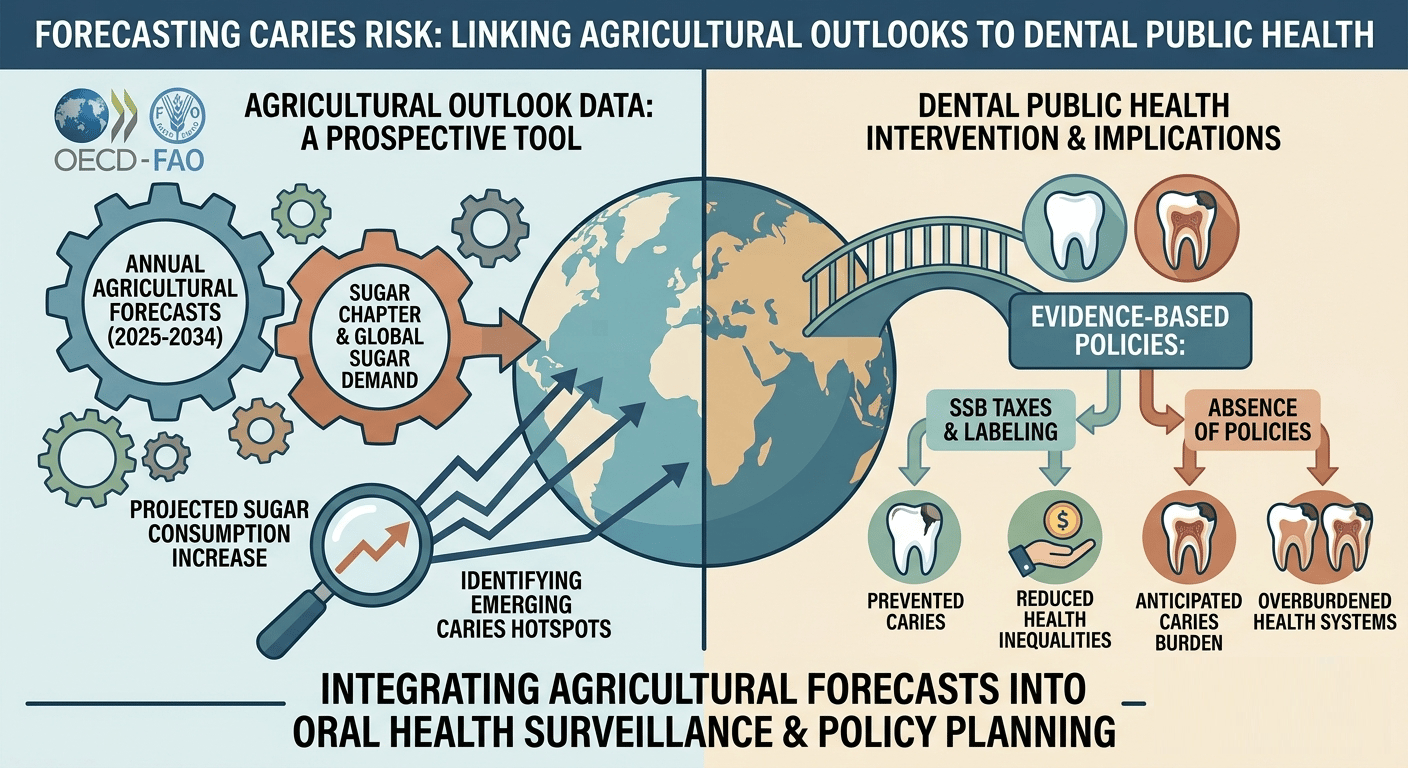




As a dental public health researcher, I recently published a Letter to the Editor in the British Dental Journal (BDJ), part of the Nature Portfolio, proposing that dental public health fully adopt the OECD‑FAO Agricultural Outlook as a key tool for caries prevention and surveillance. (https://www.nature.com/articles/s41415-026-9893-2) DOI https://doi.org/10.1038/s41415-026-9893-2
Dental caries is the world’s most prevalent non‑communicable disease, affecting 2.5 billion people, and free sugars are the main driver. Despite robust evidence on effective policies—such as sugar‑sweetened beverage (SSB) taxes and front‑of‑pack labelling (FoPL)—there is currently no prospective framework to anticipate where future caries burdens will hit hardest. We argue that the OECD‑FAO Agricultural Outlook, updated annually and freely available, provides precisely that.
The OECD‑FAO Agricultural Outlook 2025–2034 shows global sugar consumption rising to 202 million tonnes by 2034, growing at 1.2% per year. Asia will account for 64% of this increase and Africa 29%, while regions with strong SSB‑tax policies and reformulation efforts—such as parts of Latin America and Europe—see sugar consumption slowly declining. This divergence creates a powerful “natural experiment”: policy‑active regions are bending the sugar curve; policy‑absent regions are not.
A 2025 Italian modelling study covering the same 2025–2034 period found that a 20% SSB tax would reduce DMFT by 0.07, save €38.6 million in dental treatment costs, and yield greater benefits in regions with higher baseline caries and lower dental‑care utilisation. This underscores the equity‑promoting potential of fiscal and labelling interventions.
Yet large evidence gaps remain, especially in low‑ and middle‑income countries in Asia and Africa, where the sharpest sugar increases are projected but where SSB‑tax impact on caries is poorly documented. We call on national dental associations, health ministries, and the WHO to:
-
Integrate the OECD‑FAO Sugar Chapter into routine oral health surveillance to identify emerging caries hotspots.
-
Commission policy‑effectiveness research in Asia and Africa to fill the current evidence gap.
-
Embed agricultural supply‑side forecasts into global oral health monitoring as a routine caries risk outlook.
For our “Research Data” community, this is a clear example of how agricultural data, policy datasets, and public‑health surveillance can be linked across disciplines to generate actionable insights. By connecting nutrition data with dental epidemiology, we can move from reactive treatment to prospective prevention, especially in the world’s most vulnerable populations.
If you work with agricultural data, food‑policy models, or public‑health surveillance systems, I’d love to hear how you are already using or could reuse such datasets for chronic‑disease and oral‑health forecasting. Let’s build more bridges between agricultural outlooks, sugar‑policy evaluation, and dental public health.

Follow the Topic
-
British Dental Journal
This is an international, peer-reviewed journal for the dental community, published by Springer Nature on behalf of the British Dental Association.

Related Collections
With Collections, you can get published faster and increase your visibility.
Periodontology
Publishing Model: Hybrid
Deadline: Dec 31, 2026
Fluoride
Publishing Model: Hybrid
Deadline: Dec 31, 2026