Anchorless vs Anchor-Based Rotator Cuff Repair: Similar Outcomes, Lower Costs? Insights From a Randomized Controlled Trial
Published in Healthcare & Nursing and Surgery
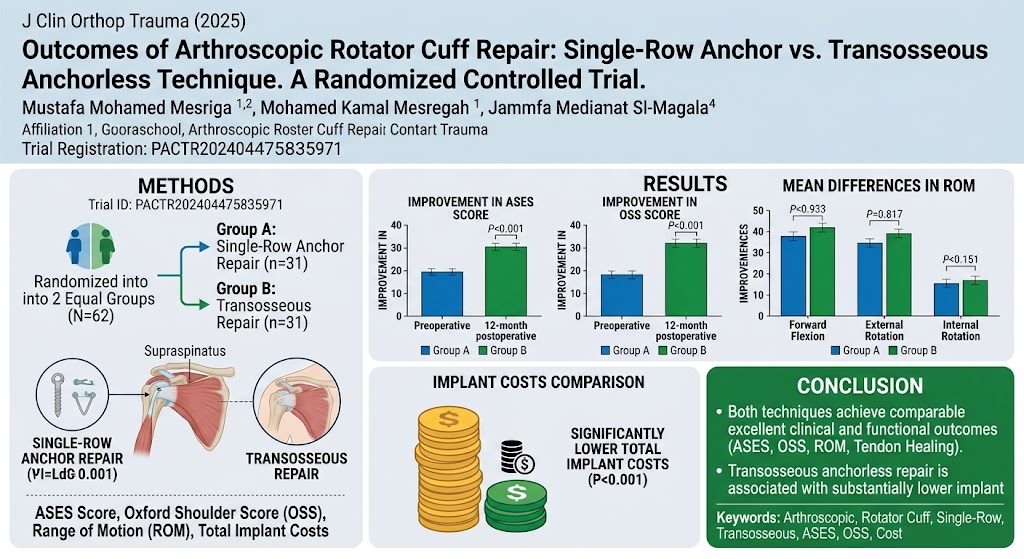
Rotator cuff tears are among the most common causes of shoulder pain and dysfunction, with arthroscopic repair considered the standard surgical treatment. While anchor-based techniques are widely used, they contribute substantially to procedural costs. This raises an important question: can anchorless transosseous repair achieve comparable outcomes while reducing financial burden?
In our prospective randomized controlled trial, we compared arthroscopic single-row anchor repair with arthroscopic transosseous anchorless repair in patients with small- to medium-sized rotator cuff tears. Sixty-two patients were randomized equally between the two treatment groups and followed clinically using validated outcome measures, including the American Shoulder and Elbow Surgeons (ASES) score, Oxford Shoulder Score (OSS), and range-of-motion assessments.
Both techniques demonstrated significant improvements in shoulder function, pain, and mobility. At final follow-up, patients in both groups achieved excellent and nearly identical clinical outcomes, with no significant differences in ASES scores, OSS scores, or range of motion. Importantly, the transosseous anchorless technique achieved these outcomes at a substantially lower implant cost.
These findings suggest that anchorless transosseous repair may represent a highly cost-effective alternative to traditional anchor-based repair for selected rotator cuff tears, particularly in healthcare systems where resource utilization and value-based care are increasingly important considerations.
As healthcare costs continue to rise worldwide, should cost-effectiveness become a larger factor in selecting rotator cuff repair techniques? We welcome your thoughts and experiences.
Article links
https://pubmed.ncbi.nlm.nih.gov/40109510/
https://linkinghub.elsevier.com/retrieve/pii/S0976566225000475
Mustafa Mohamed Mesriga, Mohamed Kamal Mesregahsports, Ahmed Abdel-Monem Dewidar, Hany Elsayed Saad, Ayman Mohamed Ebied
#Orthopaedics #ShoulderSurgery #RotatorCuffRepair #Arthroscopy #SportsMedicine #ValueBasedHealthcare #ClinicalResearch #RandomizedControlledTrial #OrthopaedicResearch #SpringerNature

Dr. Mohamed Mesregah MD is an experienced orthopedic surgeon with a strong background in both clinical practice and orthopedic research. He specializes in the diagnosis and management of musculoskeletal conditions, with a commitment to delivering high-quality, patient-centered care.
With years of hands-on experience, Dr. Mohamed Kamal Mesregah has developed a deep understanding of modern orthopedic techniques and evidence-based treatment approaches. His research involvement reflects his dedication to advancing medical knowledge and improving patient outcomes.




Please sign in or register for FREE
If you are a registered user on Research Communities by Springer Nature, please sign in